

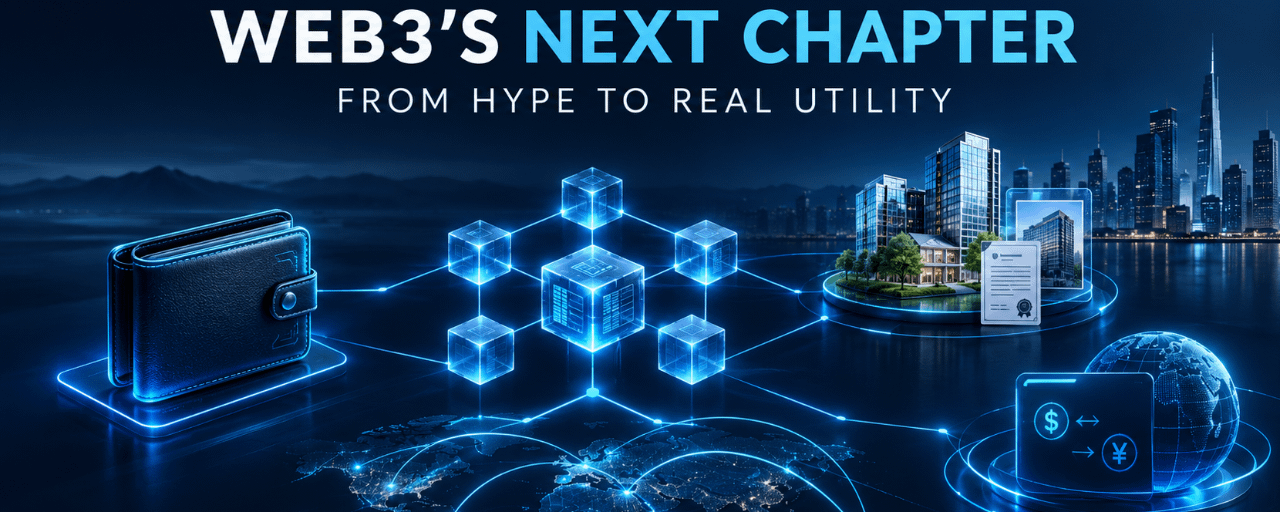

For years, Web3 has been associated with NFT collections, meme coins, speculative tokens, and promises of a decentralized internet. These topics helped bring millions of people into crypto, but they also created a misleading impression that Web3 is primarily about buying digital assets and waiting for their prices to rise.
The bigger story is much more interesting.
Web3 is gradually evolving into an ecosystem of programmable financial services, digital ownership, on-chain payments, decentralized applications, and infrastructure designed to reduce dependence on traditional intermediaries.
The important question is no longer simply which blockchain has the fastest transactions or which token has the strongest community.
The question is whether these technologies can solve real problems, attract sustainable demand, and become useful to people who have no interest in following crypto markets every day.
1. Tokenization: Bringing Real-World Assets On-Chain
One of the most significant developments in the Web3 ecosystem is the tokenization of real-world assets.
Tokenization involves representing an asset or a financial claim as a digital token on a programmable ledger. Depending on its legal structure, the underlying asset could be a bond, a money-market fund, a share, a loan, or a real-estate-related interest.
Why does this matter?
Traditional financial transactions often involve several separate processes. An asset may need to be issued, recorded, transferred, reconciled, and settled through different institutions and systems.
Tokenized infrastructure can combine some of these functions through shared ledgers and smart contracts. This may reduce operational friction, improve recordkeeping, and allow certain transactions to settle more efficiently.
Fractional ownership is another potential benefit. Instead of requiring an investor to purchase an entire unit of an asset, a tokenized structure can support smaller transaction sizes where the legal and market arrangements permit it.
However, there is an important distinction between creating a token and establishing genuine ownership.
A token does not automatically give its holder enforceable rights to a building, company, or financial instrument. Those rights depend on the legal structure, the issuer, the custody arrangements, and the jurisdiction involved.
This is one reason tokenization deserves serious attention without being treated as a guaranteed revolution.
An October 2026 analysis from the International Monetary Fund highlighted both its potential and its limitations. Tokenized markets remain small relative to traditional financial markets, and activity is fragmented across platforms and networks. The IMF also emphasized that legal certainty, regulatory clarity, interoperability, and reliable settlement assets are necessary for the sector to mature.
In other words, the technology is promising, but adoption requires more than putting financial assets on a blockchain.
2. Stablecoins: The Practical Side of Web3
Stablecoins are another important part of the ecosystem because they address a problem that volatile cryptocurrencies are not designed to solve: the need for a relatively stable unit of value when transferring funds or interacting with digital financial services.
A stablecoin is designed to maintain a relatively stable value, often against a currency such as the US dollar. Depending on the issuer and structure, its stability may rely on reserve assets, collateral, redemption mechanisms, or other arrangements.
Stablecoins are used in crypto trading, but their potential applications extend beyond exchanges.
They can support on-chain payments, transfers between wallets, digital commerce, and settlement between financial applications. In some situations, they may also offer a convenient way to move dollar-denominated value across borders.
For businesses operating internationally, programmable digital money could simplify certain payment and settlement processes. For individuals, it can provide access to digital transfers without requiring every transaction to pass through the same traditional payment infrastructure.
Nevertheless, faster transfers do not automatically mean cheaper or safer transfers.
Network fees, exchange spreads, withdrawal costs, local conversion charges, and regulatory requirements can all affect the final amount received. The user also needs to understand whether the stablecoin can be redeemed reliably and whether its reserves and issuer are trustworthy.
A stablecoin is not identical to a bank deposit, and its name alone does not guarantee that it will always trade at its intended value.
The broader takeaway is that stablecoins may become valuable Web3 infrastructure when they make payments more useful, accessible, and efficient—not merely when trading activity increases.
3. DeFi: Financial Services Without the Traditional Front Desk
Decentralized finance, commonly known as DeFi, attempts to provide financial services through blockchain-based applications and smart contracts.
Depending on the protocol, users may be able to exchange assets, supply liquidity, borrow against collateral, or earn returns through predefined rules.
The most interesting feature of DeFi is composability.
In simple terms, one application can interact with another. A lending protocol, for example, may use assets or services provided by other protocols. This creates the possibility of building financial products from interoperable components rather than relying entirely on separate, closed systems.
Such flexibility can encourage experimentation and make certain services accessible directly through digital wallets.
But composability is a double-edged sword.
If a protocol depends on another protocol, a vulnerability or failure in the underlying system can affect the applications built on top of it. Smart-contract bugs, compromised administrative keys, manipulated price oracles, poorly designed collateral systems, and sudden liquidity shortages can all create losses.
Decentralization also exists on a spectrum. Some applications depend heavily on centralized operators, privileged administrators, or concentrated governance.
Therefore, evaluating a DeFi project requires looking beyond its advertised annual percentage yield or total value locked.
Users should understand where the return comes from, what risks they are accepting, who can change the protocol, and what happens if markets move sharply against their positions.
Real DeFi innovation should make financial services more transparent and accessible without hiding risk behind attractive numbers.
4. The User Experience Problem: Web3 Must Become Easier
One major obstacle to mainstream Web3 adoption is that many applications still require users to understand technical details that ordinary internet services handle in the background.
People may need to manage seed phrases, choose networks, understand gas fees, approve smart-contract permissions, and navigate confusing wallet interfaces.
Making a mistake can be expensive. In many cases, blockchain transactions cannot simply be reversed through a customer-support request.
This creates a major challenge for developers.
A technology can be secure and technically impressive, yet fail to attract mainstream users if it is difficult to operate.
Account abstraction and smarter wallet designs aim to improve this experience. Depending on their implementation, they can support features such as transaction batching, sponsored transaction fees, spending limits, and alternative account-recovery mechanisms.
Ethereum's 2026 protocol priorities specifically identify user experience and interoperability as important areas of continued development.
The broader goal is straightforward: users should be able to benefit from blockchain infrastructure without needing to become blockchain experts.
Imagine using a decentralized application with a familiar login process, clear transaction costs, understandable permissions, and reliable account recovery. The underlying system could still use blockchain technology, but the user would not need to think about every technical detail.
That is a more meaningful measure of progress than simply counting new protocols.
5. Interoperability: The Problem of a Fragmented Ecosystem
Web3 does not operate as one unified network.
Different blockchains have different assets, execution environments, applications, liquidity pools, and security assumptions. Moving information or value between them can require additional infrastructure.
This fragmentation creates friction.
Liquidity may be spread across competing platforms. Developers may have to build and maintain applications in multiple environments. Users may face confusing bridging procedures and additional security risks.
Interoperability aims to make these systems work together more effectively.
However, interoperability is not simply a matter of connecting two networks. It also requires reliable messaging, consistent asset representations, secure transaction execution, and clear assumptions about which systems are trusted.
Bridges and cross-chain protocols have historically introduced additional attack surfaces. A connection between two networks does not automatically inherit the full security of either network.
The strongest long-term solutions will need to make moving between blockchain environments simpler without forcing users to accept unnecessary risk.
If Web3 wants to compete with familiar internet services, users should not need to understand the entire architecture of the ecosystem just to move an asset or use an application.
6. Decentralization Is Valuable Only When It Improves the Outcome
Decentralization is one of Web3's defining principles, but the word is sometimes used as a marketing label rather than a measurable property.
A project may operate on a public blockchain while still relying on a small group of decision-makers, a centralized interface, a limited set of infrastructure providers, or concentrated token ownership.
That does not automatically make the project useless. It does mean that its actual level of decentralization should be evaluated honestly.
The important questions include:
Who controls upgrades?
Who can freeze or restrict access?
Who maintains the infrastructure?
How concentrated is governance?
Can users verify the activity taking place?
What happens if the company behind the application disappears?
These questions matter because different applications need different trade-offs. A regulated financial product may require compliance controls that a permissionless application does not. A decentralized protocol may offer stronger user autonomy, but users may also have fewer recovery options when something goes wrong.
The goal should not be decentralization for its own sake. It should be a system in which the chosen architecture provides meaningful benefits in transparency, resilience, user control, or access.
7. What Is Still Preventing Mainstream Adoption?
Despite the progress, several challenges remain.
Security is still a major concern. Smart contracts can contain bugs, private keys can be stolen, and malicious applications can exploit user approvals. Audits help, but they cannot eliminate every risk.
Regulation remains important. Businesses and consumers need clarity about ownership, consumer protection, taxation, financial compliance, and responsibility when things go wrong.
Liquidity is not guaranteed. Tokenizing an asset does not automatically create buyers and sellers. An asset can be technically transferable but difficult to sell at a fair price.
User trust takes time. Complicated wallets, confusing fees, misleading promotions, and irreversible mistakes can discourage newcomers.
Sustainable economics matter. Projects need to demonstrate where their revenue or demand originates. Incentives funded primarily by token emissions may attract temporary activity without creating lasting use.
These obstacles are not reasons to dismiss Web3. They are the practical problems that builders must solve if they want adoption to continue beyond crypto-native communities.
8. What Should We Watch Next?
Rather than focusing exclusively on token prices, it is worth watching a few fundamental indicators.
First, examine whether people use a product repeatedly. Daily activity can be temporarily inflated by incentives, bots, or airdrop farming, so raw transaction counts are not enough.
Second, look at the quality of the activity. Are users completing useful transactions? Are businesses integrating the technology? Are customers returning after rewards end?
Third, pay attention to security and transparency. Clear documentation, independently reviewed code, understandable risk disclosures, and responsible handling of incidents are important signals.
Fourth, follow interoperability and the user experience. Lower friction and safer account management could expand adoption far beyond the current group of crypto enthusiasts.
Finally, distinguish technological progress from token investment performance. A useful product does not guarantee that its associated token will rise in value. Token economics, dilution, governance rights, market valuation, and the relationship between product usage and token demand must all be considered separately.
Final Thoughts: Web3 Needs to Prove Its Value
The future of Web3 will not be determined by the number of tokens launched, the size of the next speculative rally, or the strength of a project's marketing campaign.
It will depend on whether decentralized applications can deliver practical benefits that users can understand and trust.
Tokenization may improve how certain assets are issued and transferred. Stablecoins may support useful payment and settlement applications. DeFi may expand access to programmable financial services. Better wallets and interoperability may make these systems easier to use.
None of these outcomes is guaranteed, and the challenges are substantial. Legal rights, security, liquidity, regulation, and sustainable economics will continue to determine which projects succeed.
But the direction is worth watching.
The most important Web3 projects may ultimately be those that make blockchain technology less visible to ordinary users while making its benefits more tangible.
When people start using a product because it solves a problem—not because they expect its token to pump—that is when the industry will have a stronger foundation for long-term adoption.
What do you think will drive the next major wave of Web3 adoption: tokenized real-world assets, stablecoin payments, DeFi, or a much better user experience?
Share your perspective in the comments.
Educational content only. This article is not financial or investment advice.