


I've started to notice that the most memorable moments in gaming are not always the ones that offer the biggest rewards. Sometimes, they come from the small details that make a virtual world feel alive: a limited-time Halloween event, a carefully decorated environment, a strange story hidden behind an ordinary quest, or a group of players gathering simply because something unusual is happening. At first, these experiences can seem like small additions to a game, designed to give players something different to explore. But over time, I've begun to see them as something more important. They reveal what keeps people connected to a game when the rewards become less exciting and the novelty begins to fade.
Halloween events offer an interesting example of how game design can influence player behavior without relying entirely on financial incentives. A world filled with unusual decorations, mysterious locations, and seasonal challenges creates a different atmosphere from the one players experience during ordinary sessions. The same map can suddenly feel unfamiliar, even when its underlying mechanics remain unchanged. Players begin exploring corners they usually ignore, searching for hidden details, sharing discoveries, and returning to see what has changed. What stood out to me was how these experiences could encourage participation through curiosity rather than obligation. The reward might be a rare item or a temporary achievement, but the reason someone remembers the event years later may have very little to do with what they received.
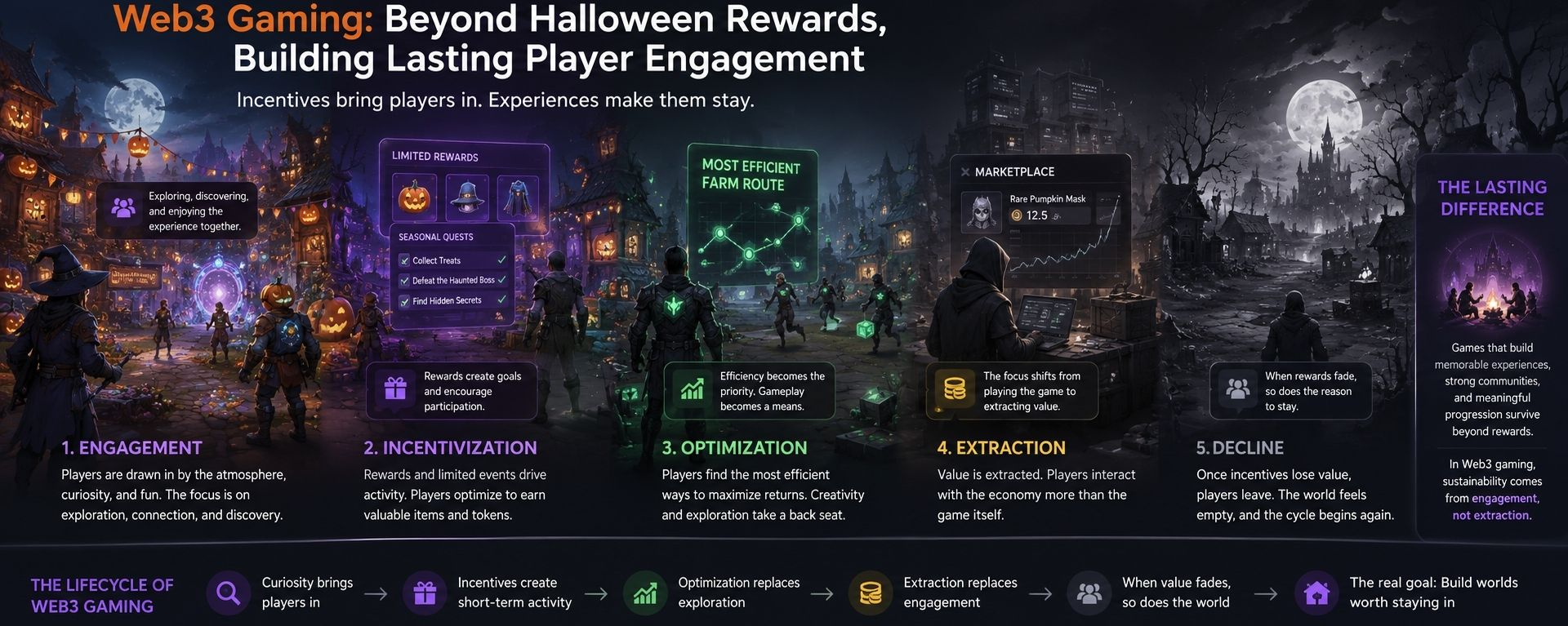
This becomes especially interesting when seasonal events enter Web3 gaming, where digital assets and token-based incentives can become part of the experience. A Halloween costume might be more than a visual change. It could become a collectible, a tradable asset, or a limited item associated with a particular moment in the game's history. That possibility creates new forms of ownership, but it also introduces a subtle tension. When players know an item may have market value, their attention can shift from enjoying the event to calculating what they might gain from it. An activity designed around exploration can gradually become a race to collect the most valuable rewards before the opportunity disappears.
The shift was subtle at first. Players still entered the same haunted locations, completed the same challenges, and gathered the same seasonal items. Yet their conversations began to revolve around scarcity, resale potential, and the most efficient ways to earn. A hidden room became interesting because it contained something valuable rather than because discovering it felt satisfying. A difficult challenge mattered less for the experience it offered and more for whether its reward justified the time required. Nothing about the event had necessarily broken, but the way people experienced it had started to change. The game was still creating activity, although some of that activity was becoming disconnected from the reasons the event had been created in the first place.
Over time, I began to notice a similar pattern in the broader design of Web3 games. Incentives often begin as a way to encourage experimentation and bring players into unfamiliar systems. A new quest offers a reason to explore. A collectible gives players a goal. A limited event creates a shared moment that people can discuss afterward. These elements can strengthen engagement when they complement an enjoyable experience. The difficulty appears when rewards become the main reason to participate. Once players learn that every activity can be evaluated according to its financial return, they naturally begin to organize their behavior around that calculation. The game does not need to tell them to stop exploring. It only needs to reward repetitive efficiency more consistently than curiosity.
What looked like growth could then conceal a gradual change in the community. More players might enter during a seasonal event, marketplaces might become busier, and activity might increase as everyone tries to secure limited rewards. From the outside, the event appears successful. Underneath, however, players may be participating for entirely different reasons. Some are enjoying the atmosphere, some are interested in collecting, and others are simply trying to extract as much value as possible before the event ends. These motivations can coexist, but they do not always create the same kind of long-term attachment. When the decorations disappear and the rewards are no longer available, the players who came for the experience may remain interested in the world, while those who came primarily for extraction may move on to the next opportunity.
The more I watched, the more I realized that the problem was not the existence of rewards themselves. Rewards have always been part of game design, and they can make progress feel meaningful. The deeper issue is the relationship between the reward and the behavior it encourages. If a Halloween event gives players a reason to explore, cooperate, and discover something unexpected, the incentive supports the experience. If it encourages everyone to repeat the same task as quickly as possible, the experience becomes secondary. Both designs can produce impressive participation during the event, but only one naturally gives players reasons to remember what they did beyond the value of the items they collected.
In a Web3 environment, this distinction becomes harder to maintain because the economy can continue operating even as engagement weakens. A digital costume may retain a market price long after the event ends, and a limited collectible may continue changing hands even when few people are actively playing the game. Transactions can create the appearance of continuing interest, but ownership and participation are not interchangeable. Someone may hold a rare item without returning to the world where it was earned. Another player may spend hours exploring the game without owning anything particularly valuable. The ecosystem has room for both, yet it becomes fragile when economic activity is treated as a reliable substitute for genuine engagement.
There is also something revealing about the way scarcity changes the emotional texture of an event. A limited Halloween reward can make participation feel special because it connects an item to a particular moment. Years later, the item might remind its owner of a memorable quest or a group of friends who played together during that season. But when scarcity becomes the primary design tool, the meaning can become narrower. Players may feel pressured to participate because they fear missing an opportunity rather than because they are interested in the event itself. The limited window begins to dictate the pace of play, and the experience becomes another deadline to manage. What once felt like a shared celebration can start to resemble a temporary production cycle in which attention is gathered, converted into activity, and then redirected elsewhere.
This is where game design has to balance short-term participation with the long-term health of the world. Seasonal events naturally create temporary excitement, and there is nothing wrong with giving players a reason to return at a particular time. The question is what remains when the event ends. If players leave with a new story, a stronger connection to the community, or a deeper understanding of the game, the event has contributed something that extends beyond its duration. If they leave only with an inventory of assets and a calculation of how much time they spent earning them, the system may have generated activity without building much attachment. The difference can be difficult to measure because both outcomes may look similar while the event is taking place.
The pattern became clearer when I considered how quietly these systems can weaken. A game does not necessarily collapse because its rewards suddenly disappear or its economy experiences an obvious failure. Sometimes, the decline begins when players stop finding value in the ordinary moments between major events. They log in only when a new incentive appears. They ignore activities that offer no measurable return. They become less interested in the world itself because the world has gradually been presented as a place where every action should produce something tangible. Developers respond by introducing more rewards, more limited collections, and more reasons to return quickly. For a while, this can restore activity, but it may also deepen the dependence on incentives that caused the original problem.
Eventually, the game can become trapped in a cycle where every new event must offer something more attractive than the previous one. Players become accustomed to waiting for the next opportunity, while ordinary gameplay begins to feel less important. The system continues to function, but its ability to hold attention without constant external motivation becomes weaker. This is not always visible in a marketplace or an activity chart. It becomes visible in the small things: fewer players exploring without a specific objective, fewer conversations about unexpected discoveries, and less interest in experiences that cannot be converted into a reward. The world remains available, but the reasons for spending time in it become increasingly narrow.
What I find most interesting about Halloween memories is that they can represent the opposite of this pattern. The decorations may be temporary, the quests may eventually disappear, and the rewards may lose their novelty, yet the experience can remain meaningful. A strange encounter, a shared discovery, or an evening spent exploring with other players can leave a stronger impression than an item whose value once seemed important. These moments cannot be fully designed through reward schedules, and they cannot be guaranteed by attaching a token to every achievement. They emerge when the game gives people enough room to participate for reasons beyond extraction.
I've come to see that the lasting value of a gaming ecosystem may depend partly on what players continue to care about after the incentives have done their work. A reward can bring someone through the door, and a limited event can give them a reason to return. But the quieter details of the experience determine whether they develop a relationship with the world or simply move through it collecting whatever is available. Sometimes, the most revealing moment comes after the Halloween event has ended, when the decorations are gone, the special rewards are no longer being distributed, and the game returns to its ordinary rhythm. Some players disappear with the opportunity. Others remain, perhaps without any particular goal, simply because there is still something about the world that ma kes them want to be there.