



Every year, when Halloween arrives, people decorate their homes, share old photographs, and tell stories about experiences they still remember. What makes these traditions interesting is not the decorations themselves, but the way people use them to connect with others. A simple photograph can start a conversation, while a personal story can bring strangers together through a shared experience. The same principle applies to online communities, where participation depends on whether people feel comfortable sharing something meaningful and receiving genuine responses.
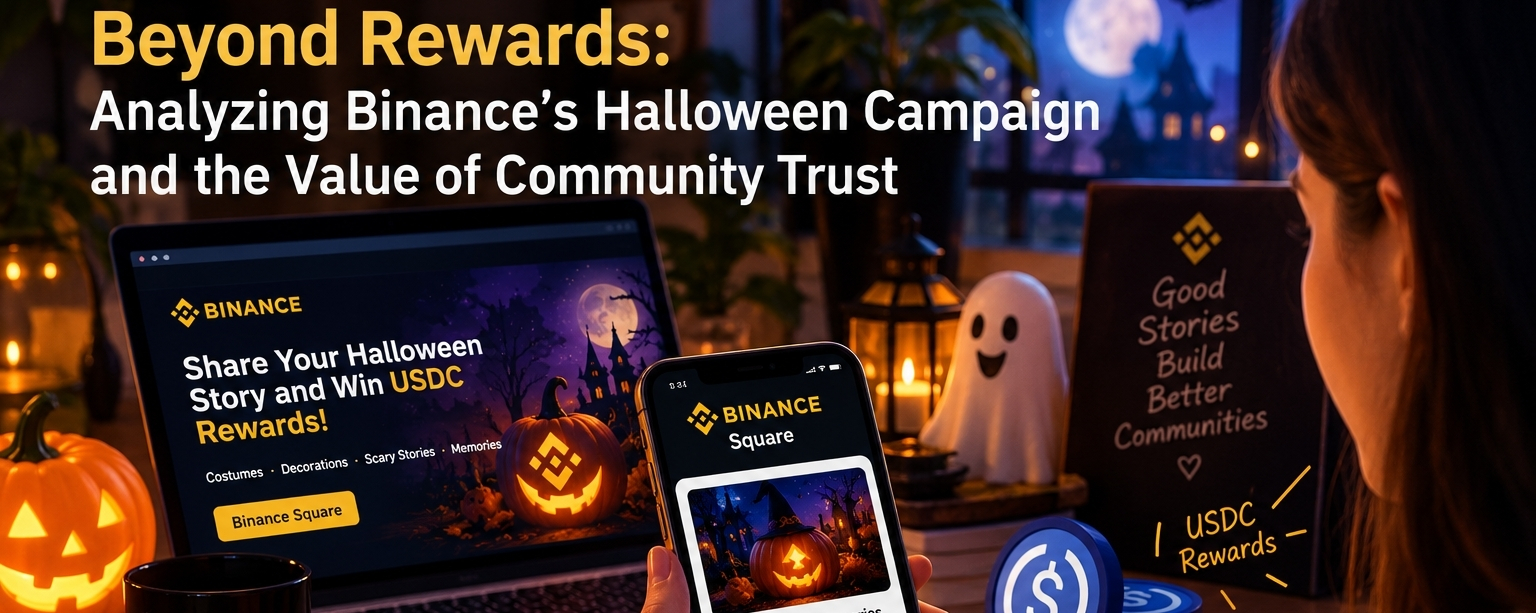
Binance's Halloween campaign brings this idea into the digital asset community by inviting users to share their Halloween memories, costumes, decorations, or scary stories on Binance Square. Participants are encouraged to include a photo featuring Binance branding and share their experiences for a chance to receive USDC rewards. At first glance, this is a seasonal community activity, but it also offers an opportunity to examine how online platforms encourage participation, establish trust, and create value beyond ordinary financial transactions.
I see community engagement as a system built on incentives, expectations, and consistent participation. In a physical community, people contribute because they enjoy belonging, exchanging ideas, or helping others. Online platforms operate similarly, although the incentives can be different. Some users participate because they genuinely enjoy the subject, while others are attracted by rewards, visibility, or the possibility of reaching a wider audience. Neither motivation is necessarily wrong, but understanding the difference helps explain what a campaign can realistically achieve.
The inclusion of USDC rewards introduces a practical economic element. Unlike points that exist only within a particular platform, USDC is a stablecoin designed to maintain a value close to the US dollar. This makes the reward easier to understand, although its practical value still depends on eligibility requirements, distribution rules, applicable fees, and the conditions of the relevant platform. A reward may attract attention, but the more important question is whether that attention leads to meaningful participation or disappears once the campaign ends.
I would compare this approach to how businesses use introductory offers to attract new customers. A discount can encourage someone to visit a store, but it cannot guarantee that the customer will return. Long-term relationships depend on the quality of the experience, the reliability of the service, and the value people receive after the initial incentive disappears. Similarly, a Halloween campaign can bring users to Binance Square, but lasting engagement requires more than a temporary reward. People need reasons to continue reading, sharing, and discussing ideas after the seasonal excitement has passed.
There is also a question of authenticity. When rewards are connected to public posts, participants may focus on meeting campaign requirements rather than sharing genuine experiences. Some posts may be thoughtful and personal, while others may be created primarily to qualify for rewards. This is a familiar challenge in any incentive-based system. If participation is measured only by the number of posts, the result may look impressive without reflecting the actual quality of the community. A stronger evaluation would consider meaningful interactions, original contributions, and whether users remain active after the campaign concludes.
Verification and operational fairness matter as well. Participants should be able to understand the rules, the required Binance branding, the submission process, and the conditions for receiving rewards. Clear criteria reduce confusion and help prevent disputes. Organizers also need reasonable safeguards against duplicate submissions, copied stories, misleading claims, and attempts to manipulate participation. These issues may seem minor in a Halloween event, but they reflect the same operational challenges that appear in larger digital systems: rules must be understandable, evidence must be checked, and incentives must not make abuse more profitable than honest participation.
I also think campaigns like this can reveal something important about the relationship between technology and everyday users. The digital asset industry often concentrates on trading activity, market movements, and financial innovation. However, an ecosystem also depends on communication, shared experiences, and the ability to make unfamiliar technology accessible. A Halloween story is not a financial breakthrough, but it gives people a familiar reason to participate in a space that might otherwise feel technical or intimidating. That modest function should not be underestimated, although it should not be confused with proof of wider adoption.
My view is that Binance's Halloween campaign is best understood as a community experiment rather than evidence of deeper ecosystem growth. It creates a straightforward opportunity for users to express themselves, interact with others, and potentially earn USDC rewards. Its real value, however, will depend on the fairness of its execution and the quality of the conversations it encourages. I believe the strongest online communities are not those that generate the most activity during a promotion, but those that give people a reason to return when the rewards are gone. If this campaign helps create genuine connections and encourages more thoughtful participation, it will have achieved something worthwhile. If its impact ends with the final reward distribution, it will still have served a purpose, but a limited one.