

U.S. stocks fell hard Thursday, and for once nobody had to hunt for the reason. Oil jumped on fresh Middle East risk, and the latest batch of big-tech earnings made the AI spending story look a little shakier. Tesla's plan to lower its capital spending guidance added a third worry nobody had asked for. Money poured into Treasuries, taking some heat out of bets on another Federal Reserve rate hike this year.
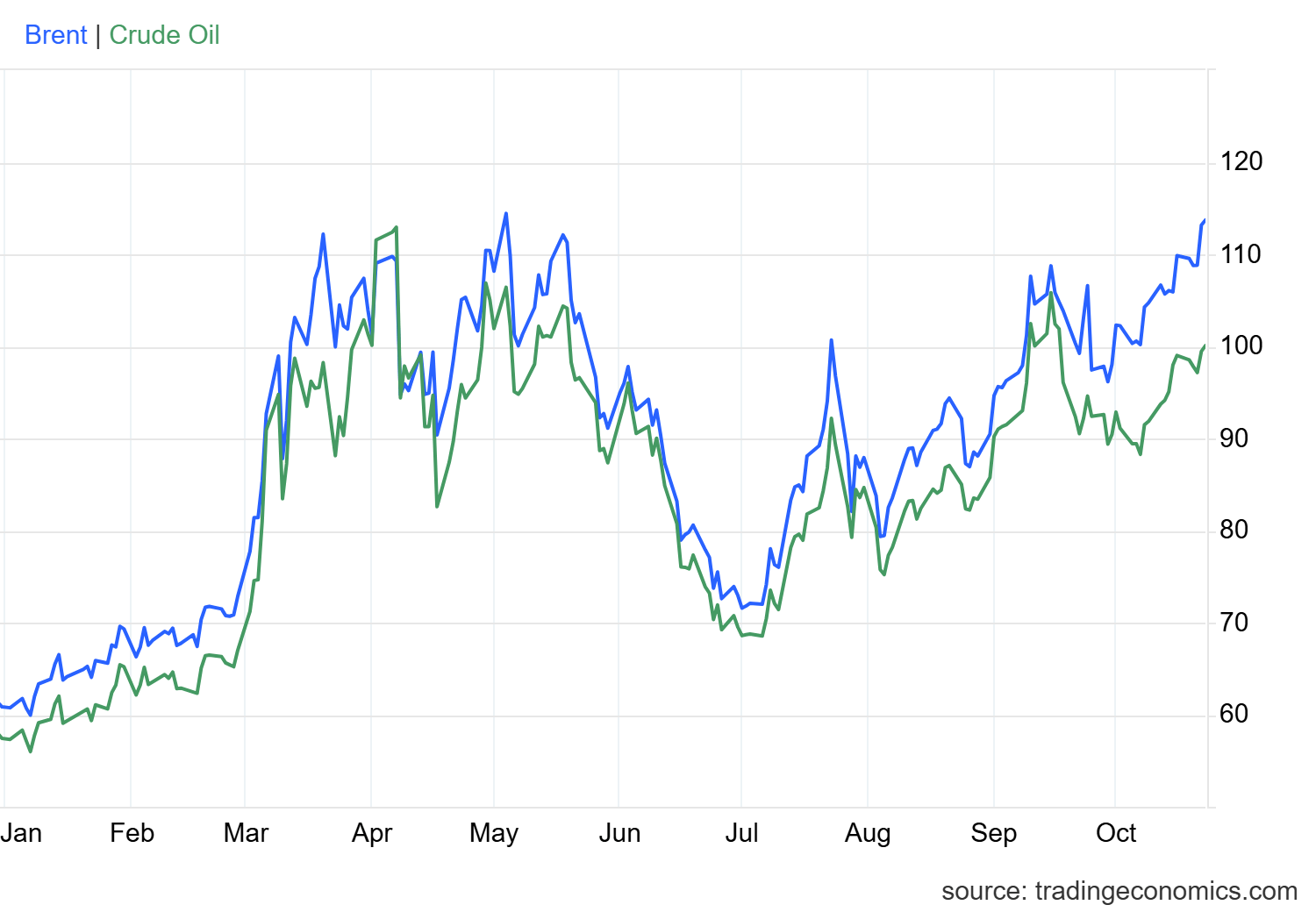
The spark came from the New York Times. Citing U.S. officials, the paper reported that American and Israeli military planners have drawn up specific plans for renewed military action against Iran, to be carried out after the Nov. 3 midterms. Traders needed no translation. Brent futures jumped 4% to settle at $113.17 a barrel, the highest close since May 4, and West Texas Intermediate gained 2.4% to $99.47.
The money leaving equities had to land somewhere, and bonds were the obvious address. The 10-year yield fell more than 17 basis points to 4.972%. Below 5% for the first time since Sept. 23, and the biggest one-day drop since March 2023. The 2-year note, which follows Fed expectations more closely, shed more than 16 basis points to 4.659%.
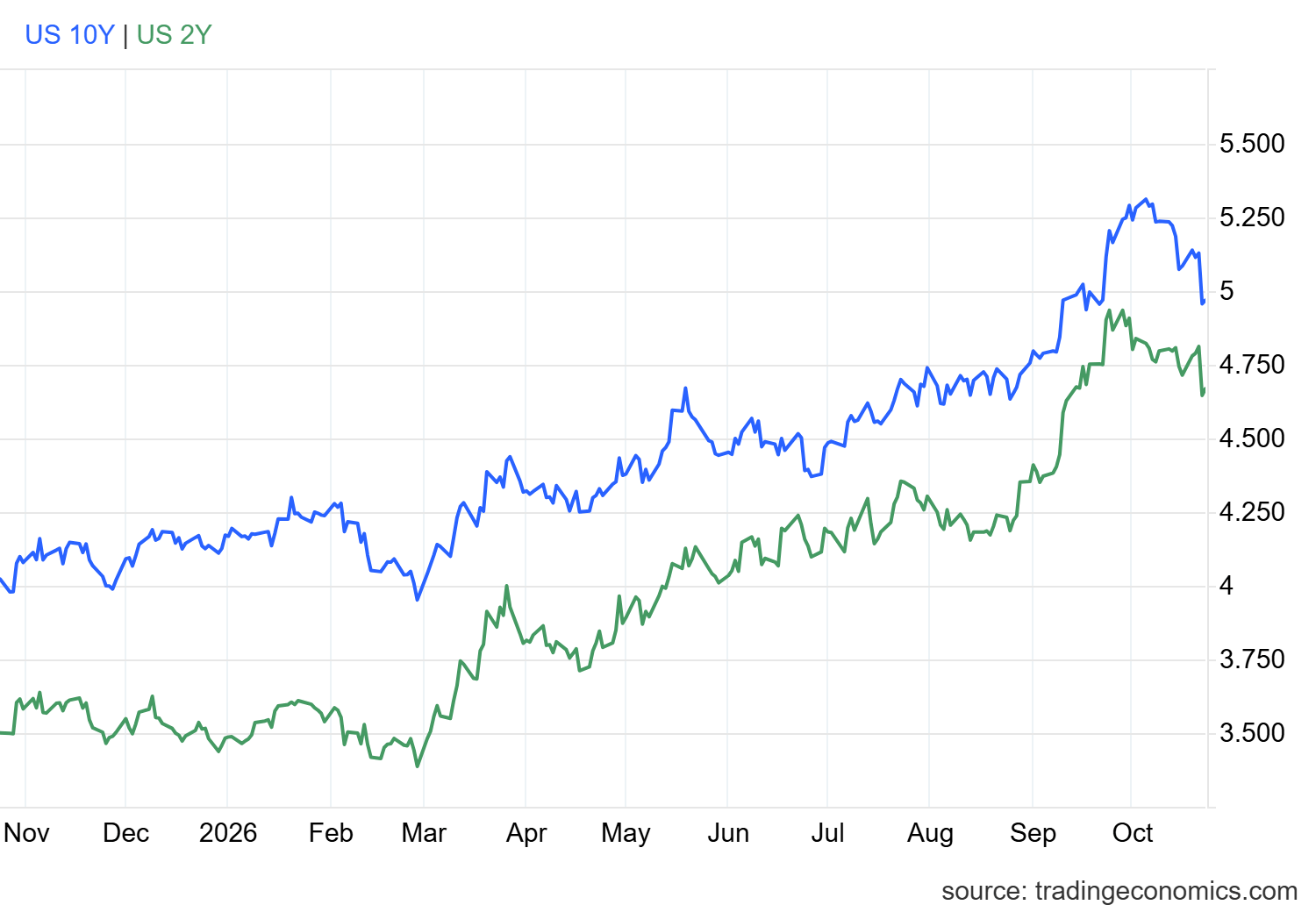
That flowed straight into Fed pricing. Futures now show about a 5% chance of a hike when policymakers wrap up their meeting Oct. 28, according to Bloomberg data, versus roughly 15% a day earlier. December remains the likelier home for the next move, though conviction slipped even there: a hike that traders treated as certain on Wednesday is priced at around 75%.
The Index Fell. The Typical Stock Didn't.
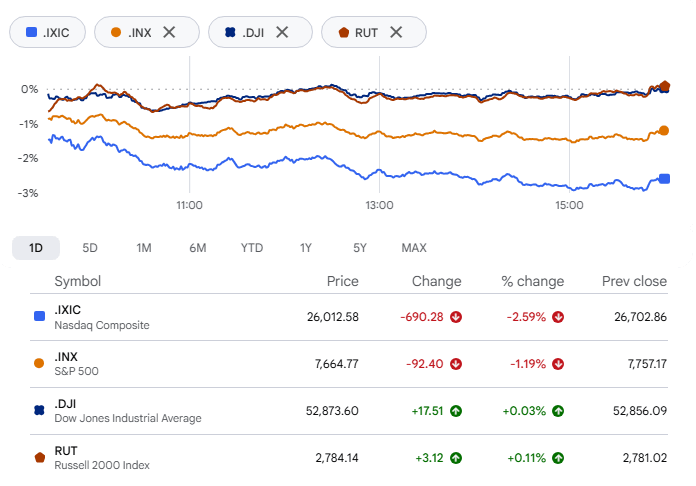
Start with the damage. The Nasdaq Composite sank 2.6% to 26,008.86, its worst day since June, and the S&P 500 lost 1.2% to 7,663.43, the steepest slide since July. Now the odd part. An equal-weighted version of the S&P 500, which gives every stock the same vote, actually rose 0.8%. Against the regular index, it had its best day since 2024.
The 30-stock Dow Jones Industrial Average closed flat, while the small-cap Russell 2000 benefited from flight to defensive stocks, gaining more than 0.1% to close at 2,784.14.
Chips took the worst of it. The Philadelphia Semiconductor Index, known as the SOX, dropped 6.7%, and every one of its 30 components finished in the red.
Meta Shows the Bill, and Investors Do the Math
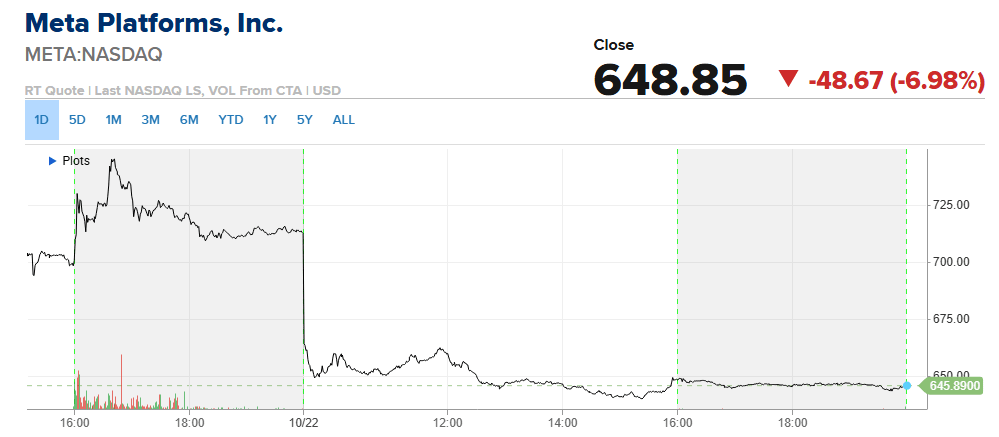
Meta was the name everyone pointed at. The stock fell nearly 7% the morning after the company reported free cash flow of negative $2.12 billion for the third quarter. Management also raised the floor on its 2026 capital spending range from $130 billion to $135 billion, so the full-year band now runs $135 billion to $145 billion. Revenue beat forecasts, a detail that mattered far less than the spending.
Chips and Neoclouds Follow Meta Down
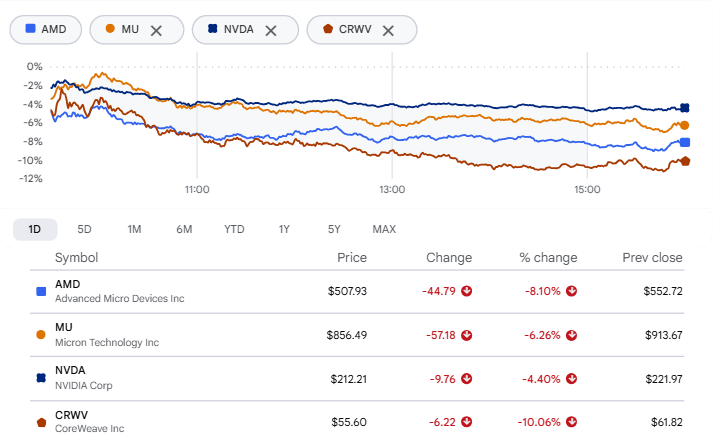
Others went along for the ride, and some took it harder than the headline suggested. AMD fell more than 8%. Micron gave back about 6%, Nvidia a little over 4%. CoreWeave, the neocloud leader whose bond yields and credit default swaps have stayed high, dropped 10%.
Nvidia CEO Jensen Huang had the unlucky timing to be on CNBC that day. Demand for neocloud capacity, he said, is "off the charts." The catch, in his telling: money is scarce, and that is slowing growth.
The Power Suppliers Didn't Escape
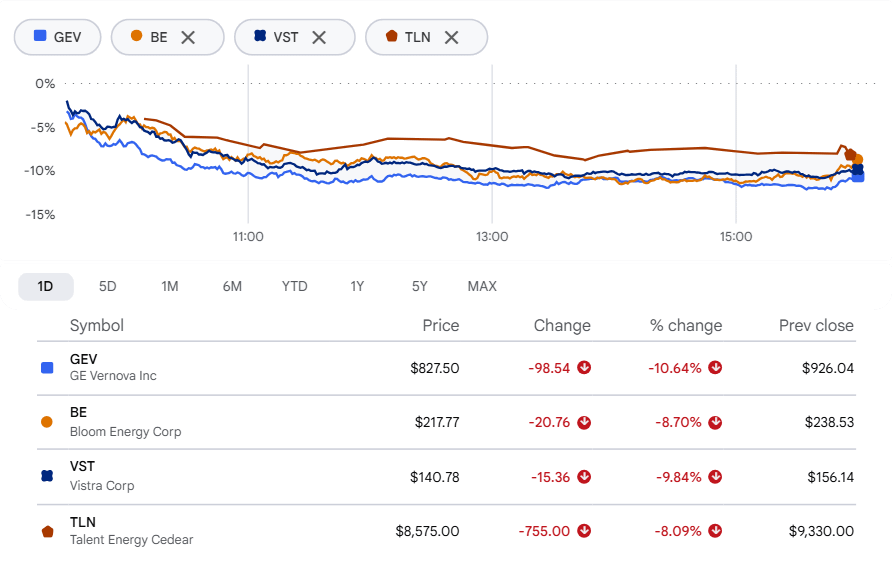
Anyone selling electricity or equipment to the data center boom got the same treatment. GE Vernova and Bloom Energy dropped about 10% and 8%, respectively. Vistra fell nearly 10% and Quanta Services more than 8%, while Talen Energy slid 8.3%. If the cost of building data centers is the worry, the companies supplying the building blocks get sold along with it.
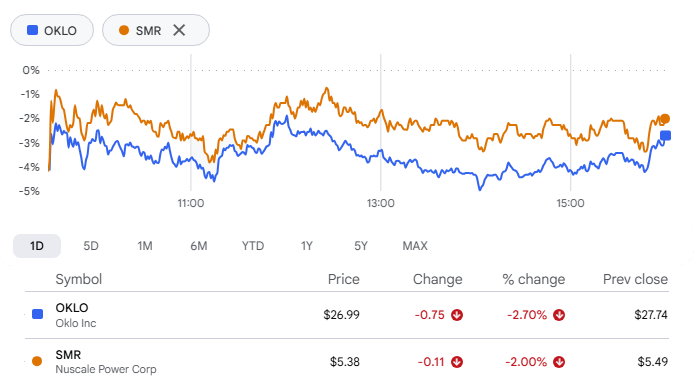
Nuclear developers got dragged in too. Oklo lost more than 4% and NuScale Power over 3%, small moves beside the rest of the list but part of the same message. Investors want proof the AI buildout can pay for itself.
Moderna's Data Leak Spoils the Party
Tech wasn't the only group with a rough afternoon. An oncology news site published results from the Moderna and Merck personalized melanoma vaccine ahead of their scheduled debut at a cancer conference, and Moderna sank 17.6% to $202.63. Merck shed about 1.8%.
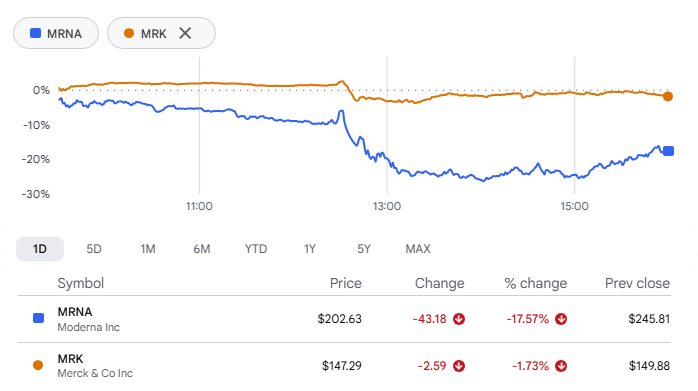
On paper, the reaction looks backwards. In August, the companies said the vaccine, paired with Merck's Keytruda, cut the risk of recurrence in a meaningful way, and both stocks ran. The full results, released by the companies once the conference lifted its embargo, showed a 42% reduction in the risk of recurrence or death against Keytruda alone, in a trial of more than 1,100 patients.
Good numbers. Just not what a stock that had spent two months climbing on expectations wanted to see, and analysts called it a classic sell-the-news move.
Tesla Clears the Bar and Still Drops
Tesla, which reported the same evening as Meta, got a milder version of the same treatment. The stock fell about 3% despite adjusted earnings of 48 cents a share (analysts wanted 43 cents) and revenue of $28.05 billion against a $27.9 billion estimate. The soft spot was cars, where automotive revenue slipped 3% from a year ago to $20.56 billion.
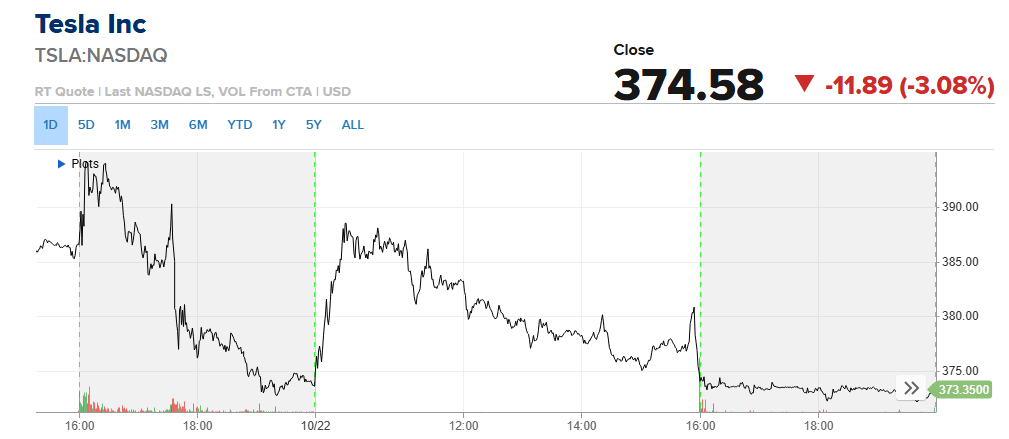
Then came the spending. Management cut its 2026 capital budget to about $20 billion from more than $25 billion, a change investors had questions about. On the call, Elon Musk held to the goal of building roughly 5 million vehicles a year around 2030 and called Full Self-Driving the biggest lever on demand. Tesla also reported cumulative unsupervised robotaxi miles up about eightfold from the prior quarter.
Musk, meanwhile, found another place to park money. Semafor reported, and CNBC later matched, that he invested roughly $1 billion in Skydance (SKYD), the media company created this month when Paramount Skydance closed its $110 billion deal for Warner Bros. Discovery. The cash lands at a company carrying close to $80 billion of debt and promising $6 billion in savings over three years.
It is one piece of a wider equity raise. Shares traded about 1% lower when CNBC published its story.
Pockets of Green Show Up Anyway
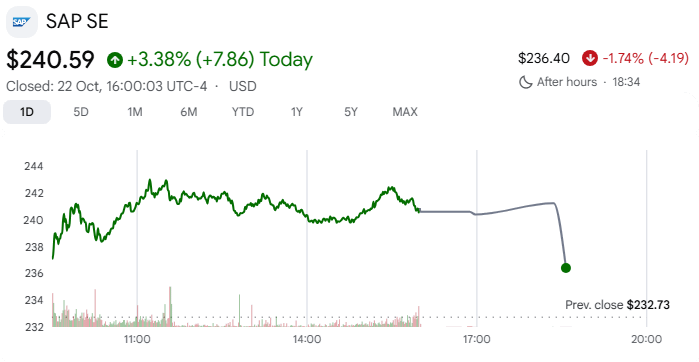
Not everything fell. SAP gave investors something to like: the German software company posted third-quarter earnings and revenue above estimates, and the stock rose 4%.
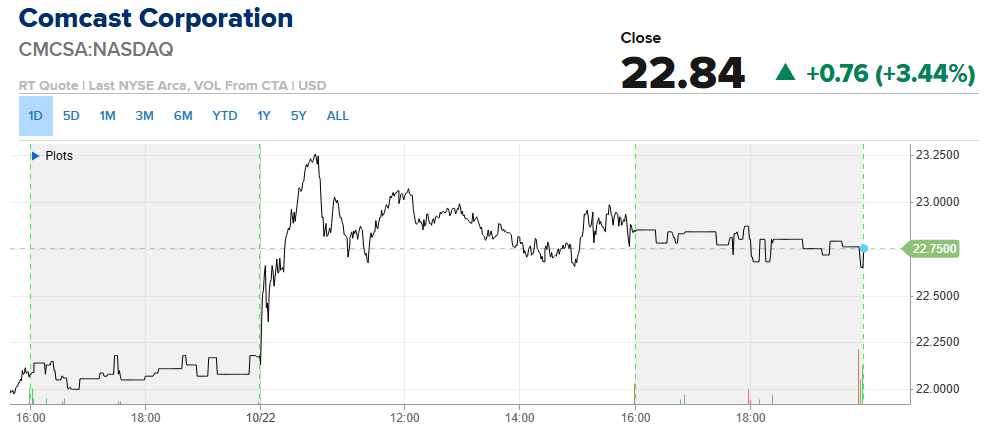
Comcast, which owns the Universal theme parks, rose more than 3% on a quarter that beat on earnings and cash flow. Adjusted earnings were $1.07 a share against a 98-cent consensus. Revenue of $29.30 billion squeaked past $29.28 billion, and free cash flow of $4.21 billion left the StreetAccount estimate of $3.32 billion well behind.
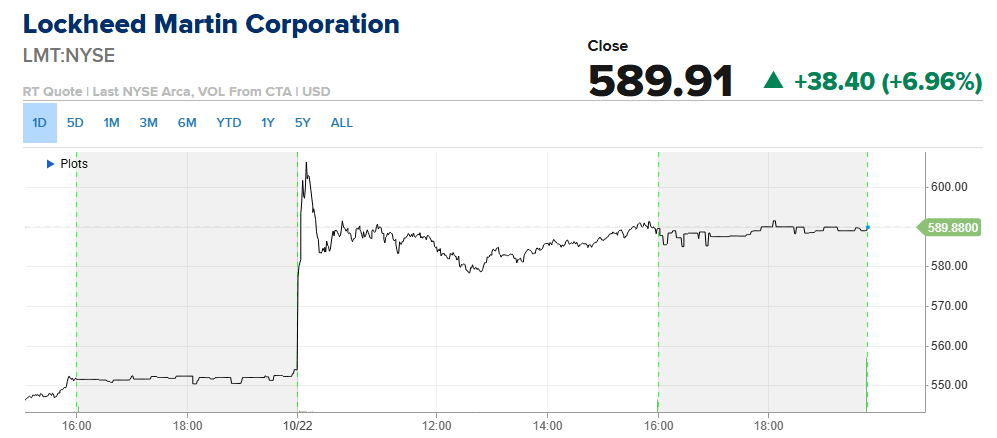
Defense was the other bright spot. Lockheed Martin ended almost 7% higher after a quarter in which fighter jets and missile defense systems pushed sales up 11% to $20.7 billion. Management lifted its 2026 outlook to roughly $80 billion to $82 billion in sales from $79.75 billion to $81.75 billion. Behind that sits a record $292 billion backlog, padded by a $52.5 billion multiyear order for PAC-3 missile interceptors.
Sector Analysis:
Technology megacaps, the engine of a bull market now four years old, took the hit. Mixed reports from Meta and Tesla revived the worry that tech's climb since late March has gone too far, too fast.
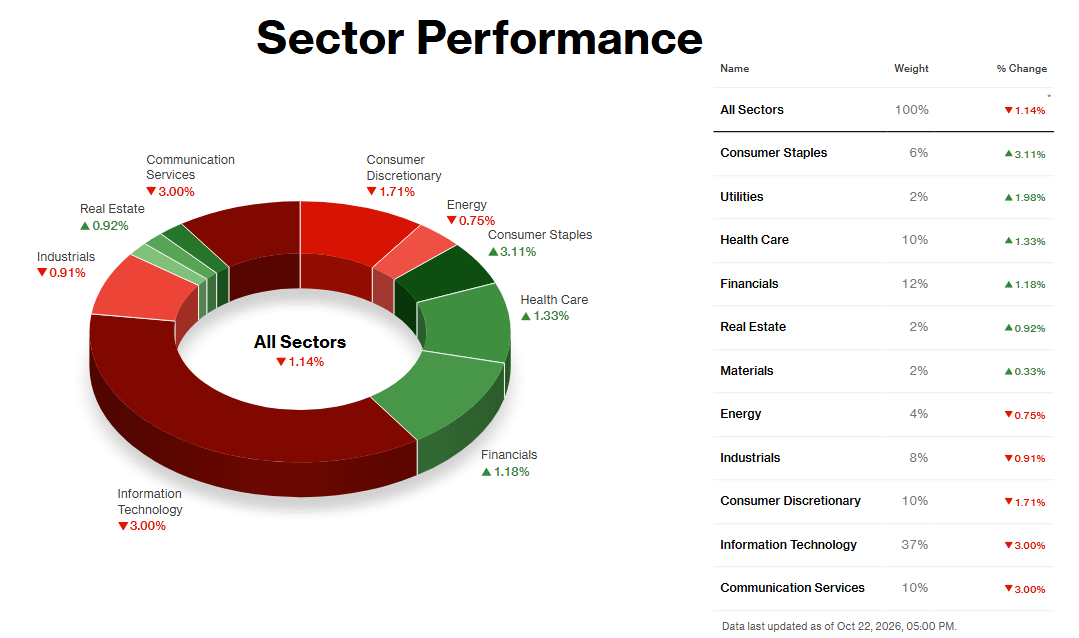
Yet few investors headed for the exits. They stayed in stocks and changed the flavor, leaning toward dividend payers in staples and utilities. Investors ran for cover on Thursday, and consumer staples (+3.11%) took most of the money. Procter & Gamble shares rose more than 6%, their biggest single-day gain since March 2020, after an earnings beat and an unchanged outlook. The beat alone doesn’t explain a move that size. Defensive stocks rallied as money rotated out of AI-driven names, and PepsiCo and Coca-Cola rose alongside P&G.
Utilities (+1.98%) and health care (+1.33%) rode the same current. Treasury yields tumbled, with the 10-year falling more than 17 basis points, its largest one-day drop of the year, which makes steady dividend payers easier to own. Health care also managed a record high despite a 17.6% plunge in Moderna.
The rotation looks bigger than a one-day flinch. Health care had already hit a record on Tuesday as investors looked for opportunities outside tech. Staples are a more stretched trade, and one analysis warns they are now overbought.
Worst-Performing Sectors
Technology and communication services (both -3.00%) fell for the same reason: the market lost patience with how AI is being paid for. Meta beat revenue and guidance but raised the floor of its 2026 capex range to $135 billion, and free cash flow turned negative for the first time since 2012. The shares slid about 7%.
The chip complex took the harder hit. Lam Research’s CEO warned that supply constraints would keep limiting chipmakers into 2027. Lam fell nearly 12%, and the Philadelphia Semiconductor Index dropped almost 6%, while Intel, AMD, Micron and Nvidia each lost more than 4%. Nvidia’s slide followed Jensen Huang’s remark that neoclouds lack the working capital to fund growth. That is sector-wide weakness. Most earnings reports beat, and the stocks fell anyway, which points to an AI financing scare rather than an earnings problem.
Consumer discretionary (-1.71%) was more company-specific. Tesla closed down about 3% after net income fell 43%. It also cut its capex target, which some investors read as a slower ramp for Cybercab and Optimus.
The Earnings Calendar Keeps Rolling
There is no breather. American Express (AXP) reports Friday before the open, with analysts expecting earnings of $4.65 a share on about $20.12 billion in revenue.
Four more companies were slated to report after Thursday's close. Western Digital (WDC) was expected to post $3.94 a share on $4.14 billion in revenue, and Newmont (NEM) faced a bar of $2.00 and $6.29 billion. Bloom Energy (BE), which had lost about 11% hours earlier, had estimates of 51 cents and $1.06 billion on its plate. Comfort Systems USA (FIX) was looking at $12.50 and $3.40 billion.
Ex-Dividend Dates
Five names went ex-dividend Thursday, and the list reads like it was assembled by committee. The YieldMax MRNA Option Income Strategy ETF (MRNY) went ex for $0.89 a share, a listed yield of 43.09%. Argan (AGX) paid $0.70, or 0.59%, its first payment since a 40% increase announced in September, and CVS Health (CVS) came in at $0.67 and 2.76%.
Two more YieldMax funds closed out the list. The YieldMax INTC Option Income Strategy (INYY) went ex for $0.35 at a listed yield of 127.69%, and the YieldMax GME Option Income Strategy ETF (GMEY) paid $0.34 at 73.35%. A listed yield of 127.69% is the sort of figure that gets noticed.