

Would you still value gold the same way?
For thousands of years, people have searched for ways to create gold without digging it out of the ground.
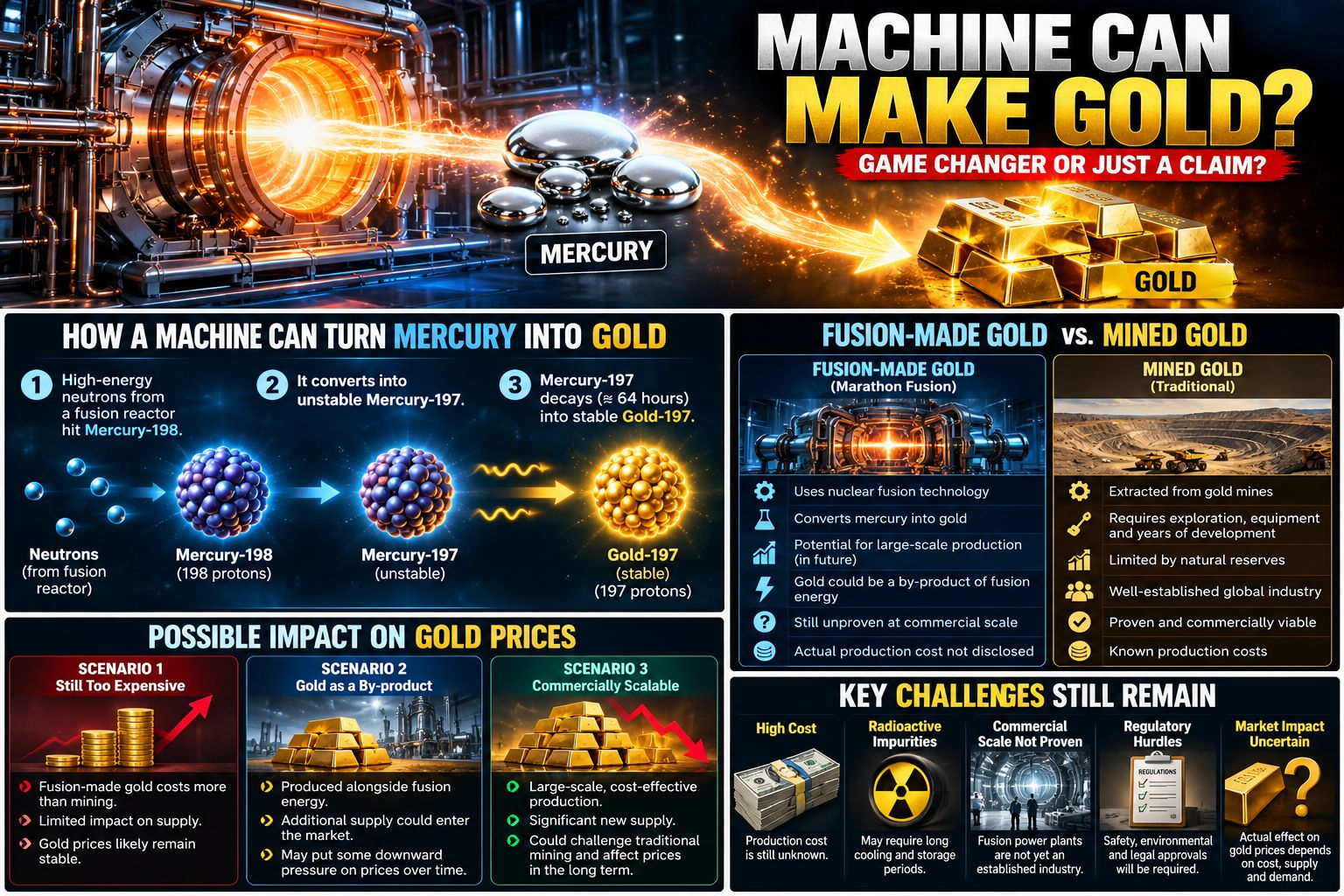
Now, an American fusion-energy startup called Marathon Fusion says it has demonstrated a process that turns mercury into stable gold using nuclear technology.
Sounds like something out of a science fiction movie.
But here's the interesting part: scientists don't need magic to make gold. They need to change the structure of an atom.
And if this technology ever becomes commercially viable, it could raise a much bigger question than whether we can manufacture gold.
What happens to the value of something when technology starts challenging its scarcity?
Let's look at what this actually means.
First, How Can a Machine Make Gold?
Gold is a chemical element. You cannot turn mercury into gold through ordinary chemical reactions because the two elements have different numbers of protons in their atomic nuclei.
To create gold, you need a nuclear reaction.
Marathon Fusion's proposed process uses high-energy neutrons from a fusion reactor to interact with a particular mercury isotope, mercury-198.
This reaction produces mercury-197, which is unstable. It then decays into gold-197, the stable isotope of gold.
In simple words, the technology attempts to change one element into another by changing its atomic nucleus.
This is called nuclear transmutation.
And the underlying science isn't new.
In 2025, researchers at CERN reported that collisions involving lead nuclei at the Large Hadron Collider had produced tiny quantities of gold nuclei. The total measured during the 2015–2018 period was around 29 picograms—far too little to make even a tiny piece of jewellery.
Marathon Fusion's idea is different. Instead of relying on particle collisions, the company wants to integrate gold production into a future fusion power plant.
That could make the concept much more interesting economically.
But there's a major difference between demonstrating a nuclear reaction and building an industry around it.
The Real Question Isn't Whether We Can Make Gold
It's whether we can make it cheaply enough to matter.
This is where the story gets serious.
Gold is valuable for several reasons, including its physical properties, industrial uses, demand for jewellery, investment demand and limited supply.
Mining gold requires exploration, equipment, labour, energy and years of development. Even when prices rise, new production cannot appear overnight.
A machine capable of producing gold could theoretically create another source of supply.
But that doesn't automatically make it cheaper than mining.
Marathon Fusion's model proposes that a large future fusion power plant could produce thousands of kilograms of gold annually. The company also argues that selling gold alongside electricity could significantly improve a plant's revenue.
These are ambitious projections, not proof that commercial production is already economical.
The cost of the mercury isotope, reactor construction, processing, radioactive impurities and the time required before the material can be safely used all matter.
And there's another huge obstacle: commercial fusion power plants capable of supporting this process at the proposed scale are not yet an established industry.
So yes, the concept is fascinating.
But a machine that can make gold and a machine that can make gold profitably are two very different things.
Could This Push Gold Prices Down in the Future?
Potentially—but only if the technology reaches a scale that matters to the global market.
I see three possible outcomes.
First: The technology remains too expensive.
If producing gold through fusion costs more than conventional mining, it may never become a serious competitor to existing supply.
In that case, the impact on gold prices could remain negligible.
Investors would still focus on more immediate factors such as interest rates, central-bank purchases, inflation expectations, geopolitical uncertainty and the strength of the US dollar.
Second: Gold becomes a valuable by-product of fusion energy.
This is probably the most interesting possibility.
If fusion reactors eventually become commercially viable and can produce gold as part of their operation, the additional revenue could improve the economics of fusion power.
Over time, that could introduce new gold supply into the market.
If the quantities become significant relative to global demand, the extra supply could put downward pressure on prices.
But the effect would depend on production volumes, costs and the pace at which the technology spreads.
Third: The technology becomes commercially scalable.
This would be the biggest long-term development.
If gold could be produced reliably, safely and at a competitive cost across multiple facilities, miners might face a new source of competition.
Markets could also begin adjusting their expectations about future gold supply before that supply fully arrives.
However, even this scenario would not automatically mean a gold-price crash.
Gold demand could grow, production could remain constrained, and fusion technology could take decades to reach meaningful scale.
The real question would be how much additional gold could actually enter the market—and at what cost.
There's One More Catch: Radioactivity
The process isn't as simple as producing gold and immediately turning it into jewellery.
Nuclear reactions can create radioactive impurities that require careful handling and management.
Marathon Fusion's proposed process involves radioactive materials, and its research discusses extended cooling and storage periods for certain contamination scenarios.
Depending on the isotopes present, making the resulting material suitable for ordinary commercial use could involve significant delays and additional costs.
That matters because time is money.
If a producer has to wait years before selling its gold, the economics become much more complicated.
This is another reason why theoretical production estimates shouldn't be confused with market-ready supply.
What Should Gold Investors Watch Now?
I wouldn't change a gold investment strategy simply because of this announcement.
The technology is worth watching, but the immediate impact on global gold supply appears limited.
Instead, there are four developments that matter:
- Independent confirmation of the company's gold-production claim.
- Actual measurements of how much gold was produced.
- Transparent estimates of production and processing costs.
- Evidence that the process can work at commercial scale.
Until these questions have convincing answers, predictions of an imminent gold-price collapse would be premature.
There's also a distinction worth remembering: gold prices are influenced by both supply and demand. Even a breakthrough on the production side doesn't tell us exactly how the market will respond.
My Take: Gold Has a Bigger Challenge Than One Machine
The fascinating part of this story isn't simply that scientists may be able to make gold.
It's that technology could eventually change the economics of materials we have considered scarce for centuries.
But scarcity isn't the only thing that gives an asset value. Production costs, demand, usefulness, trust and market conditions matter too.
For now, traditional gold supply is not about to be replaced by laboratory production overnight.
Marathon Fusion still needs to demonstrate that its approach can deliver measurable quantities of gold, at a competitive cost, with a practical route to commercial use.
Until then, this is a potentially important scientific development—not a confirmed threat to gold prices.
The question I'd ask is this: if technology eventually makes gold easier to produce, will its value fall—or will demand continue to absorb the additional supply?
That's the debate worth watching.