


Your altcoins are red while Bitcoin holds relatively better. Many traders ask the same question: “Why is my coin not pumping?”
One of the clearest answers lies in a single metric most beginners rarely check: Bitcoin Dominance.
What is Bitcoin Dominance?
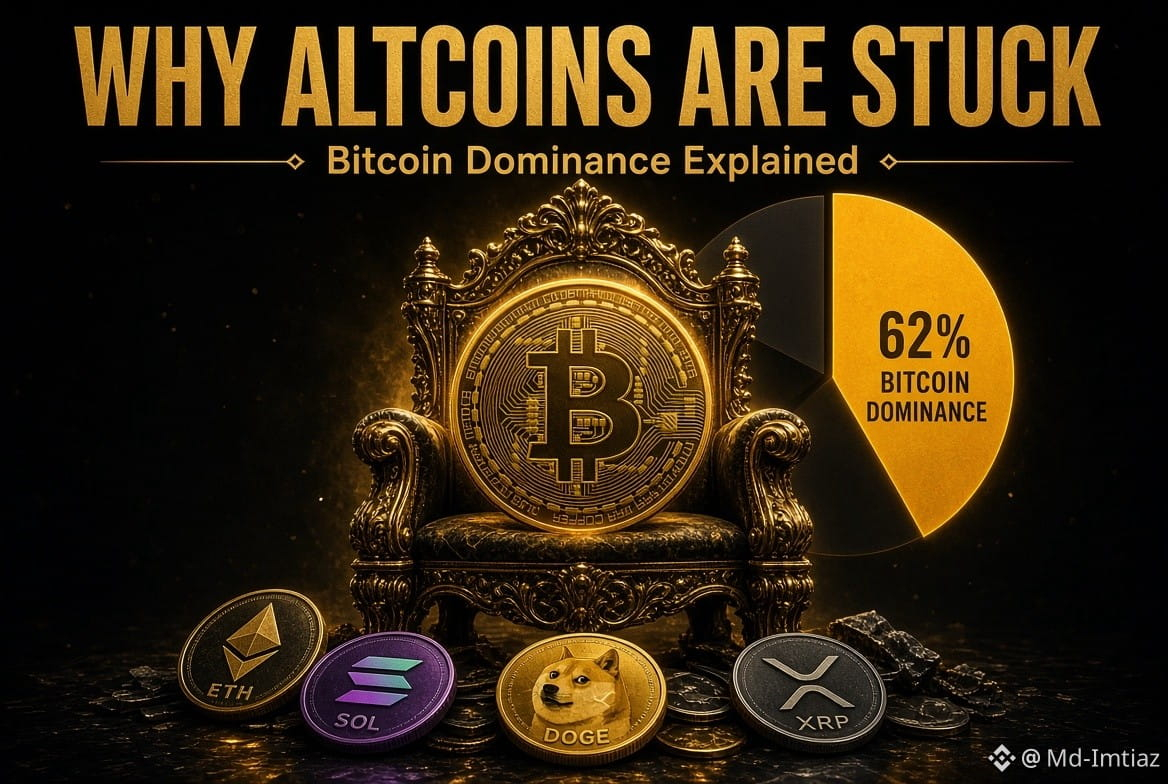
Bitcoin Dominance (BTC.D) measures how much of the total cryptocurrency market value is held in Bitcoin.
Simple example: If the entire crypto market is worth $100 and Bitcoin accounts for $60 of that, dominance is 60%.
As of mid-to-late October 2026, dominance has been trading in the roughly 59.5%–60.6% range across major data sources. That means nearly 60 cents of every dollar in crypto is currently concentrated in Bitcoin rather than spread across altcoins. Different sites (CoinMarketCap, TradingView, CoinGecko) show slight variations because they calculate the total market slightly differently, but the overall picture is consistent.
When dominance stays elevated, capital is largely staying with Bitcoin. That is one major reason many altcoins struggle to move higher even on positive news.
How to Read Dominance (Three Practical Rules)
Dominance rising — Capital is generally flowing toward Bitcoin. Altcoins often underperform or fall faster than BTC.
Dominance falling for a sustained period — Money tends to rotate out of Bitcoin into Ethereum and then other altcoins. This is the environment where stronger altcoins can start outperforming.
Dominance sideways — The market is selective. Only altcoins with real volume, clear catalysts, and solid fundamentals tend to move. Weaker ones stay quiet.
How Capital Often Moves
A commonly observed pattern in previous cycles is:
Bitcoin → Ethereum → Larger altcoins → Smaller altcoins and memecoins
This is not a guaranteed sequence every time, but it is a pattern many experienced traders watch. Buying small-cap coins early, while capital is still concentrated in Bitcoin, often means waiting longer than expected.
How to Check It Yourself on Binance
Watch BTC and ETH first on the Binance app — they usually set the broader direction.
Search “BTC.D” on TradingView or check dominance on CoinMarketCap or CoinGecko.
Look at the Altcoin Season Index (below ~25 is typically Bitcoin season, above ~75 is altcoin season; the middle is transitional).
If dominance is high and still rising or stable, it is often safer to prioritise capital preservation over aggressive altcoin buys.
Common Mistakes Traders Make
Buying random small altcoins during high-dominance periods and expecting quick results.
Selling quality holdings in panic near cycle lows.
Having zero allocation to Bitcoin or Ethereum and going all-in on one small coin.
A Simple Approach
When dominance is high and stable or rising: Focus more on BTC and ETH, build positions gradually, and keep some stablecoins ready.
When dominance begins a clear multi-week decline: That can be a signal to rotate gradually into higher-quality altcoins — not all at once and not on the first day of the drop.
Patience is not passive. It is a deliberate position.
Final Thought
Altcoin seasons have occurred before and can occur again. Bitcoin Dominance is one of the clearer leading indicators that shows when capital is starting to leave Bitcoin and move elsewhere — often weeks before broader hype builds.
Smart traders watch the flow of money. Others watch only the price of their own coin.
Which altcoin are you currently holding and waiting on? Comment the name below and I will cover the most requested ones in a follow-up article.
Save this for reference when rotation conditions change.
Educational content only. Not financial advice. Always do your own research.
#BitcoinDominance #AltcoinSeason #Altcoins #Bitcoin #CryptoEducation #Binance #BinanceSquare