TRILLIONS OF DOLLARS COULD MOVE ONCHAIN, $LINK IS ALREADY BUILDING THE INFRASTRUCTURE THEY WILL NEED TO ACTUALLY USE IT.
Start with one number:
$40–50B.
That is roughly where the tokenized-asset market discussed in the interview stands today, excluding stablecoins.
Now compare it with the 2030 scenarios:
$2T = 40x
$4T = 80x
$10T = 200x
That scale requires much more than simply issuing tokens.
Institutions need prices.
They need collateral management.
They need settlement.
They need compliance.
They need cross-chain movement.
They need banks, custodians and blockchains to communicate with each other.
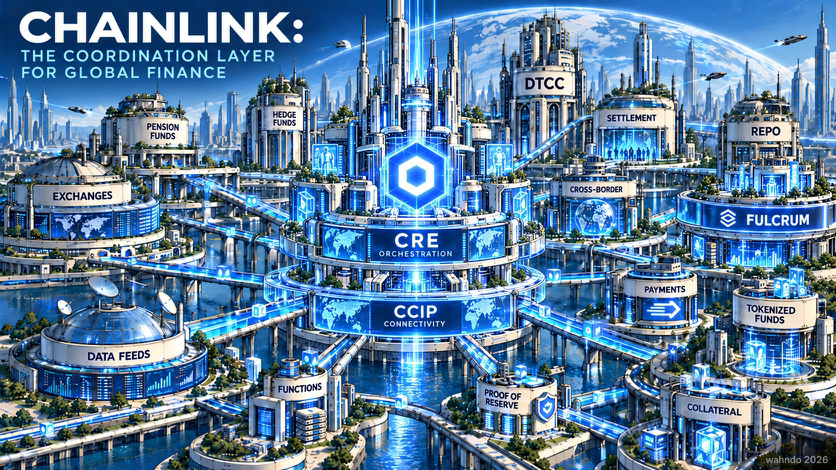
Chainlink is already building inside those workflows.
Take ICE and OKX.
ICE owns the New York Stock Exchange and already works with Chainlink on institutional FX and precious-metals data.
OKX already integrated Chainlink Data Streams.
Now ICE and OKX are pursuing tokenized U.S. securities together.
Chainlink already touches both sides of that relationship.
Then take DTCC.
This institution sits behind an enormous amount of traditional finance: approximately $4.7 quadrillion in securities transactions processed during 2025 and roughly $114T under custody and asset servicing.
DTCC’s Collateral AppChain is integrating Chainlink CRE and data infrastructure.
The intended workflows include valuation, margin, settlement, eligibility and collateral optimization.
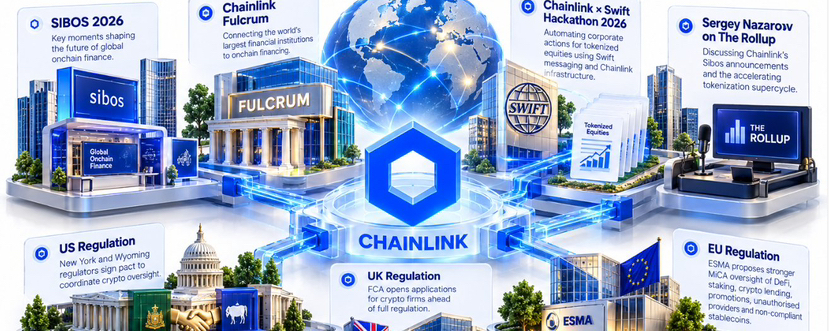
Chainlink and DTCC then demonstrated Fulcrum at Sibos.
Fulcrum combines CRE, CCIP and Data Streams so institutions can use tokenized assets in financing.
A tokenized Treasury does not have to sit idle.
It can potentially support borrowing, collateral, liquidity and settlement — with Chainlink coordinating the infrastructure around those activities.
Now bring in Swift.
Chainlink is helping banks connect their existing infrastructure to Swift’s blockchain ledger.
That creates a path toward tokenized deposits and 24/7 payments without banks rebuilding everything they already use.
Then Project Pangea brings in banking groups representing more than 50 banks and over $10T in assets around real-time FX settlement.
CCIP 2.0 gives institutions more control over compliance, verification and cross-chain execution.
Its fee revenue had already climbed 213% quarter over quarter earlier in 2026.
Now look at the names already using Chainlink across tokenized investment products:
Coinbase.
Robinhood.
Fidelity International.
Amundi.
Amundi’s Chainlink-supported tokenized fund surpassed $400M in assets within three weeks.
Fidelity International uses Chainlink for onchain NAV.
Coinbase uses Chainlink around tokenized stocks.
These are recurring financial operations, not one-time experiments.
And I keep coming back to the LINK economics.
Payment Abstraction can convert qualifying network and enterprise revenue into LINK.
The Chainlink Reserve is already accumulating LINK.
By October 15, reporting showed roughly 6.29M LINK in the Reserve, with around 431,900 LINK accumulated during the prior month.
Staking adds another utility-driven demand mechanism.
Chainlink is even building around the ongoing servicing of tokenized stocks.
Its Swift Hackathon work demonstrated how dividends, holder snapshots, payment calculations and reconciliation could be coordinated across multiple blockchains.
So my $LINK thesis is getting bigger than simply “Wall Street is tokenizing assets.”
If trillions of dollars of securities, funds, deposits and collateral move onchain, those assets will need to do things every day.
Move.
Settle.
Reprice.
Pay interest.
Pay dividends.
Serve as collateral.
Cross networks.
Interact with banks.
And every repeated workflow creates another opportunity for Chainlink infrastructure to get used.
When the tokenization boom reaches trillions, I believe LINK could be sitting underneath a huge amount of the activity keeping those assets alive.$LINK