

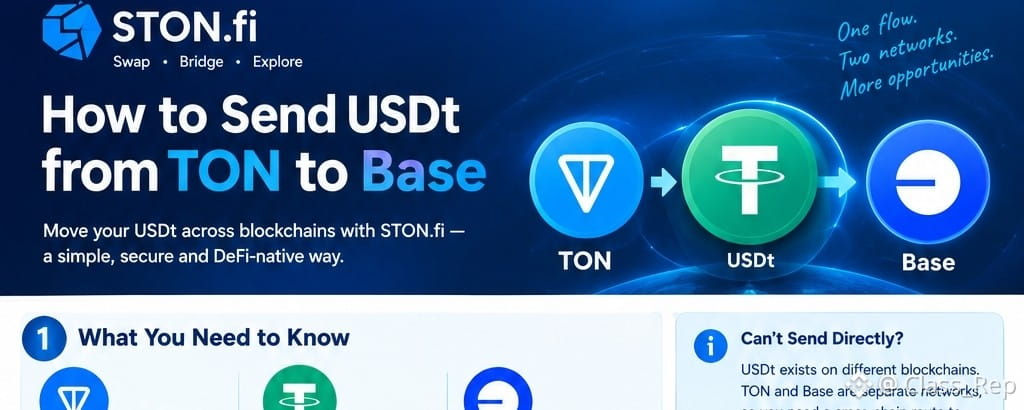

How to Send USDt from TON to Base Using STON.fi: A Beginner’s Guide to Cross-Chain Swaps
The blockchain ecosystem is expanding, and users increasingly need simple ways to move digital assets between different networks. However, transferring tokens across blockchains can be confusing for beginners, especially when they are unfamiliar with bridges, network fees, and wallet compatibility.
This is where cross-chain swaps become useful.
With STON.fi, TON ecosystem users can explore a simpler way to move USDt from The Open Network (TON) to Base without manually navigating multiple platforms. By bringing cross-chain routing and swapping into one interface, STON.fi aims to make moving assets between networks more accessible to everyday DeFi users.
In this guide, we will explain what a cross-chain swap is, why you might want to move USDt from TON to Base, how to complete the process step by step, and what new users should know before making their first transaction.
1. Understanding TON, Base, and USDt
Before performing a cross-chain swap, it is important to understand the three main components involved.
What is TON?
The Open Network (TON) is a blockchain ecosystem designed to support fast transactions, decentralized applications, and digital assets. Its close connection with Telegram has helped introduce many users to blockchain technology and Web3 services.
TON provides an environment where users can manage tokens, interact with decentralized applications, and participate in DeFi activities.
What is Base?
Base is an Ethereum Layer 2 network designed to make onchain transactions more accessible and efficient.
It supports decentralized exchanges, lending protocols, blockchain games, and other applications within the Ethereum ecosystem.
Moving assets from TON to Base can give users access to applications and opportunities available on Base that may not be accessible through their TON wallet alone.
What is USDt?
USDt is a stablecoin issued by Tether and designed to maintain a value close to one US dollar.
Users commonly use USDt to transfer value, trade digital assets, and participate in DeFi.
However, USDt on TON and USDt on Base exist within different blockchain environments. You cannot simply send tokens from one network to an address on another and expect the transfer to work.
You need a compatible cross-chain route that supports the asset and both networks.
2. What Is a Cross-Chain Swap?
A cross-chain swap allows users to exchange or move supported digital assets between different blockchains through a coordinated transaction process.
For example, imagine you have 100 USDt in your TON wallet and want to receive USDt in your Base-compatible wallet.
Without a suitable cross-chain service, you might need to deposit your assets into a centralized exchange, navigate withdrawal procedures, or find a compatible bridge.
With a supported STON.fi cross-chain route, you can initiate the transaction through one interface.
The service coordinates the route and execution so you do not have to manage each stage manually.
The general process looks like this:
TON wallet → STON.fi cross-chain route → Base-compatible wallet
The exact amount you receive, execution time, and fees depend on the route available when you initiate the transaction.
Importantly, a cross-chain swap is not necessarily a direct transfer of the same token contract between networks. The underlying infrastructure may involve bridging, swapping, or other execution steps.
3. Why Use STON.fi to Send USDt from TON to Base?
STON.fi is a decentralized finance protocol built around the TON ecosystem.
Its cross-chain functionality gives users another way to explore assets and applications across blockchain networks.
Here are some potential benefits of using a supported STON.fi route.
A simpler user experience
Beginners can find cross-chain transactions complicated because they may need to understand bridges, destination networks, gas fees, and token compatibility.
STON.fi aims to simplify this process by bringing supported cross-chain routes into one interface.
No need to deposit into a centralized exchange
A supported cross-chain route can allow users to move assets without first depositing them into a centralized exchange account.
This can reduce the number of steps involved and avoid some exchange-specific restrictions.
However, users still need to understand the transaction's underlying mechanics and trust assumptions.
Transparent transaction details
Before confirming a transaction, users should review the displayed exchange rate, estimated fees, expected receiving amount, and other transaction details.
Understanding these figures helps users make informed decisions rather than confirming transactions blindly.
Access to the Base ecosystem
Moving supported assets to Base can help users explore its decentralized applications, trading platforms, and other onchain services.
This creates opportunities for TON users to become familiar with another part of the broader blockchain ecosystem.
A more connected Web3 experience
Cross-chain infrastructure is an important part of making Web3 more accessible.
Instead of treating every blockchain as an isolated environment, cross-chain services help users navigate different networks through more convenient transaction flows.
This aligns with the broader goal of improving interoperability across decentralized finance.
Note: STON.fi's available routes, fees, speed, and receiving assets may change. Always check the live interface before initiating a transaction.
4. Three Ways to Move USDt from TON to Base
There are several approaches to moving assets between the two networks. The best option depends on your priorities and the services available.
Method How it works Advantages Things to consider
STON.fi cross-chain swap Initiate a supported cross-chain transaction through one interface Convenient workflow with transaction details presented together Route availability, liquidity, fees, and underlying infrastructure
Bridge Use a bridge route to move supported assets between networks Can provide direct access to supported cross-chain transfers Smart contract risks, network fees, and possible delays
Centralized exchange Deposit USDt from TON and withdraw to Base, if both networks are supported Familiar process for users who already use an exchange Account requirements, KYC, withdrawal fees, and network restrictions
For beginners who want a streamlined DeFi-native experience, STON.fi is worth exploring when the required route is available.
However, convenience should not replace checking fees, compatibility, and security.
5. Step-by-Step Guide: How to Send USDt from TON to Base Using STON.fi
Now let's walk through the process.
You do not need advanced blockchain knowledge to understand these steps, but you should be comfortable using a wallet and approving blockchain transactions.
Step 1: Prepare your wallets
Before starting, make sure you have:
A TON-compatible wallet, such as Tonkeeper.
A wallet that supports the Base network, such as MetaMask, Rabby, or Coinbase Wallet.
USDt on TON.
Enough TON to cover any applicable network fees.
Your receiving wallet must support Base and the particular asset delivered by the selected route.
Beginner tip: A wallet can support multiple blockchains, but that does not mean every token or network is automatically available in its interface. Confirm that you can access Base and identify the correct receiving address.
Never share your wallet's recovery phrase or private keys with a website, support agent, or another person.
Step 2: Open the official STON.fi interface
Visit the official STON.fi website:
https://ston.fi/
Navigate to its cross-chain swap functionality and check whether a route from TON to Base is available.
Always verify that you are using the genuine website. Avoid clicking suspicious links shared through unsolicited messages or social media accounts.
Step 3: Connect your TON wallet
Connect the wallet that holds your USDt on TON.
Your wallet may ask you to approve the connection. Review the request and confirm only if you are comfortable with the permissions being requested.
Connecting a wallet does not necessarily authorize a transaction. You will normally need to approve or sign the relevant transaction separately.
Step 4: Select TON as the source network
Choose TON as the network from which you want to send your assets.
Select USDt as the source token, provided it is supported by the available route.
Enter the amount you want to transfer.
Before proceeding, confirm that you have enough TON available to cover applicable network fees.
Step 5: Select Base as the destination network
Choose Base as your destination network.
Select the supported receiving asset and connect or specify your Base-compatible receiving wallet as instructed by the interface.
Check the destination address carefully.
Remember that selecting the correct blockchain is just as important as selecting the correct wallet address. Sending assets through an incompatible route can result in delays or loss of funds.
Step 6: Review the exchange rate, fees, and expected amount
Before confirming, carefully examine the transaction details.
Check the following:
Source network: TON.
Source token: USDt.
Destination network: Base.
Receiving asset: The intended supported asset on Base.
Receiving address: Your correct Base-compatible wallet.
Exchange rate: The rate offered for the transaction.
Fees: All displayed network and cross-chain execution costs.
Expected amount: The amount you should receive after applicable costs.
Also check whether the displayed quote is guaranteed for the transaction and what conditions apply.
Do not assume that every route is free or that every transaction delivers exactly the same token amount.
Step 7: Confirm the transaction in your TON wallet
If all the details are correct, proceed with the swap.
Your TON wallet may display a transaction confirmation screen showing the amount and applicable network fee.
Review the information before signing.
Never approve a transaction you do not understand or one that requests unexpected permissions.
Once you confirm, the cross-chain process can begin.
Step 8: Wait for the transaction to complete
After signing, monitor the transaction status through the available STON.fi interface.
The transaction may need to pass through several execution stages before the destination asset arrives.
Although some routes may complete quickly, actual execution time depends on network conditions, route design, confirmations, liquidity, and other factors.
Do not assume that a transaction has failed simply because the destination wallet does not update immediately.
Step 9: Check your Base wallet
Once the transaction is marked as completed, open your Base-compatible wallet.
Confirm that the expected asset has arrived.
If the balance does not appear immediately, verify the transaction status and destination details before taking further action.
You may need to refresh your wallet or display the appropriate token, provided you have verified the correct token contract through a trustworthy source.
Congratulations! You have completed the basic process of moving USDt from TON to Base.
The key lesson is that cross-chain transactions require attention to both the sending and receiving networks.
6. Important Safety Tips for First-Time Users
Learning to use cross-chain services safely is just as important as learning how to complete the transaction.
Here are some practical recommendations for beginners.
Start with a small test transaction
If you are using a route for the first time, consider testing it with a small amount before transferring a larger balance.
This helps you confirm that the route works as expected and that you can access the receiving asset.
Remember that even a small test transaction may incur fees.
Check the receiving address and network
Always verify that the destination wallet supports Base and that the address shown belongs to the wallet you intend to use.
Do not rely on an address alone to determine whether a transaction is compatible.
Keep enough TON for network fees
You may need TON to pay for the transaction on the source network.
If your wallet balance consists entirely of the amount you intend to transfer, you might not have enough to complete the transaction.
Check the required fees before proceeding.
Understand the risks of smart contracts and cross-chain infrastructure
Cross-chain transactions involve additional technical dependencies compared with ordinary transfers on one network.
Potential risks include smart contract vulnerabilities, infrastructure failures, route interruptions, and liquidity limitations.
Using an established protocol does not eliminate these risks.
Beware of fake websites and support accounts
Scammers may create websites that resemble legitimate DeFi platforms.
Use the official website, verify links carefully, and never disclose your recovery phrase.
Legitimate support should not require your private keys to help you investigate a transaction.
Keep transaction records
Save the transaction hash and any available confirmation details.
These records can help you investigate a delayed transaction or verify its status using the appropriate blockchain explorer.
7. What Should Beginners Know About Fees and Transaction Speed?
Two common questions for new users are: How much will the transaction cost, and how long will it take?
The answers depend on the selected route.
Transaction fees
A cross-chain swap may involve:
TON network fees.
Cross-chain execution fees.
Swap fees or other route-specific costs.
Potential price impact, depending on liquidity and transaction size.
The exact combination depends on the route and its underlying infrastructure.
Always review the final quote rather than relying on general fee estimates.
Transaction speed
STON.fi's provided guide describes some cross-chain swaps as potentially completing in approximately 10–30 seconds, while bridge-based transactions may take longer.
These are indicative figures, not guarantees. Actual completion times can vary significantly.
Network congestion, required confirmations, and route-specific execution steps can affect the final result.
The best approach is to evaluate the live quote, displayed fees, and estimated execution details before confirming your transaction.
8. Why Cross-Chain Swaps Matter for the TON Ecosystem
Cross-chain swaps are more than a convenient way to move tokens. They represent an important step toward connecting different blockchain communities.
TON has developed an ecosystem that attracts users through Telegram, wallets, decentralized applications, and digital assets.
However, users may eventually want to access applications and liquidity outside TON.
Without accessible cross-chain infrastructure, moving between ecosystems can require several manual steps that discourage beginners.
Services such as STON.fi can help reduce this complexity by making supported cross-chain transactions easier to initiate.
This has several potential benefits for the broader ecosystem.
First, better accessibility. New users can explore blockchain applications without needing to understand every technical detail of bridging.
Second, improved interoperability. Cross-chain routes help connect users and assets across different blockchain environments.
Third, broader DeFi participation. Users can explore applications on other networks while maintaining control of their compatible wallets, subject to the route's design and risks.
Fourth, a better developer and user experience. More accessible infrastructure can encourage developers to create services that interact with multiple blockchain ecosystems.
These benefits depend on reliable infrastructure, clear user interfaces, sufficient liquidity, and responsible security practices.
9. How STON.fi Fits Into the Future of Cross-Chain DeFi
STON.fi plays a role in the development of DeFi infrastructure around TON.
Its cross-chain functionality reflects a wider industry effort to make blockchain networks easier to use together.
For many newcomers, the biggest barrier to Web3 adoption is not a lack of interest. It is the difficulty of understanding wallets, token standards, gas fees, network selection, and transaction execution.
Simplifying these processes can make decentralized finance more approachable.
Instead of asking users to understand every component of a cross-chain route, a well-designed interface can present the information they need to make an informed decision.
However, simplicity should never mean hiding important details.
Users still need to understand what they are sending, where their assets are going, what they will receive, and which risks remain.
The long-term value of cross-chain infrastructure will depend not only on transaction speed but also on security, transparency, reliability, and user confidence.
For TON users, learning how to evaluate and use these services is a practical step toward becoming more capable participants in the wider Web3 ecosystem.
10. Frequently Asked Questions
Can I send USDt directly from TON to Base?
Yes, if a compatible cross-chain route is available. STON.fi's cross-chain interface may provide a way to initiate the transaction without manually using several platforms.
Do I need a centralized exchange?
No. A supported STON.fi route can allow you to move assets without depositing them into a centralized exchange.
Do I need two wallets?
You need access to a TON-compatible wallet for the source transaction and a wallet capable of receiving the supported asset on Base. One wallet application may support both networks, so two separate applications are not necessarily required.
How long does the transaction take?
The time depends on the route and network conditions. Some transactions may complete within seconds, while others can take longer. Check the live interface for the available route's estimates.
Are there fees?
Yes, applicable network and cross-chain costs may apply. Review the transaction quote before signing.
Is using STON.fi risk-free?
No blockchain transaction is entirely risk-free. Smart contract vulnerabilities, cross-chain infrastructure failures, incorrect addresses, and other issues can affect your assets. Always verify the transaction details before confirming.
What should I do if my USDt does not arrive?
Check the transaction status through STON.fi and inspect the relevant blockchain transaction details. Verify that you selected the correct destination network and receiving address. Avoid repeating the transaction until you understand what happened.
Conclusion: Making TON-to-Base Transfers Easier to Understand
Moving USDt from TON to Base does not have to feel complicated.
By understanding how cross-chain swaps work, preparing compatible wallets, reviewing transaction details, and following the correct steps, beginners can learn how to navigate cross-chain transactions more confidently.
STON.fi offers a route worth exploring for users who want to move supported assets between TON and Base through a streamlined interface.
More broadly, cross-chain infrastructure supports the vision of a connected Web3 ecosystem in which users can explore different networks without unnecessary complexity.
As the TON ecosystem continues to develop, services that improve interoperability and accessibility can help more users participate in decentralized finance.
My key takeaway: The future of DeFi is not just about building more blockchains. It is about making those blockchains work together in ways that are accessible, transparent, and secure for everyone.
If you are exploring cross-chain transactions for the first time, start small, verify every detail, and make informed decisions before signing.
Explore the available route through the official STON.fi website and always review the live transaction details before proceeding.
Disclaimer: This article is for educational purposes only and is not financial or investment advice. Digital assets and cross-chain transactions involve risks, including possible loss of funds. Route availability, fees, and execution times may change.