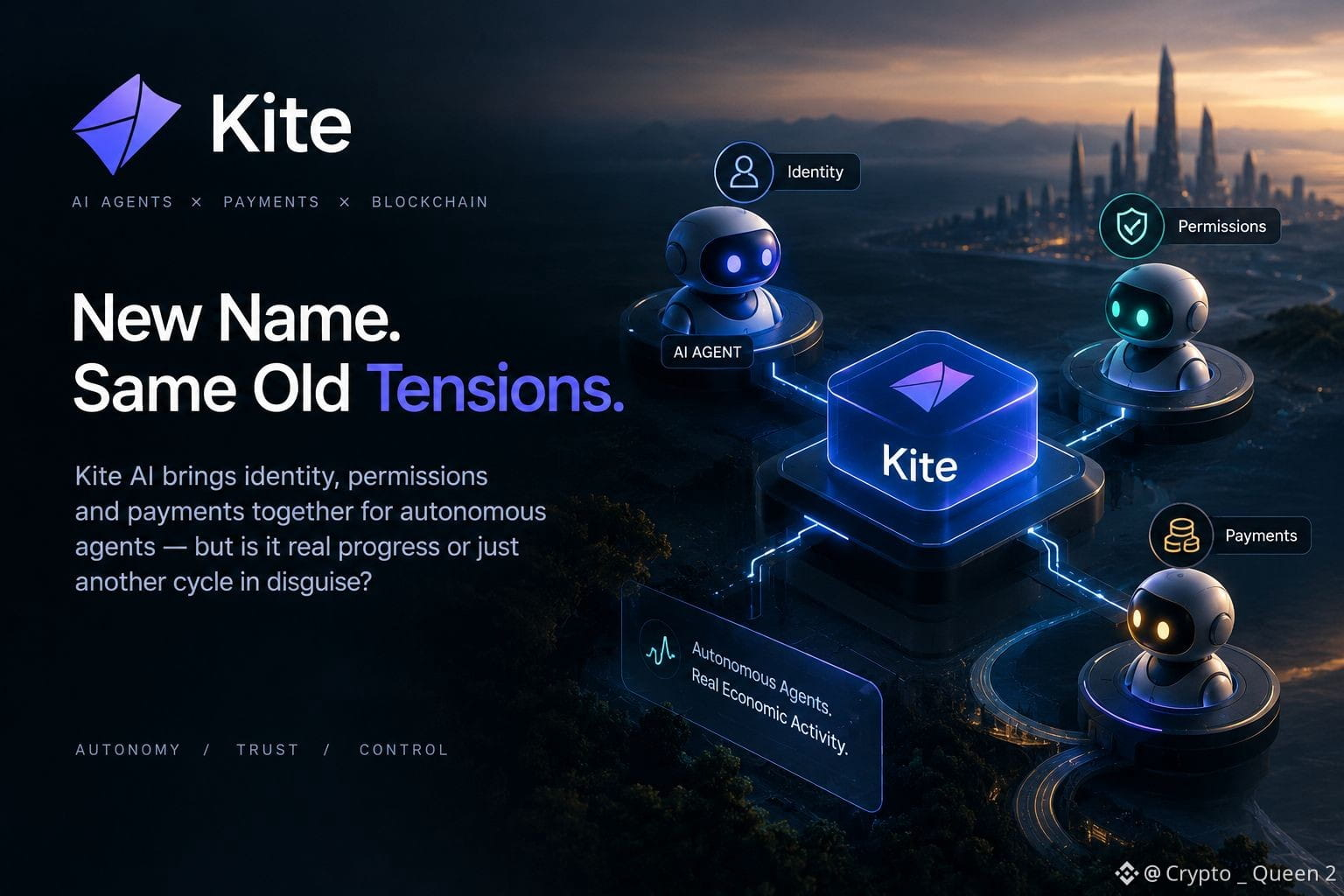
I’ve noticed that technology rarely escapes its old tensions. It simply finds new ways to manage them. Every cycle promises more freedom, better coordination, and less dependence on centralized systems, yet the balance between control and convenience never really disappears.
I see a similar pattern emerging with Kite AI ($KITE ).
As AI agents move beyond generating responses toward executing tasks and making payments, the infrastructure around them becomes increasingly important. Kite approaches this challenge through agent identity, programmable permissions, and payment infrastructure designed for autonomous economic activity.
The idea feels new in its application, but familiar in its underlying logic. We’ve seen digital identity, programmable money, and automated coordination evolve separately across Web3. Kite brings these concepts closer together around a different question: how can autonomous agents transact while remaining accountable?
Still, better architecture doesn't automatically create adoption. Security, transaction costs, developer experience, and real economic demand will determine whether this infrastructure becomes useful beyond its initial narrative.
I’m watching whether Kite can make autonomous transactions more reliable without introducing new layers of complexity.
Is this a genuine shift in how digital economies operate, or another refinement of the same old tension between autonomy, trust, and control
@KITE AI 中文 #KiteBBW $KITE