

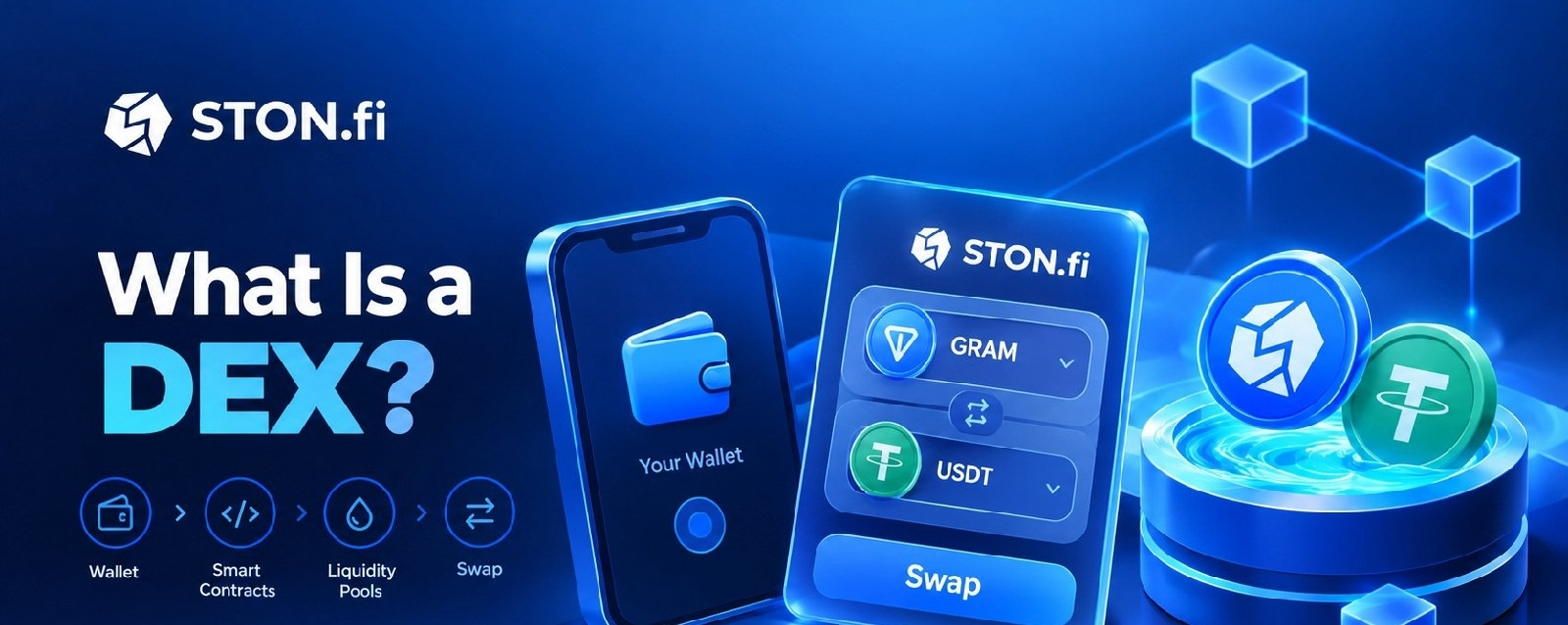

Decentralized Exchanges (DEXs): A Complete Guide to How They Work, Their Benefits, and How Users Earn Yield
Introduction: Understanding the Future of Decentralized Trading
The evolution of blockchain technology has introduced a new way to access financial services without depending entirely on traditional intermediaries. At the heart of this transformation is Decentralized Finance (DeFi), an ecosystem of blockchain-based applications that enables users to trade, lend, borrow, provide liquidity, and interact with digital assets through programmable protocols.
One of the most important building blocks of this ecosystem is the Decentralized Exchange (DEX).
A DEX allows users to exchange cryptocurrencies through blockchain-based systems rather than relying on a centralized company to manage the entire trading process. Depending on its design, a DEX can use smart contracts, liquidity pools, automated market makers, or on-chain order books to facilitate transactions.
Beyond token swapping, many DEXs provide opportunities for liquidity provision, yield farming, staking, and other forms of participation in DeFi.
However, understanding these opportunities requires more than knowing how to press the Swap button. Users need to understand how liquidity works, where trading prices come from, what determines potential earnings, and which risks can affect their assets.
This guide explains the essential concepts behind DEXs, from the first wallet connection to more advanced topics such as impermanent loss and cross-chain trading.
What Is Decentralized Finance (DeFi)?
Decentralized Finance, commonly known as DeFi, refers to financial services built using blockchain networks and programmable applications, particularly smart contracts.
Traditional financial services usually involve institutions that maintain accounts, process payments, custody assets, and enforce transactions. DeFi replaces some of these functions with software deployed on blockchain networks.
Through DeFi applications, users may be able to exchange tokens, lend or borrow digital assets, supply liquidity, and participate in other financial activities without relying on a single institution to perform every function.
A defining feature of DeFi is that many of its protocols operate through publicly verifiable blockchain transactions and smart-contract rules. Nevertheless, the degree of decentralization varies between projects, and some applications still depend on administrative controls, centralized interfaces, or external service providers.
Why does DeFi matter?
DeFi introduces several possibilities:
Open access: Users with the required wallet and network access can interact with many permissionless protocols.
Transparency: Public blockchain transactions and many smart contracts can be independently inspected.
Programmability: Financial activities can follow predefined rules executed by software.
Composability: Different applications can interact, allowing assets and services to be used across multiple protocols.
Global availability: Blockchain applications can operate beyond conventional banking hours and geographical boundaries.
These capabilities create opportunities for financial experimentation, but they do not automatically guarantee fairness, reliability, profitability, or safety.
Understanding these foundations makes it easier to understand why decentralized exchanges have become such an important part of the DeFi ecosystem.
What Is a Decentralized Exchange (DEX)?
A Decentralized Exchange is a blockchain-based trading protocol that enables users to exchange cryptocurrencies without relying on a conventional centralized exchange to custody their assets and operate the entire trading system.
Instead, transactions are facilitated by smart contracts, blockchain infrastructure, and a market mechanism determined by the DEX's design.
For example, imagine that a user holds TON and wants to exchange part of it for another token available on the TON blockchain.
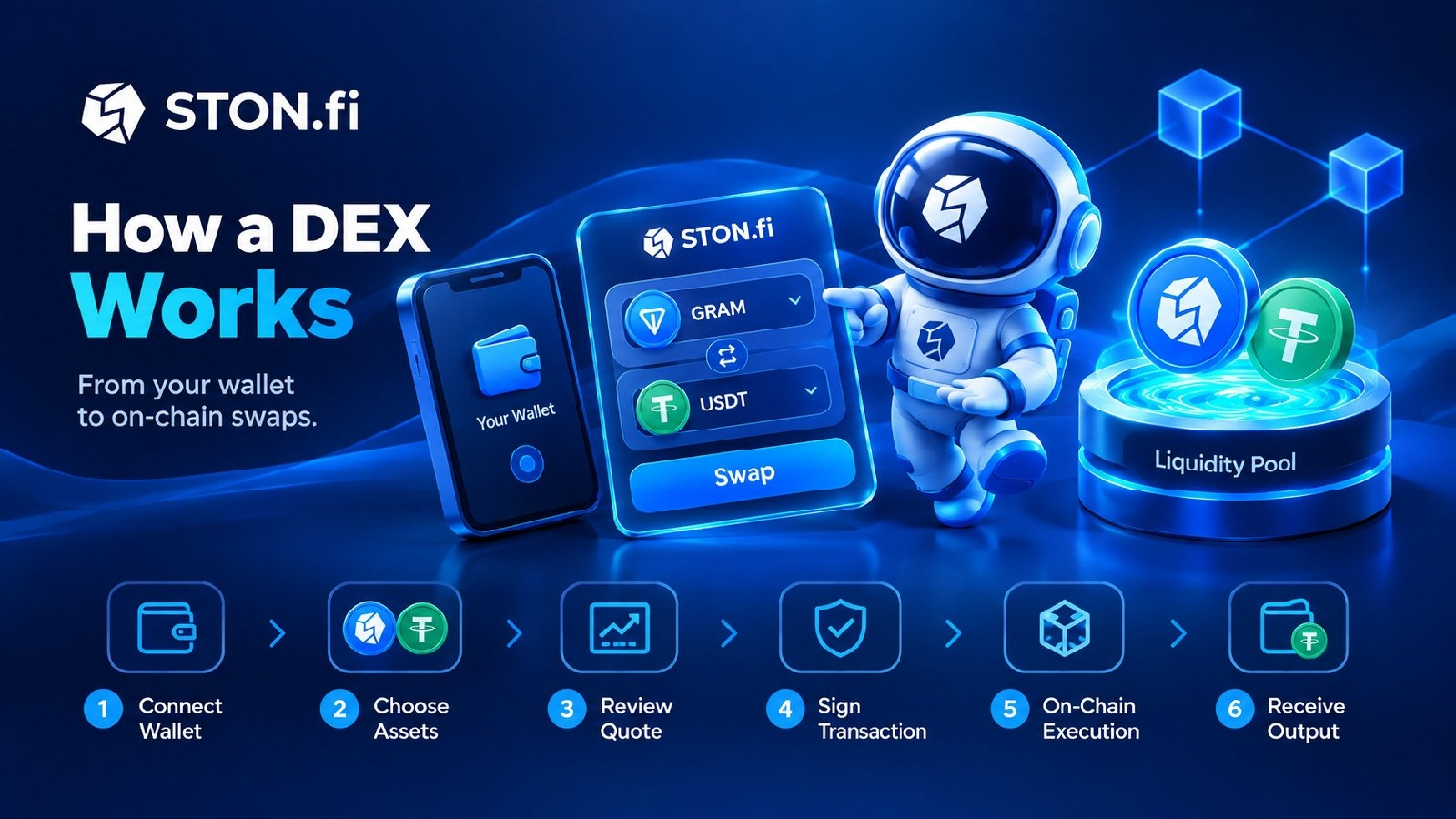
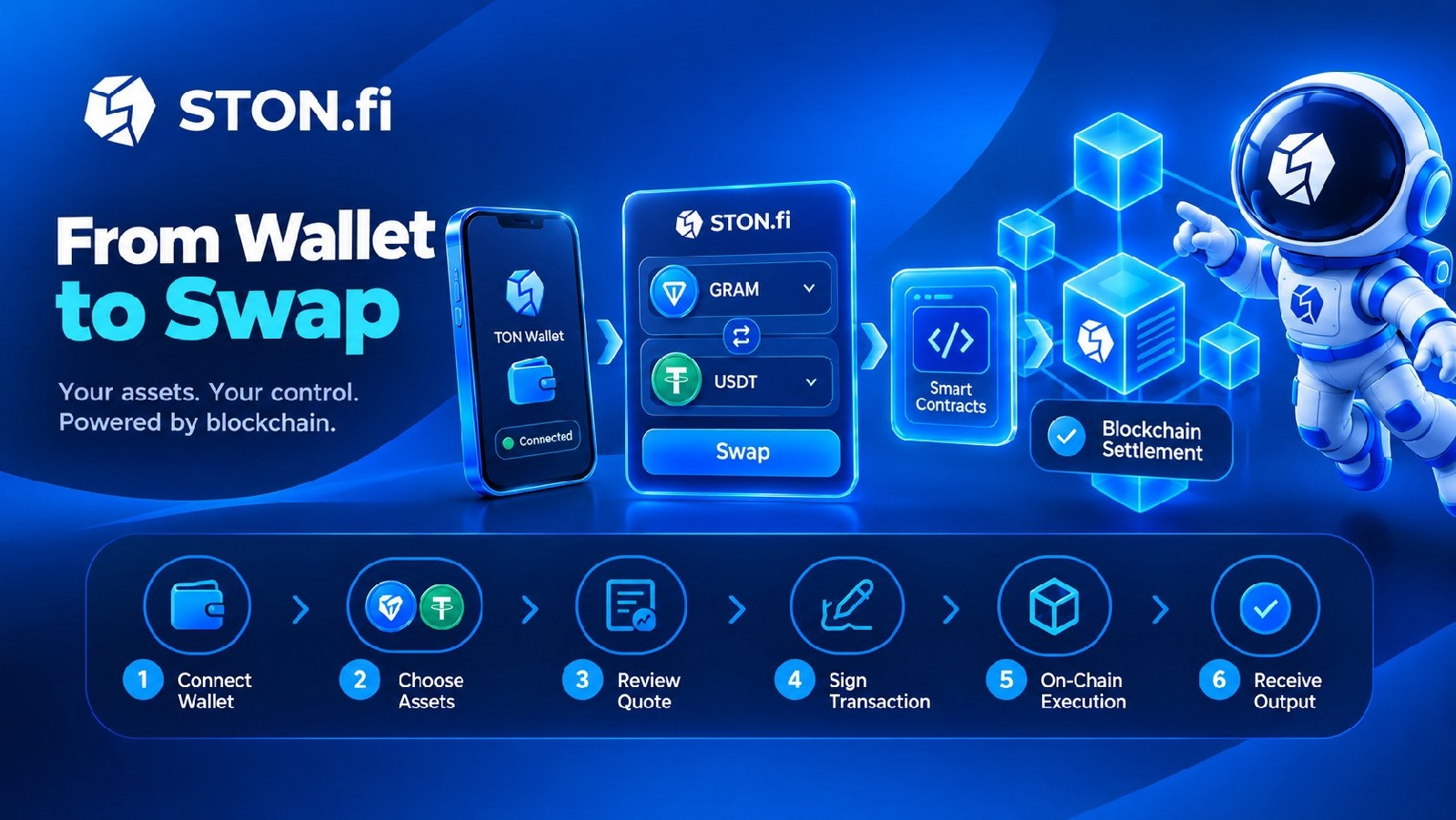
The user can connect a compatible wallet to a DEX such as STON.fi, select the two assets, review the quoted terms, and authorize the transaction. The protocol then processes the swap according to its smart-contract rules and the available liquidity.
The resulting assets are delivered to the user's wallet when the transaction completes successfully.
This process differs from depositing funds into a centralized trading account and relying on the exchange's internal systems to execute a trade.
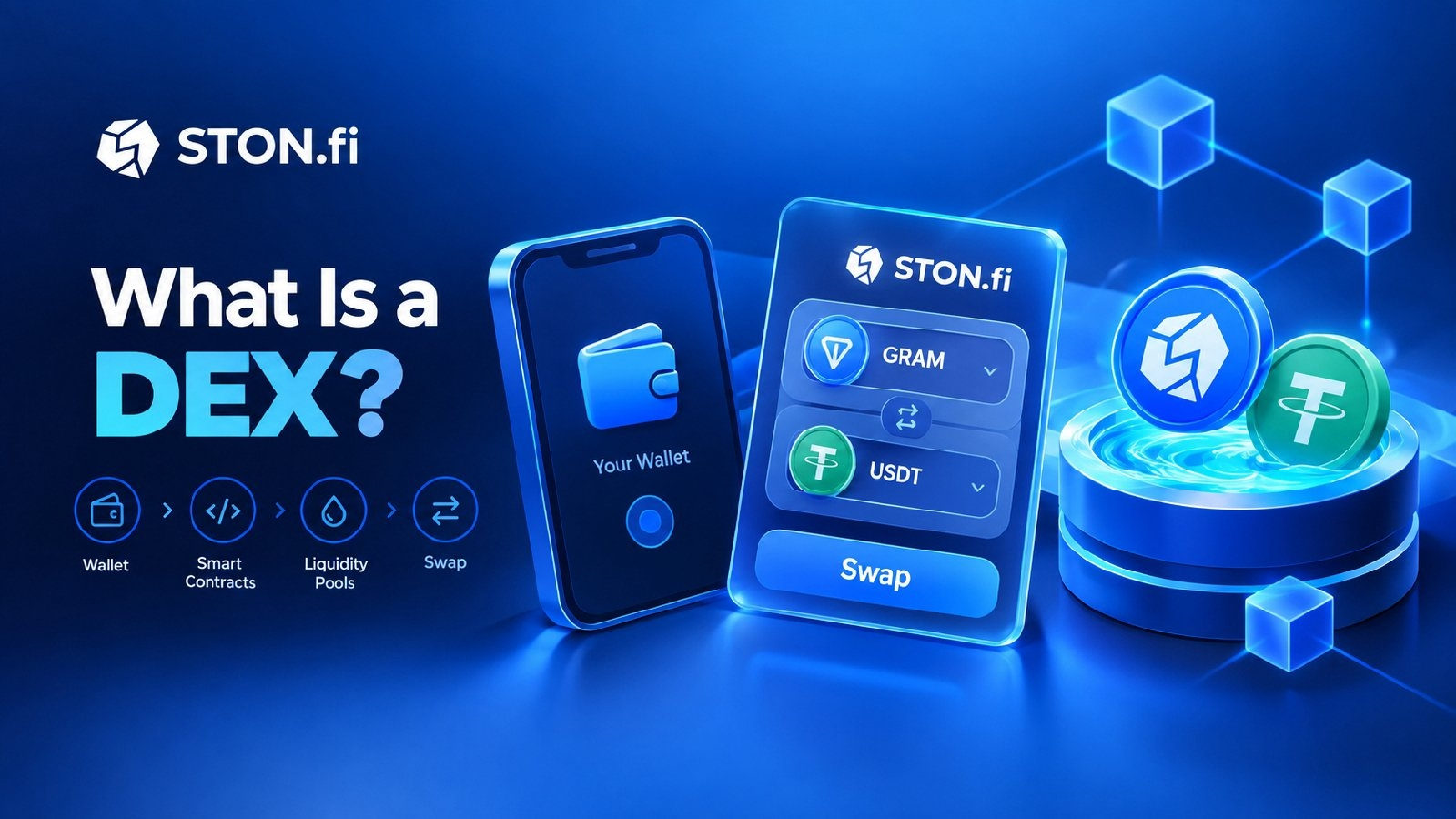
DEX vs. CEX: What is the difference?
A Centralized Exchange (CEX) is operated by a company that manages important parts of the trading service, such as customer accounts, asset custody, and order execution. A DEX typically delegates key trading functions to blockchain protocols and smart contracts.
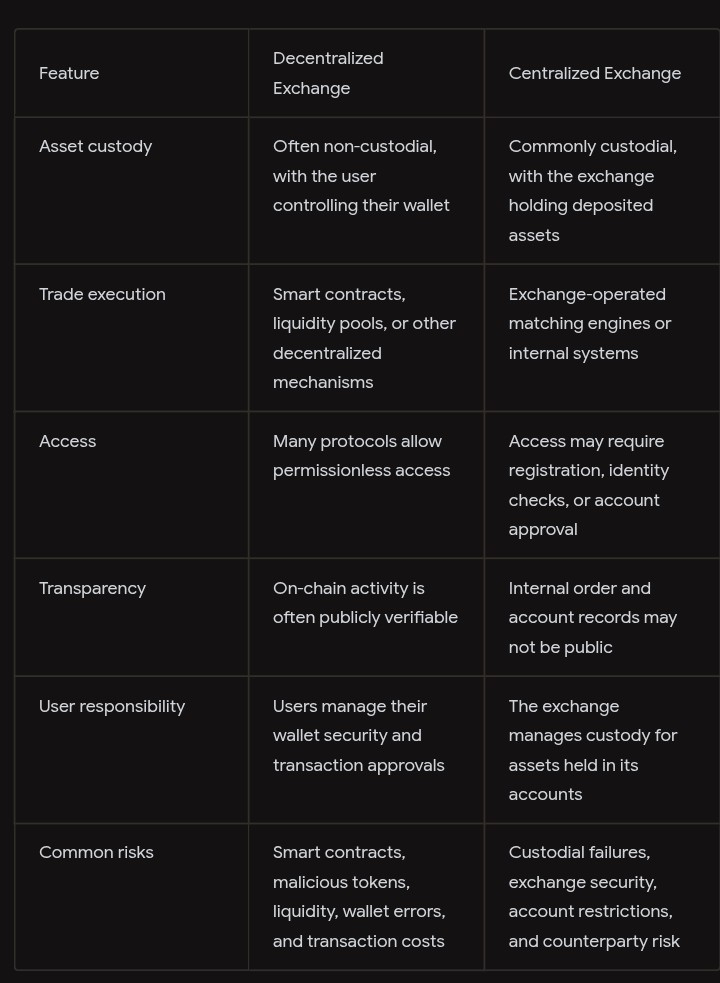
Neither model eliminates risk. The principal difference is where control, execution, custody, and responsibility are located.
A useful analogy is a marketplace. A centralized exchange resembles a managed marketplace where an operator oversees the trading infrastructure. A DEX resembles a market whose trading rules are enforced by software, with participants interacting through blockchain transactions.
The Major Benefits of DEXs
1. Greater control over assets
Non-custodial DEXs allow users to retain control of their wallet's private keys rather than depositing assets into an exchange account.
Users authorize transactions from their wallets and can generally continue managing their assets independently.
However, self-custody does not mean that assets can never leave the wallet or be exposed to risk. During a swap, tokens may be transferred to smart contracts, and previously granted token approvals may allow contracts to spend designated assets. Users must understand what they authorize.
2. Permissionless access
Many DEX protocols do not require users to create conventional exchange accounts before trading.
A compatible wallet, the required network assets, and access to the protocol may be sufficient to begin interacting with a permissionless DEX.
This can make decentralized trading accessible to people who face barriers when using traditional financial services, although network access, local laws, interface restrictions, and protocol-specific requirements still matter.
3. Transparency and verifiability
Transactions on public blockchains can often be inspected through blockchain explorers. Depending on the protocol, users may also be able to examine smart-contract code, pool reserves, liquidity positions, and transaction fees.
This transparency can help users investigate how a protocol functions.
Nevertheless, publicly available code is not necessarily easy to understand, and visibility does not guarantee that a smart contract is free from vulnerabilities.
4. Reduced dependence on centralized intermediaries
A DEX can execute trades according to predefined smart-contract rules instead of depending entirely on an exchange operator.
This can reduce reliance on a single custodian or company, although a protocol may still contain administrative privileges, centralized components, or dependencies that affect its operation.
5. Access to diverse digital assets
DEXs can support tokens that may not be available on conventional exchanges, provided that appropriate pools or other trading mechanisms exist.
This expands access to token markets but also introduces exposure to unfamiliar, illiquid, counterfeit, or malicious assets.
The ability to trade a token is not proof of its legitimacy or value.
The Core Components of a DEX
To understand how decentralized trading works, it is important to know the technology and market structures that make it possible.
Smart contracts
Smart contracts are programs deployed on a blockchain that execute according to predefined conditions.
Within a DEX, different contracts may manage token swaps, liquidity pools, fees, deposits, withdrawals, and farming rewards.
When a user submits a transaction, the relevant contracts process it according to their programmed rules and the conditions of the blockchain.
Smart contracts reduce the need for some intermediaries, but bugs, design weaknesses, compromised administrative privileges, and integration failures can expose assets to loss.
Liquidity pools
A liquidity pool is a collection of digital assets held by a smart contract or managed through a protocol's liquidity mechanism.
In an automated market maker system, traders exchange assets against the pool rather than necessarily waiting for another trader to submit a matching order.
Consider a pool containing Token A and Token B. A user can provide Token A and receive Token B, while the pool's available reserves and pricing mechanism determine the exchange rate.
Without sufficient liquidity, a pool may struggle to execute larger trades efficiently. With greater liquidity relative to a trade's size, execution can often have less price impact.
Automated Market Makers (AMMs)
An Automated Market Maker is a mechanism that determines trading prices algorithmically using liquidity and predefined mathematical rules.
One common AMM design uses the constant-product formula:
x \times y = k
Here:
represents the quantity of one asset in the pool.
represents the quantity of the other asset.
represents the pool's constant-product invariant, under the simplified model.
When a trader takes one asset from the pool and supplies the other, the relative reserves change. This changes the price available for subsequent trades.
The result is that larger trades relative to pool depth generally produce greater price impact.
Not every DEX uses this model. Some use order books, concentrated liquidity, stable-swap curves, or other mechanisms. Uniswap documents the constant-product approach, while Curve uses a StableSwap design intended to improve trading efficiency between assets expected to maintain similar values.
Liquidity Provider (LP) tokens or positions
In many liquidity-pool designs, providers receive a token or another representation of their position after supplying assets.
This representation may indicate their proportional claim on a pool's assets and accumulated value, according to the protocol's rules.
LP tokens can also be used in supported farming programs. However, not every DEX represents liquidity positions in the same way, and the rights associated with an LP token depend on the specific protocol.
DEX tokens
Some DEX ecosystems have tokens associated with governance, utility, staking, or rewards.
Their purposes differ between projects. A governance token may allow eligible holders to vote on proposals, while another token may be distributed as an incentive for participating in a farming program.
A DEX does not necessarily need its own token to facilitate swaps, and owning a protocol token does not automatically entitle someone to a share of trading revenue.
How Does a DEX Swap Work?
A token swap may appear simple on the screen, but several operations can occur behind the interface.
Consider a user exchanging Token A for Token B through an AMM-based DEX.
Step 1: Select the tokens. The user chooses the asset to exchange and the asset to receive.
Step 2: Request a quote. The DEX interface or connected routing system evaluates available liquidity, token reserves, and relevant trading paths.
Step 3: Calculate the expected output. The pricing mechanism determines how much Token B the user may receive, taking into account the input amount and applicable fees.
Step 4: Review execution terms. The interface may display the exchange rate, estimated output, price impact, slippage tolerance, network fee, and minimum amount to receive.
Step 5: Authorize the transaction. The user reviews the transaction in their wallet and signs or otherwise approves the required operation.
Step 6: Execute the swap. The blockchain processes the transaction, and the relevant contracts perform the permitted token transfers and pool updates.
Step 7: Receive the output. If the transaction succeeds, the output tokens are delivered to the user's wallet according to the protocol's rules.
Step 8: Verify the result. The user can check the wallet balance and inspect the transaction on a blockchain explorer.
A swap can fail, and the actual result may differ from the initial quote within the permitted execution parameters. Network congestion, liquidity changes, and transaction fees can also affect the outcome.
Important Trading Concepts: Slippage, Price Impact, and Fees
These terms are closely related, but they describe different things.
Price impact
Price impact is the change in a pool's price caused directly by the size of a trade relative to the available liquidity.
A small trade in a deep pool will often have less price impact than a large trade in a shallow pool.
For example, a trade representing a substantial portion of a pool's reserves can shift the asset ratio enough to result in a noticeably less favorable exchange rate.
Price slippage
Slippage refers to the difference between an expected trading price and the price at which a transaction actually executes.
The market or pool conditions may change between the time a quote is generated and the time a transaction is processed.
A slippage tolerance defines how much variation the transaction is allowed to accept under the relevant protocol's execution rules. Too restrictive a setting may cause a transaction to fail; too permissive a setting may allow an unexpectedly poor result.
Trading and network fees
DEX users may encounter several costs:
Trading fees: Charges associated with the swap, some of which may go to liquidity providers.
Network fees: Payments required to process blockchain transactions.
Routing or service fees: Additional charges that may apply through an interface or aggregation service.
The amounts and structure vary by protocol, blockchain, pool, and transaction. A displayed quote should be reviewed in its full context rather than judged by the headline exchange rate alone.
Examples of Popular DEX Protocols
Different DEXs serve different blockchain ecosystems and trading requirements.

Uniswap
Uniswap is an AMM protocol originating on Ethereum. Its protocol family allows users to swap supported tokens and supply liquidity, with the available pool design depending on the version.
Website: uniswap.org

PancakeSwap
PancakeSwap is a DEX ecosystem that originated on BNB Chain. Its services include token swaps and, where supported, liquidity provision and other DeFi features.
Website: pancakeswap.finance

Curve Finance
Curve is known for its StableSwap mechanism, which is designed to facilitate efficient swaps between assets expected to have similar values, such as certain stablecoins and related representations of crypto assets.
Website: curve.finance

STON.fi
STON.fi is an AMM-based DEX on The Open Network (TON). Its protocol supports token swaps and liquidity provision, with additional features such as farming available through supported products and pools.
Website: ston.fi
Raydium
Raydium operates in the Solana ecosystem, providing token trading and liquidity-related functionality for supported assets and markets.
Website: raydium.io

Balancer
Balancer is known for programmable liquidity pools that can use customized asset weights and pool configurations. Its design differs from the basic two-token, constant-product AMM model.
Website: balancer.fi
These protocols illustrate that decentralized exchanges are not all built identically. They differ in blockchain compatibility, pool design, fees, supported assets, governance, and the products available to users.
How to Use a DEX: A Beginner's Guide
Using a DEX requires careful wallet management and an understanding of the transaction being authorized.
Step 1: Set up a compatible wallet
Choose a wallet that supports the blockchain on which the DEX operates.
For example, users interacting with STON.fi need a TON-compatible wallet. The wallet provides an interface for managing assets and authorizing transactions.
Secure the wallet's recovery phrase and private keys. Never share them with a DEX interface, support agent, or stranger.
Step 2: Fund the wallet
Obtain the relevant tokens through a legitimate and supported method, then transfer them to the correct wallet address.
Keep in mind that you may also need the blockchain's native asset to pay network transaction fees. The required amount depends on the network and the operations involved.
Step 3: Access the official DEX interface
Verify the official website or application address before connecting your wallet.
A legitimate-looking interface is not proof of authenticity. Fake websites, impersonation accounts, and malicious links can imitate popular DeFi protocols.
Step 4: Connect the wallet
Select the wallet connection option and review the request.
Connecting a wallet is not always the same as approving a token transfer or signing a transaction. Read each request carefully and understand what permission is being granted.
Step 5: Select the input and output tokens
Choose the asset you want to exchange and the asset you want to receive.
Verify the token's contract or asset identifier when appropriate, particularly when dealing with unfamiliar tokens that may share similar names or symbols.
Step 6: Review the swap
Before confirming, examine the expected output, fees, price impact, slippage settings, and minimum amount to receive when displayed.
An attractive quoted price may not represent the complete cost of the transaction.
Step 7: Confirm and verify
Review the transaction details in your wallet before signing. After submission, confirm that the transaction succeeded and that the expected assets arrived.
For people learning through STON.fi, the Stonboarding tutorial referenced in the supplied material provides a guided introduction to making a first swap through its Telegram bot: Start Stonboarding.
Tutorials can help familiarize new users with the process, but real-token transactions still involve genuine financial and security risks.
How Can Users Earn on a DEX?
DEXs provide trading infrastructure, and some also offer mechanisms through which participants can earn fees or rewards. The most common opportunities are liquidity provision, yield farming, staking-related programs, and arbitrage.
These activities are different from one another, and none guarantees a positive return.
1. Liquidity provision
Liquidity provision involves depositing assets into a supported liquidity pool so that traders can exchange against the pool.
In return, liquidity providers may receive a portion of the trading fees generated by swaps involving that pool.
Consider a hypothetical pool containing Token A and Token B. Several users contribute liquidity. When traders use the pool, eligible providers may receive fees in proportion to their share of the pool, subject to the protocol's rules.
The potential earnings depend on factors such as:
The trading volume generated by the pool.
The fee rate and how fees are distributed.
The provider's share of eligible liquidity.
Changes in the prices and quantities of the deposited assets.
Any additional costs or applicable protocol rules.
Providing more liquidity does not automatically produce a better overall return. A large deposit in a pool with limited trading activity may generate modest fees, while changes in token prices can affect the value of the position.
2. Yield farming
Yield farming involves placing eligible assets or liquidity-position tokens into a protocol's reward mechanism to receive additional incentives.
For example, a DEX may allow a user who has supplied liquidity to deposit the resulting LP tokens into a supported farming contract.
The user may then qualify for rewards according to the program's rules, which could depend on the amount deposited, participation period, reward emissions, or other conditions.
Yield farming can combine multiple sources of return, such as trading fees and token incentives. However, those sources should not be confused with guaranteed income.
Reward rates can change, token prices can decline, programs can end, and the additional smart contract introduces its own risk.
3. Staking and protocol rewards
Some DeFi applications allow users to stake eligible tokens in exchange for rewards or other protocol-specific benefits.
Depending on the mechanism, staking may involve locking tokens, delegating them, participating in governance, or depositing assets into a dedicated contract.
Staking is not identical to liquidity provision. A staking program may not supply tokens to a trading pool, and its reward structure can be entirely different.
Before participating, users should understand what the assets are used for, how rewards are calculated, whether withdrawals are restricted, and which risks apply.
4. Arbitrage trading
Arbitrage involves attempting to benefit from price differences for the same or economically equivalent assets across trading venues.
Suppose a token trades at one price on DEX A and a higher price on DEX B. A trader may attempt to purchase it on the first venue and sell it on the second.
However, a visible price difference does not necessarily mean that a profitable opportunity exists.
Trading fees, network costs, slippage, liquidity limitations, execution delays, and changes in market prices can reduce or eliminate the difference before both trades finish.
Arbitrage is competitive and can be difficult to execute profitably, especially when automated trading systems are involved.
Understanding APY: What Does It Actually Mean?
APY stands for Annual Percentage Yield. It expresses an annualized rate of return that accounts for compounding under the assumptions used in its calculation.
Compounding means that previously earned returns are reinvested, potentially allowing subsequent returns to accrue on a larger balance.
For example, a hypothetical position earning a constant 10% APY would grow from 1,000 units to approximately 1,100 units after one year, assuming the stated APY is realized, compounding conditions are met, and no additional costs or losses apply.
That is an illustration of the mathematics, not a prediction of DeFi returns.
In practice, a displayed DEX APY may be estimated from recent activity, projected reward emissions, or other assumptions. The rate may change substantially during the participation period.
APY is not a guarantee of profit. It may not capture the full effect of token-price changes, impermanent loss, smart-contract exploits, withdrawal costs, or other factors that influence a user's final result.
It is also useful to distinguish APY from APR. APR is an annualized rate that does not account for compounding in the same way that APY does.
Impermanent Loss: A Key Liquidity-Providing Risk
Impermanent loss occurs when the value of assets held in a liquidity pool changes relative to the value those assets would have had if they had simply been held separately.
In a typical two-asset AMM pool, trading changes the quantities of the assets held by the pool. When the market price of one token changes relative to the other, the pool's composition may differ from the provider's original deposit.
As a result, the liquidity position can be worth less than the equivalent holdings outside the pool, even if the position itself has increased in value.
A simplified example
Imagine someone deposits equal values of Token A and Token B into a liquidity pool.
Later, the market price of Token A rises substantially relative to Token B. Arbitrage trading and the AMM's pricing mechanism can change the pool's asset proportions.
The liquidity provider may end up with less of Token A and more of Token B than they would have held without providing liquidity.
If the provider's resulting position is worth less than simply holding the original quantities of Token A and Token B, the difference is impermanent loss.
The comparison is about relative value, not necessarily whether the position has lost money in absolute terms. The provider may still have a positive overall return after accounting for fees and incentives, or may experience a net loss.
The term impermanent can also be misleading: the difference is not guaranteed to disappear. It can change as market prices move, and the loss relative to holding remains relevant if the provider withdraws at a disadvantageous price relationship.
What affects impermanent loss?
Important factors include the magnitude of the relative price change between pooled assets, the design of the AMM, the liquidity position's configuration, and the price relationship at the time of withdrawal.
Trading fees and farming rewards may offset some of the loss, but they may not be sufficient to do so.
This is why an attractive advertised APY should never be considered in isolation from the underlying pool risks.
Other Risks and Challenges of Using DEXs
Decentralized exchanges introduce important capabilities, but users should understand the limitations before interacting with them.
Smart-contract vulnerabilities
A bug or exploit in a swap contract, liquidity pool, farming contract, or connected protocol can lead to loss of funds.
A security audit can provide useful evidence about a contract's review, but it is not a guarantee that the code is free from vulnerabilities.
Malicious tokens and scams
Permissionless token listings can make it easier for both legitimate projects and malicious actors to introduce assets.
Some tokens may imitate established projects, impose restrictive transfer rules, or expose users to unsafe contract interactions.
Users should independently verify token identity and avoid trusting an asset simply because it appears in a DEX interface.
Wallet and approval risks
Users can lose access to assets by exposing their recovery phrase, signing malicious transactions, or granting unsafe token permissions.
A non-custodial wallet gives users more direct control, but it also places greater responsibility on them to review transactions and protect their credentials.
Liquidity and execution risks
A pool may not have enough liquidity to handle a large trade efficiently. Low liquidity can result in high price impact, substantial slippage, or a failed transaction.
Network congestion and transaction costs
Blockchain conditions affect transaction processing. Fees may change, transactions may be delayed, and submitted operations may fail depending on the network and protocol.
Volatility and token-price risk
The market value of a token can change substantially, regardless of whether it is traded on a DEX or a centralized exchange.
Providing liquidity, staking tokens, or earning rewards does not eliminate this risk.
Governance and protocol dependency
Some protocols depend on governance decisions, administrative keys, upgrade mechanisms, or external services. These dependencies may affect how the protocol operates or how its risk profile changes over time.
A protocol described as decentralized may still have important centralization or operational considerations.
Multi-Chain DEXs vs. Cross-Chain DEXs
As blockchain ecosystems grow, users increasingly encounter assets and applications spread across different networks.
This introduces two related concepts: multi-chain and cross-chain trading.
What is a multi-chain DEX?
A multi-chain DEX or DEX ecosystem operates on more than one blockchain.
For example, an exchange protocol may make its trading service available on several supported networks. Users can trade the assets available on the particular network they are using.
However, the presence of the same protocol on multiple chains does not necessarily mean that users can directly exchange assets across those chains in a single operation.
A user may still have to move funds between networks separately if the application does not support cross-chain transactions.
What is a cross-chain DEX or swap service?
Cross-chain trading allows users to exchange assets that originate on different blockchain networks through a coordinated process.
Depending on the implementation, this may involve bridges, smart contracts deployed on multiple chains, hash-time-locked contracts, liquidity providers, solvers, or request-for-quote (RFQ) systems.
The objective is to simplify the process of moving value between ecosystems and reduce the need for users to manage every intermediate step themselves.
However, cross-chain does not automatically mean bridge-free, fully trustless, or risk-free. Different architectures rely on different security assumptions, liquidity sources, and execution mechanisms. Those differences matter when assessing whether a service is appropriate for a given use case.
Why does cross-chain infrastructure matter?
Without effective interoperability, liquidity and assets can remain fragmented across blockchain networks.
A user may find an asset or opportunity on one network but hold the tokens needed to interact with it on another. Moving between the two environments may require extra transactions, fees, and technical knowledge.
Cross-chain infrastructure aims to simplify this experience by coordinating the necessary operations and presenting a more unified trading process.
In the TON ecosystem, STON.fi is an example of a DEX protocol, while Omniston provides a liquidity-aggregation layer that can collect quotes from connected liquidity sources and resolvers within supported routes. Aggregation and cross-chain execution are related but distinct capabilities; the exact networks, routes, and mechanisms available depend on the service and its current implementation.
The broader goal is to make blockchain applications easier to use across ecosystems without requiring every user to understand the full technical process behind each transaction.
A Practical Checklist Before Using a DEX
Before initiating a transaction or participating in a yield program, users should understand the following:
Asset identity: Is the token the intended asset, and have its details been verified?
Wallet compatibility: Does the wallet support the relevant network and token standard?
Execution terms: What are the quoted output, fees, slippage tolerance, and minimum amount to receive?
Liquidity: Is the pool sufficiently liquid for the size of the transaction?
Permissions: What is the wallet being asked to sign or approve?
Contract risk: What is known about the protocol's code, audits, and administrative controls?
Yield assumptions: Is the displayed APY variable, and what generates the reported rewards?
Liquidity risk: Could price divergence or other market changes reduce the value of a position?
Cross-chain assumptions: Does the route use a bridge, external solvers, or other components with additional trust or security requirements?
Transaction verification: Can the outcome be confirmed through the wallet and a relevant blockchain explorer?
These questions are useful because they focus attention on how a transaction works, not simply how attractive its advertised price or return appears.
Conclusion: Why DEXs Matter to the DeFi Ecosystem
Decentralized exchanges are a foundational part of decentralized finance. They enable users to exchange digital assets through blockchain-based mechanisms and provide infrastructure for other activities, including liquidity provision, yield farming, and certain staking and reward programs.
Their importance extends beyond individual trades. Liquidity pools, AMMs, smart contracts, routing systems, and interoperability tools form part of the infrastructure that allows decentralized applications to operate and connect.
At the same time, using a DEX requires an understanding of the trade-offs. Self-custody creates responsibility, yield involves risk, and technical transparency does not guarantee that a protocol is secure.
The most valuable starting point is education: understand the wallet, identify the protocol, inspect the transaction, learn how fees and liquidity affect execution, and recognize the difference between potential returns and guaranteed outcomes.
As blockchain ecosystems continue to develop, DEXs and cross-chain infrastructure may make decentralized applications more accessible. Their long-term value, however, will depend not only on innovation but also on reliable execution, robust security, meaningful transparency, and informed participation.
Explore more on STON.FI