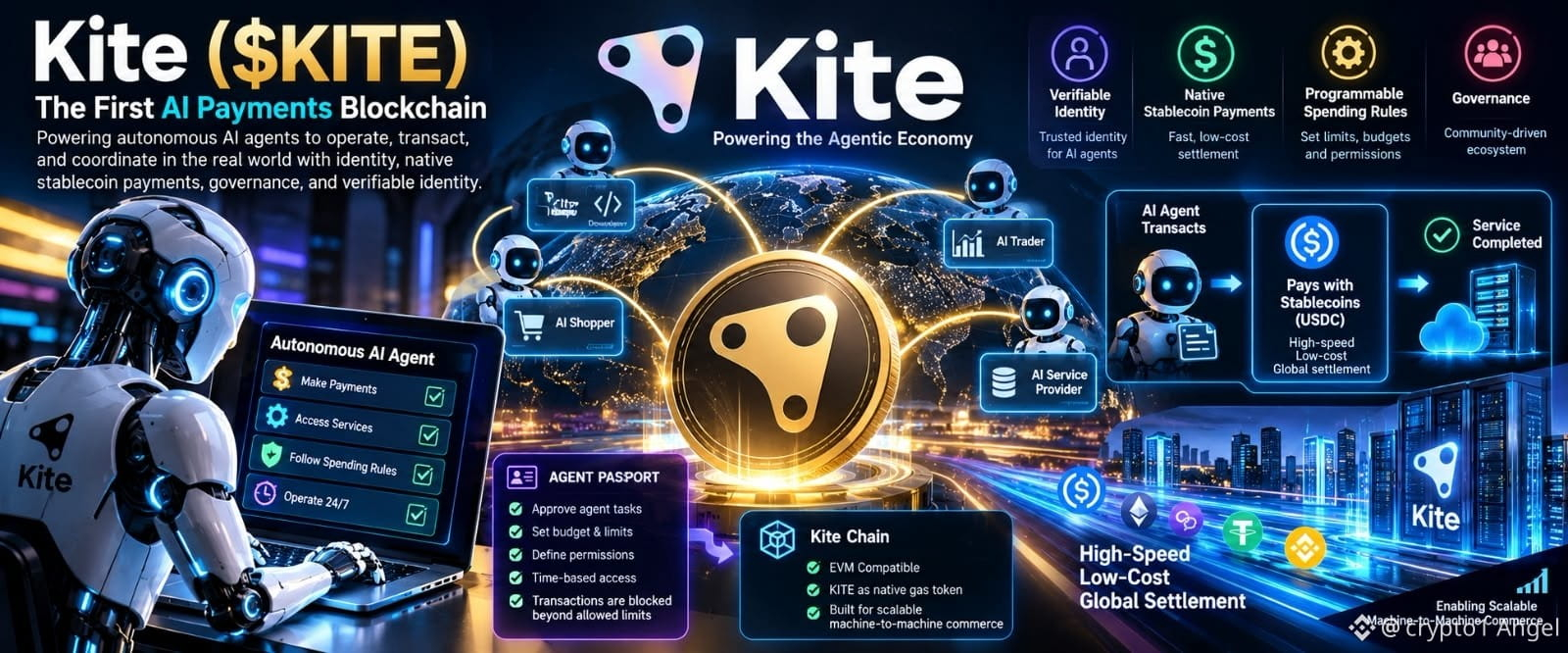
@KITE AI 中文 $KITE #KiteBBW The most interesting thing about Kite ($KITE ) isn’t that AI agents can make payments.
It’s how you let them spend money without giving them the keys to everything.
Think about it. An agent that needs human approval for every tiny API payment isn’t truly autonomous. But an agent with unrestricted access to your wallet is a risk waiting to happen.
Kite is trying to solve that uncomfortable middle ground.
What caught my attention is the structure behind Agent Passport.
Authority is separated into three layers: the user, the agent, and a temporary session. Before the agent gets to spend, the user can approve a task with a passkey and define its budget, per-transaction limit, expiry, and permitted assets.
Push beyond those boundaries, and the payment is supposed to be blocked.
That’s a meaningful distinction. Telling an AI to behave is one thing. Enforcing what it can actually spend is another.
Kite Chain is already live, with EVM compatibility and KITE as its native gas token. Meanwhile, agent-service payments use stablecoins such as USDC. Passport connects identity, delegated permissions, paid API access through x402, and an activity trail that makes spending easier to inspect.
But there’s another detail crypto natives should pay attention to.
More agent payments do not automatically mean more value for $KITE .
KITE has roles in network access, module liquidity, staking, and governance. The tokenomics also describe a mechanism intended to connect service commissions with KITE demand.
That’s the part I’d watch closely. Does real usage create sustained reasons to hold, lock, or stake the token? Or does most of the economic activity remain in stablecoins and at the service-provider level?
The distinction matters. A useful product and a valuable token are two different things, even when they belong to the same ecosystem.
For Kite, I’m more interested in repeat paid transactions, genuine agent activity, and measurable token value capture than another headline about transaction speed.