
BitTorrent has completed its first quarterly $BTT Buyback & Burn for Q3 2026, marking a milestone in its evolving token economy.
This is more than a token burn. It connects revenue from real decentralized services to a transparent mechanism designed to reduce token supply.
𝗛𝗼𝘄 𝗱𝗼𝗲𝘀 𝗶𝘁 𝘄𝗼𝗿𝗸?
Real business revenue → $BTT buyback → Token aggregation → Permanent burn → Public reporting.
📊 𝗣𝗵𝗮𝘀𝗲 𝟭 𝗮𝘁 𝗮 𝗴𝗹𝗮𝗻𝗰𝗲:
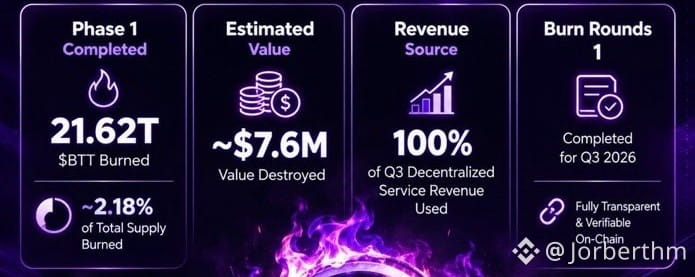
◽️ $BTT burned: 21,621,611,570,729.6
◽️ Estimated value: ~$7.6 million
◽️ Total supply removed: ~2.18%
◽️ Revenue allocation: 100% of Q3 decentralized-service revenue, according to the announcement.
The burn is reportedly complete, with transaction records available for on-chain verification.
𝗪𝗵𝗲𝗿𝗲 𝗱𝗼𝗲𝘀 𝘁𝗵𝗲 𝗺𝗼𝗻𝗲𝘆 𝗰𝗼𝗺𝗲 𝗳𝗿𝗼𝗺?
Potential revenue sources include:
♤ Download acceleration and in-app revenue.
♤ Decentralized AI inference and compute leasing through BTT InferGrid.
♤ BTTC on-chain transaction gas fees.
The principle is simple: services generate revenue, allocated revenue funds buybacks, and repurchased tokens are permanently burned.
𝗛𝗼𝘄 𝘁𝗵𝗲 𝗽𝗿𝗼𝗰𝗲𝘀𝘀 𝘄𝗼𝗿𝗸𝘀:
01 — Revenue assessment: Revenue from the previous period is assessed to establish available funding.
02 — $BTT buybacks: Allocated revenue is used to repurchase tokens from the market.
03 — Token aggregation: Repurchased tokens are consolidated before the burn.
04 — Permanent burning: Tokens are sent to a designated burn address, removing them from ordinary circulation.
05 — Public reporting: Burn amounts, estimated values and transaction records provide a basis for verification.
𝗪𝗵𝘆 𝗱𝗼𝗲𝘀 𝟮𝟭.𝟲𝟮 𝘁𝗿𝗶𝗹𝗹𝗶𝗼𝗻 $𝗕𝗧𝗧 𝗺𝗮𝘁𝘁𝗲𝗿?
A permanent burn reduces the tokens available for ordinary use and trading. Revenue-funded buybacks can connect ecosystem activity with supply reduction.
However, burns alone do not guarantee price appreciation. Demand, liquidity, adoption and market conditions still matter. Long-term success depends on sustainable revenue and consistent execution.
𝗧𝗵𝗲 𝗯𝗶𝗴𝗴𝗲𝗿 𝗽𝗶𝗰𝘁𝘂𝗿𝗲: 𝗔 𝘂𝗻𝗶𝗳𝗶𝗲𝗱 𝗕𝗶𝘁𝗧𝗼𝗿𝗿𝗲𝗻𝘁 𝗲𝗰𝗼𝘀𝘆𝘀𝘁𝗲𝗺
BitTorrent’s brand upgrade brings its decentralized services under one primary brand, connecting content distribution, download acceleration, decentralized AI and compute services, and BTTC infrastructure.
A unified ecosystem could improve user understanding and create opportunities for different business lines to contribute to revenue.
𝗪𝗵𝗮𝘁 𝘁𝗼 𝘄𝗮𝘁𝗰𝗵 𝗻𝗲𝘅𝘁?
𝗪𝗵𝗮𝘁 𝘀𝗵𝗼𝘂𝗹𝗱 𝘄𝗲 𝘄𝗮𝘁𝗰𝗵 𝗻𝗲𝘅𝘁?
◽️ Revenue generated by decentralized services.
◽️The amount allocated to future buybacks.
◽️The volume of $BTT repurchased and burned.
◽️The estimated value of each burn.
◽️Public reports and verifiable on-chain transactions.
These metrics will help the community evaluate the program’s transparency, consistency and sustainability over time.
𝗧𝗵𝗲 𝗯𝗼𝘁𝘁𝗼𝗺 𝗹𝗶𝗻𝗲
Phase 1 establishes a starting point: 21.62 trillion $BTT reportedly burned, worth an estimated $7.6 million, representing approximately 2.18% of total supply.
The bigger story is the connection between service revenue, buybacks, permanent burns and public verification.
The next milestone is proving this model can be repeated as the ecosystem grows.
𝗥𝗲𝘃𝗲𝗻𝘂𝗲 → 𝗕𝘂𝘆𝗯𝗮𝗰𝗸 → 𝗕𝘂𝗿𝗻 → 𝗧𝗿𝗮𝗻𝘀𝗽𝗮𝗿𝗲𝗻𝗰𝘆 → 𝗥𝗲𝗽𝗲𝗮𝘁. ♻️
Phase 1 is complete. Now, the focus shifts to sustainable growth.
