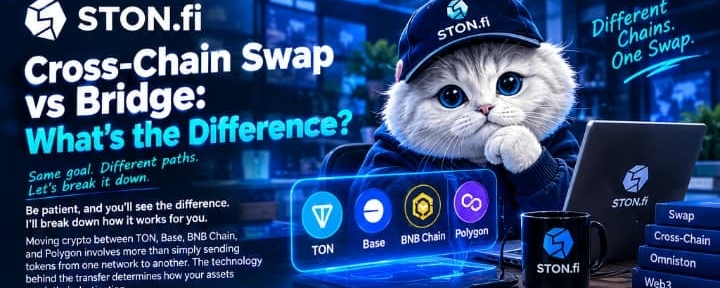

Be patient, and you’ll see the difference. I’ll break down how it works for you.
Moving crypto between TON, Base, BNB Chain, and Polygon involves more than simply sending tokens from one network to another. The technology behind the transfer determines how your assets reach their destination.
There are two common approaches: traditional bridges and resolver-based cross-chain swaps.
🌉 1. How Traditional Bridges Work
A traditional bridge typically locks or burns tokens on the source chain and releases or mints a corresponding representation on the destination chain.
For example, moving assets from TON to Base may involve receiving a bridged version of an asset rather than the original token on Base.
The main consideration is the bridge’s security model, including its smart contracts, validators, or other mechanisms used to secure cross-chain transfers.
⚡ 2. How Resolver-Based Cross-Chain Swaps Work
STON.fi takes a different approach through Omniston, its cross-chain execution layer.
Instead of relying on a traditional lock-and-mint bridge model, Omniston coordinates swaps through resolvers and linked Hashed Timelock Contracts (HTLCs).
Here’s the basic process:
1. You select the asset you want to send and the asset you want to receive.
2. A resolver provides a quote and coordinates the swap.
3. Your source asset and the destination asset are locked through linked contracts.
4. When the required cryptographic condition is fulfilled, both sides can settle.
5. If the swap does not complete within the required timeframe, the timelock mechanism enables refunds.
The goal is to let users receive the destination asset directly, without creating a wrapped representation as part of the swap.
🧩 Why Is TON Different?
Base, BNB Chain, and Polygon are EVM-compatible networks, meaning they share compatibility with Ethereum’s smart-contract environment.
TON uses a different architecture, with its own smart-contract languages and asynchronous messaging model.
That means connecting TON with EVM networks requires infrastructure that can coordinate different execution environments and transaction flows.
With Omniston, the linked HTLCs coordinate the cross-chain settlement, rather than relying on a single transaction executing atomically across both blockchains.
💰 What About Fees?
Regardless of the method, consider the full cost:
Source-chain network fees
Protocol or swap fees
Destination-chain network fees, where applicable
Always review the quote, expected output, and transaction conditions before confirming.
🔑 The Key Difference
Traditional bridge: Transfers value using a bridge mechanism that may involve wrapped assets.
Resolver-based cross-chain swap: Coordinates an exchange between assets on different chains through resolvers and linked contracts.
Both approaches have risks, so the underlying security design matters.
With @STONfi DEX Omniston aims to make cross-chain swaps simpler by coordinating the complex steps behind one user-facing flow.
Different chains. Different architectures. One coordinated swap experience.
#STONfi #Omniston #TON #DeFi #CrossChain