

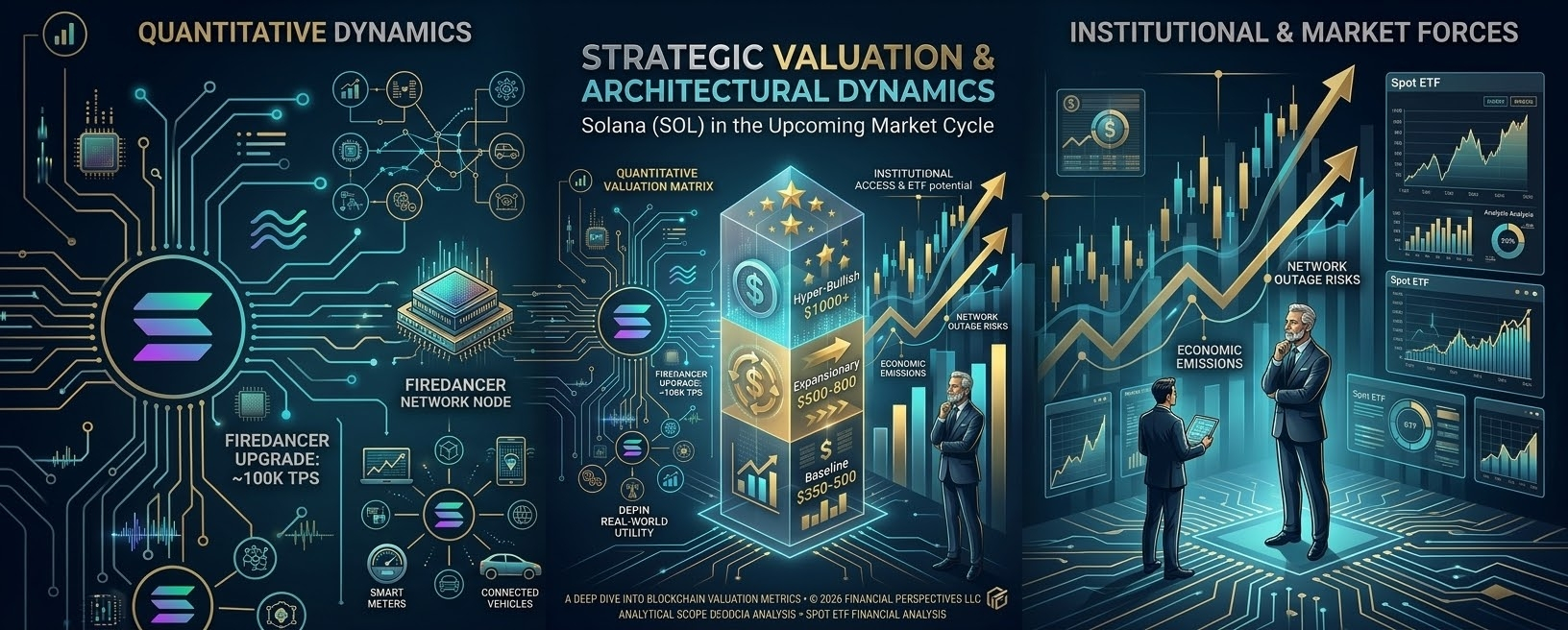

Solana (SOL) enters the current market cycle in a fundamentally transformed operational state. With full-scale validator client diversification via Jump Crypto’s Firedancer and the roll-out of spot ETFs across major global financial exchanges, SOL has crossed the threshold from an ultra-fast retail venue to an institutional-grade settlement layer. This analytical breakdown evaluates the mathematical models, technical upgrades, structural risks, and valuation scenarios defining SOL's current trajectory.
1. Architectural Upgrade Dynamics
Solana’s throughput capabilities and core network architecture have undergone significant execution updates:
┌──────────────────────────────────────┐
│ Firedancer C/C++ Engine │
│ (~100,000 TPS Target Capability) │
└──────────────────┬───────────────────┘
│
┌────────────────────────────┴────────────────────────────┐
▼ ▼
┌───────────────────────┐ ┌───────────────────────┐
│ Independent Consensus │ │ Memory Footprint │
│ (Mitigates Outages) │ │ Reduced ~307GB→182GB │
└───────────────────────┘ └───────────────────────┘
Jump Crypto's Firedancer Engine
Client Diversity & Resilience: Engineered completely in C/C++, Firedancer operates independently from Agave (formerly Labs). This double-client architecture resolves single-point-of-failure vulnerabilities, removing the main cause of previous network outages.
Raw Throughput: Firedancer unlocks hardware-level network efficiency, supporting a target capacity of roughly 100,000 transactions per second (TPS). Recent updates reduced core memory utilization from ~307 GB to ~182 GB, enabling cost-effective node hosting.
Alpenglow Consensus Integration: Modern consensus efficiency gains are accelerating transaction finality to sub-second durations, drastically shortening block propagation delays across global nodes.
Expanding Real-World Utility (DePIN & RWA)
DePIN Network Dominance: High throughput and near-zero fees make Solana the primary settlement platform for physical infrastructure networks like Helium, Hivemapper, and Render.
Real-World Asset (RWA) Tokenization: Traditional finance issuers (e.g., Securitize, BlackRock) have expanded tokenized asset infrastructure onto Solana, bringing institutional equity and treasury access on-chain.
2. Quantitative Valuation Matrix
The multi-tiered price valuation framework accounts for network throughput, TVL trajectory, and capital access mechanisms:
Valuation TierPrice RangeTarget Market CapPrimary Drivers & CatalystsBaseline$350 – $500~$180B – $260BSteady institutional ETF accumulation, baseline DeFi TVL retention, and network uptime maintenance.Expansionary$500 – $800~$260B – $420BMass DePIN protocol migration, high-volume RWA trading, and sustained $5B+ daily DEX activity.Hyper-Bullish$1000+>$520BMainstream corporate treasury allocation, cross-border payment integration, and global spot ETF momentum.
3. Structural Risk Assessment & Execution Matrix
HIGH ┌─────────────────────────┬─────────────────────────┐
│ │ Network Outages / │
│ │ Client Desync │
RISK ├─────────────────────────┼─────────────────────────┤
LEVEL │ Economic Emissions & │ Macro Rate Tightening │
│ Staking Dilution │ & Capital Outflows │
LOW └─────────────────────────┴─────────────────────────┘
LOW HIGH
IMPACT LEVEL
Key Operational Risk Vectors
Consensus Mismatch Risk: Operating two distinct client codebases (Agave and Firedancer) creates a non-zero risk of consensus divergence, which could lead to network forks if client releases lag protocol upgrades.
Economic Emissions & Inflation: While staking yield rewards validators (~5.2% to 7%), ongoing supply emissions impact non-staked holdings during periods of cooling market activity.
Institutional Flow Volatility: Spot ETF products introduce institutional liquidity while exposing SOL to broader macroeconomic capital rotations and rate-decision volatility.
4. Strategic Outlook & Next Steps
Validator Migration Monitoring: Track the migration percentage of active validators adopting full Firedancer builds on mainnet.
On-Chain Yield & Staking Strategy: Non-staked holders should evaluate delegated staking channels to offset economic emissions.
Macro Catalyst Timing: Watch quarterly ETF net flow trends and RWA expansion metrics to identify shifts between baseline and expansionary valuation tiers.