




Most blockchains are designed to make transactions transparent. But what happens when AI agents, trading strategies, and sensitive user data need to remain private?
That’s where @Nillion stands out.
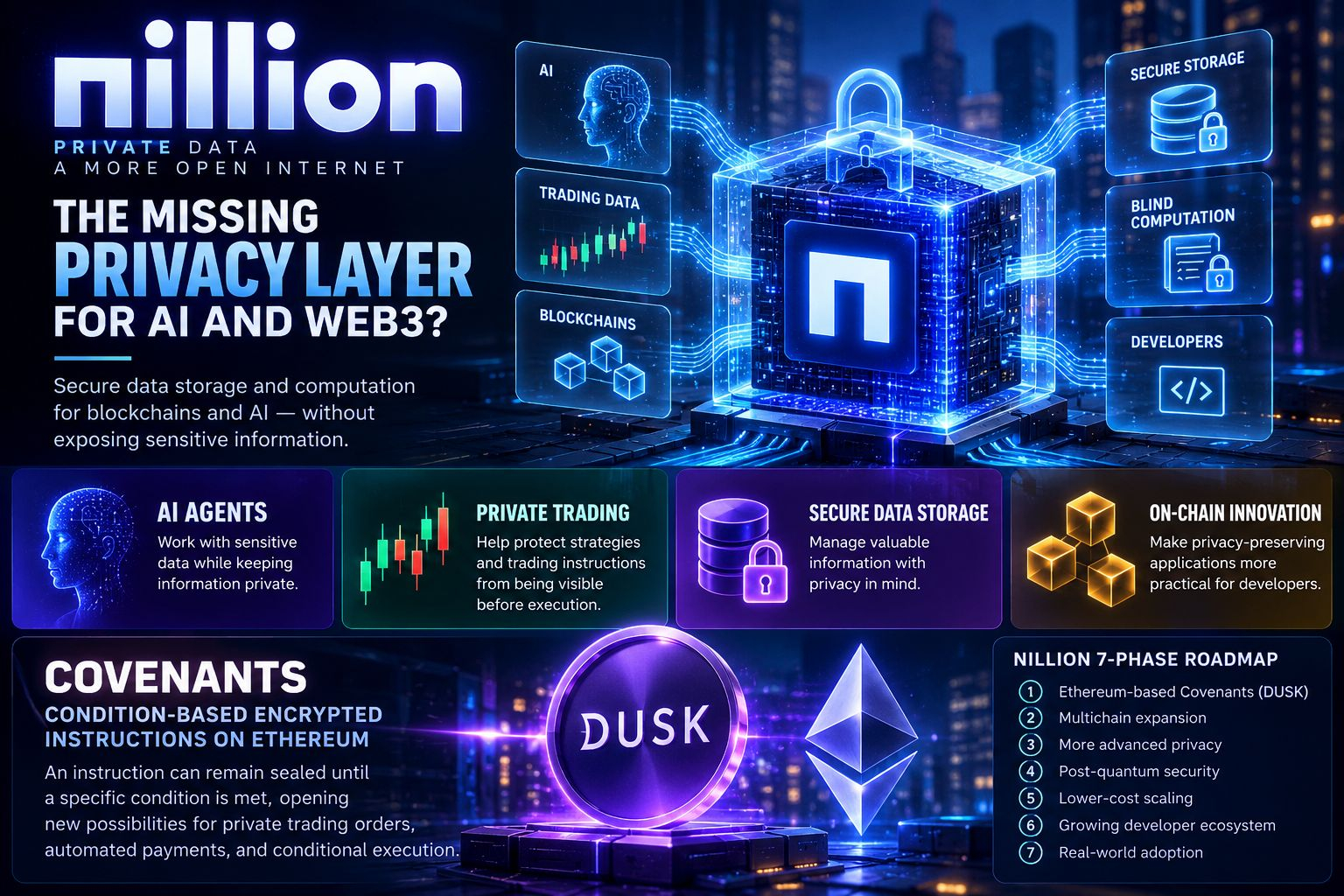
Nillion is building a decentralized Blind Computer that enables secure data storage and computation while protecting sensitive information. Instead of exposing raw data during processing, its technology uses privacy-enhancing techniques to help keep information confidential.
Why does this matter?
• Private AI: AI applications can work with sensitive information without unnecessarily exposing user data.
• Confidential trading: Financial applications could analyze strategies and data while reducing the risk of exposing valuable trading intelligence.
• Secure data infrastructure: Nillion supports privacy-focused storage and computation for applications that need more than ordinary blockchain transparency.
• Ethereum ecosystem: Nillion’s integration with Ethereum creates new opportunities for developers to combine on-chain coordination with private computation.
The next step is especially interesting: Covenants and Dusk. Nillion’s roadmap describes Covenants as instructions that remain sealed until specified conditions are met, with Dusk establishing this functionality on Ethereum.
Imagine AI agents and blockchain applications that can execute conditional instructions without revealing sensitive details too early. That could open the door to new forms of automated, privacy-aware coordination.
The bigger picture is simple: blockchains made digital transactions programmable. Nillion is working to make sensitive computation private.
Privacy may become a critical part of the next generation of AI and Web3 infrastructure.
Do you think confidential computation will become essential for AI agents and DeFi, or will transparent execution remain the priority?