


The agreement signed between Italy and the European Commission on October 16, 2026 seeks to ease energy expenses. However, would lower energy cost help Bitcoin mining to turn a profit in Italy?
The deal eases costs but sets no numbers yet
As reported by ANSA, Italy and the EU reached an agreement on elaborating provisions included in the Energy Bills Decree (Decree-Law 21/2022) whose goal is to “mitigating the impact of energy costs” and “preserving a level playing field within the internal market and minimizing distortions.”
The information regarding tariffs, eligibility requirements, and savings has not been provided. There is no mention of any provisions directly aimed at miners.
What a megawatt-hour costs in Italy right now
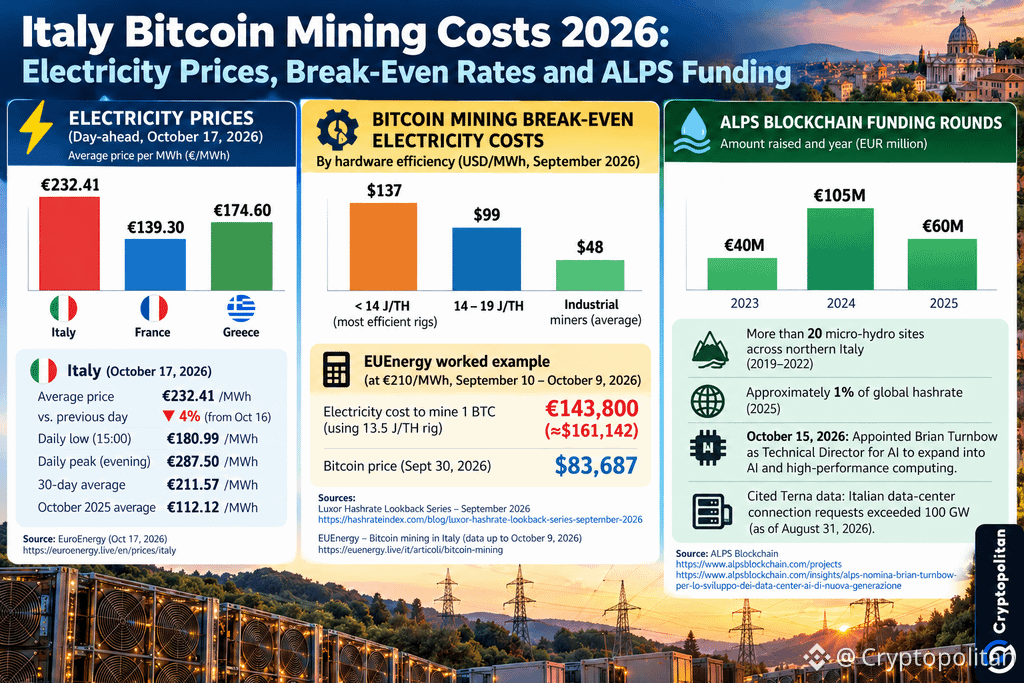
The day-ahead numbers released by EuroEnergy on October 17, 2026, indicate that Italy’s price of €232.41/MWh is four percent lower than October 16’s price. The energy cost in France was €139.30/MWh, while Greece’s cost was €174.60.
The day-ahead number for Italy’s energy prices ranged from €180.99 to €287.50, while the thirty day moving average was €211.57, compared to the average price of €112.12 in October 2025.
According to EUEnergy’s calculations, the average electricity price across six different Italian zones was approximately €210/MWh over the period between September 10 and October 9, exclusive of electricity distribution fees, taxes, as well as margins imposed by electric power suppliers. These are wholesale prices, not miners’ contracted rates.
The break-even math is unforgiving
During its review in September 2026, Luxor revealed that hashprice was at the level of $39.92 per PH/s/day at the end of the month. Hashprice is the number indicating how much miners are earning based on their computing power.
According to the report, network difficulty was at 132.76 trillion as of the end of September, and the seven days average of the hashrate reached 975 EH/s. The hashrate value approached 999 EH/s on October 8.
The figures indicate that there is minimal opportunity for high-priced electricity. According to Luxor, break-even power costs were established at $137 per MWh for rigs below 14 J/TH, and $99 per MWh for those rated at 14–19 J/TH. For comparison, the average cost of electricity for industrial mining firms is around $48 per MWh.
To get a better picture of the situation in Italy, we can refer to the Italian electricity market average price, which was €232.41 per MWh (approximately $261.53 at ECB exchange rate on October 16). That puts Italian electricity well above both break-even thresholds.
The difference is even more stark in EUEnergy’s evaluation. According to the report published on October 10, the average price of electricity over a 30-day period in Italy was €210 (about $235.33 at the ECB exchange rate on October 9). At that average price, using the example of a mining device with total measurement capacity of 13.5 J/TH, the average electricity cost incurred when mining a bitcoin is €143,800 ($161,142).
According to Luxor data, Bitcoin price for September 30 was $83,687. While different dates are used for calculations, the values for electricity expenses are almost double those proposed for Bitcoin price, not counting other operational costs. That raises a practical question: how can miners operate in a country where wholesale power costs so much?
How ALPS works around Italy’s high electricity costs
One potential solution is provided by ALPS, an Italian mining company that was founded in 2018 in Trento. The firm was able to establish more than 20 micro-hydropower mining sites throughout northern Italy between 2019 and 2022. By locating equipment alongside existing power plants, it could use locally generated electricity instead of depending solely on wholesale market purchases.
The strategy became the foundation for its global expansion. ALPS reported funding of €40 million in 2023, €105 million in 2024 and another €60 million in 2025.
Its latest move extends that strategy beyond Bitcoin mining. The company has hired Brian Turnbow on October 15 to establish AI and high-performance computing facilities next to its mining installations. The purpose behind this is to build infrastructures that could provide for different types of computing activities.
ALPS has not revealed enough to assess whether its mining facilities located in Italy would be profitable in terms of current prices. Still, its strategy highlights an important distinction: securing affordable electricity directly can matter far more than waiting for government relief.
 Italy Bitcoin Mining Costs 2026: Electricity Prices, Break-Even Rates and ALPS Funding
What this means for global hashrate and competition
CoinShares found listed miners’ Q2 2026 cash production cost averaged $75,500 per bitcoin, versus a June 30 price of $58,400. Core Scientific paid $41.9 million to cancel hardware; Keel exited mining.
A Cambridge report found electricity accounts for over 80% of miners’ cash expenses. An April 2026 study documented mining’s geographic shifts, while Cryptopolitan reported Tether’s Uruguay power dispute.
Italy’s deal changes little unless actual savings and future network difficulty make its power competitive.
The smartest crypto minds already read our newsletter. Want in? Join them.