

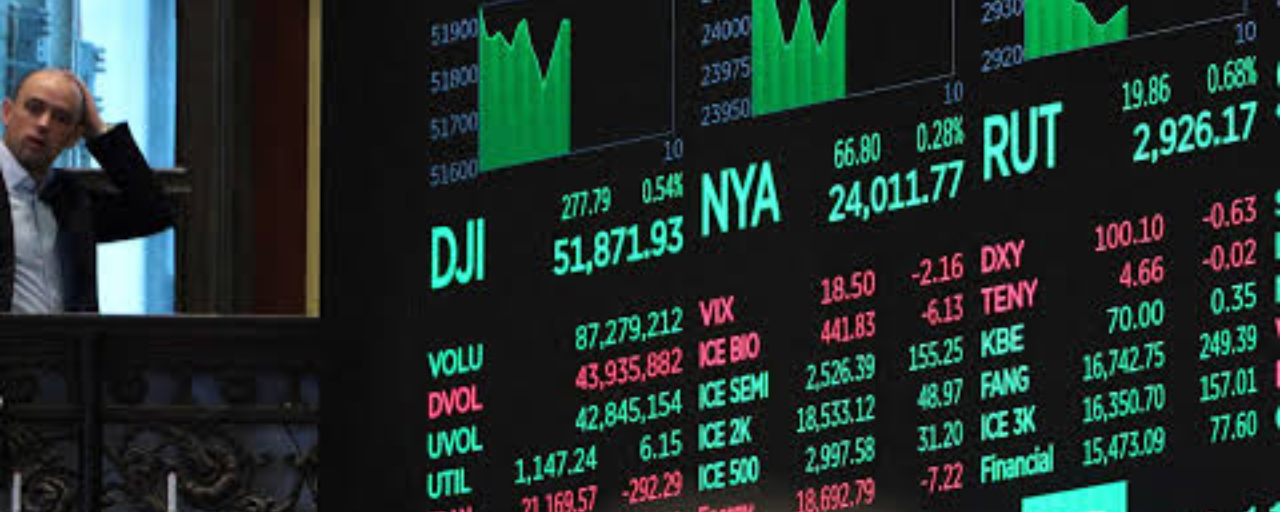

Defensive stocks rallied Thursday as worries about how much money tech companies are pouring into artificial intelligence pushed investors out of the AI trade and toward value. Caution has become the house rule in that corner of the market, and CoreWeave shows why.
CoreWeave's bonds ring the loudest alarm
The yield to maturity on CoreWeave's 9.75% bond due in 2031 reached 15.78%, and yields tend to climb when investors see a borrower as riskier. Credit default swaps, which work as insurance against a missed payment, told the same story. On the five-year contracts, the spread shot past 1,140 basis points at one point.
Gavan Nolan, an executive director of fixed income pricing at S&P Global Market Intelligence, said a spread of 1,000 basis points or more generally signals credit distress.
Nor was the damage confined to one company. Twenty of the most valuable AI and semiconductor stocks worldwide have lost more than $1 trillion in value this week, with the prospect of more rate hikes, AI financing worries and stiffer competition all dragging on sentiment.
Hot producer prices, a calmer tape
Fresh inflation data landed too. September producer prices rose 1.3% from August and 6.3% from a year earlier, the largest monthly gain since March 2022 and the largest annual gain since December 2022. Economists polled by Dow Jones had expected 0.6% and 5.5%.
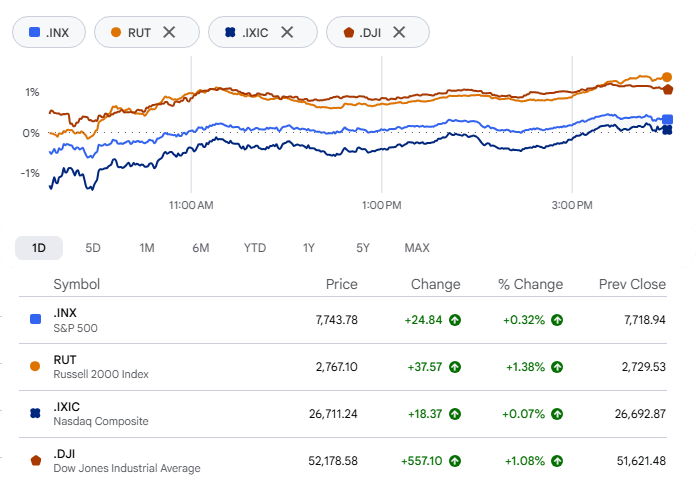
Stocks handled it better than they had handled Wednesday's consumer price report. Leading the way, the Dow Jones Industrial Average jumped 556.21 points, or 1.08%, to close at 52,177.69. The S&P 500 gained 0.33% to 7,744.06. Wobbling most of the day, the Nasdaq Composite finished up 0.08% at 26,713.03, a recovery from a session low that had it down 1.4%. Treasury yields fell, which helped, and the 10-year slipped to about 5.09%.
Small caps did best of all, with the Russell 2000 rising 1.4% to 2,767.27.
The buyers show up elsewhere
Where did the money go? Into the wide middle of the market. More than half of S&P 500 stocks now trade above their 200-day moving averages, up from about 40% at the end of September, when gains were bunched in tech. Walmart and Universal Health Services moved above that line for the first time in more than a month. Nike jumped more than 5%.
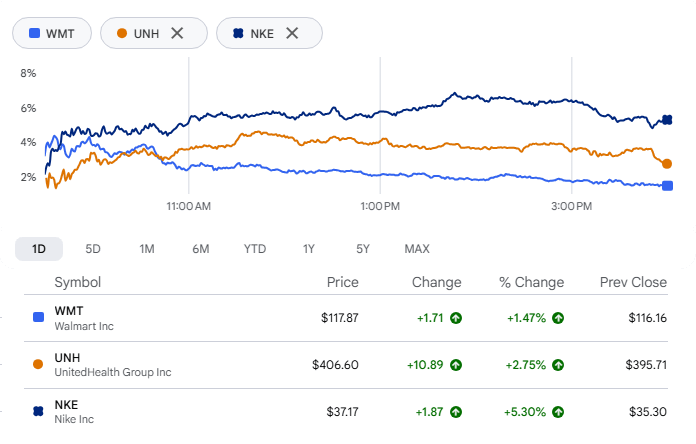
Walmart had a catalyst. Deutsche Bank upgraded it to buy from hold on a brighter outlook for 2027, with analyst Krisztina Katai expecting incremental margins to improve and noting that today's inflation could steer more shoppers its way.
AI hardware gives up more ground
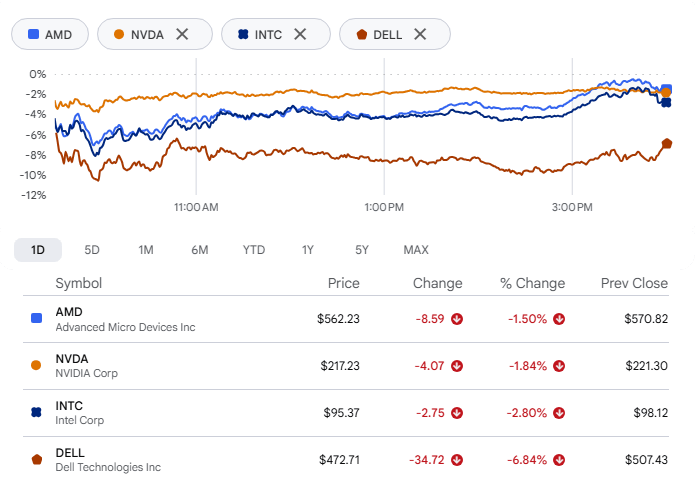
Worries about AI funding drove the rotation, and the biggest AI names paid for it. Nvidia fell 1.84%. AMD slid 1.5%, Intel lost about 2.8%, and Dell Technologies sank 6.8%.
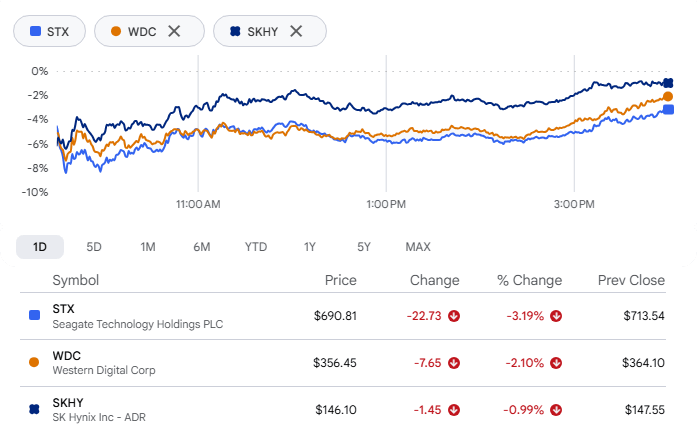
Memory and storage names took more punishment. Seagate Technology and Western Digital added to their weekly declines, and SK Hynix drove a rout in South Korea's Kospi overnight, with the index tumbling more than 6% at the open. Traders fear a memory chip glut as South Korea faces stiffer competition from China, a worry Elon Musk stoked on X by writing, "China will be making a LOT of RAM in 2028."
A chip-fund slide with some history
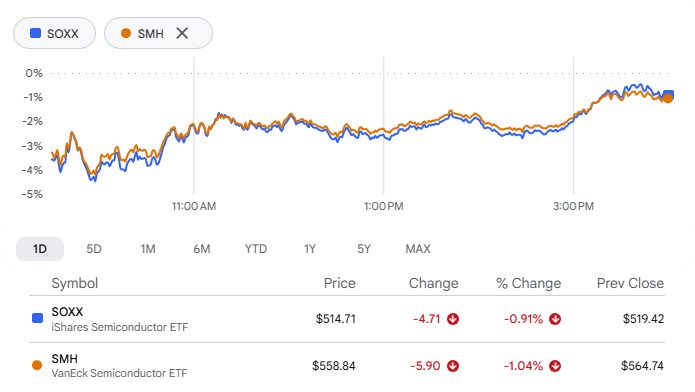
SOXX, the iShares Semiconductor ETF, closed lower for an eighth straight session, its first slide that long since September 2015. Over the stretch it has lost more than 15%, though Thursday's damage was only about 1%. VanEck's Semiconductor ETF, SMH, also fell for an eighth straight day. Neither fund has slid longer since May 2006, when each fell for nine sessions.
CoreWeave finds its footing
The name at the center of Wednesday's tech rout had a different day. That hit came from several directions at once: hotter inflation data that lifted bond yields, prominent voices fretting about the stock online, and analyst warnings about its sector. On Thursday, CoreWeave was down as much as 9.5% in early trading, then climbed into positive territory and closed up almost 6%.
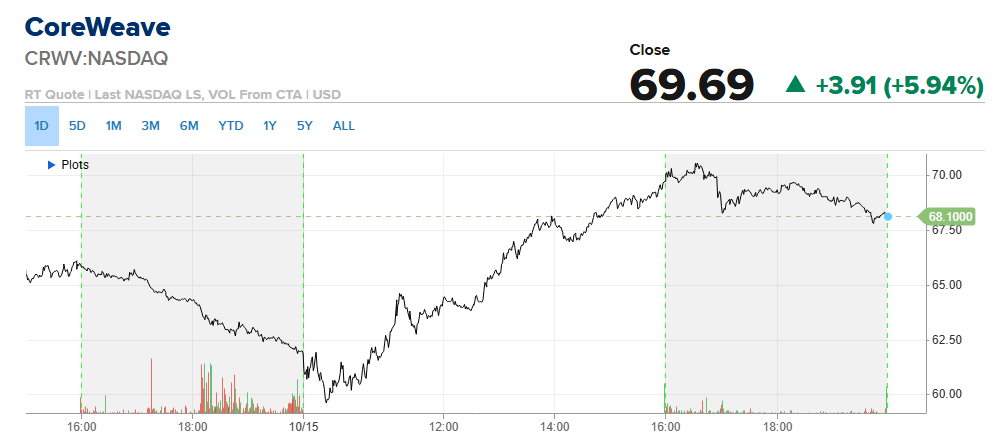
Nvidia CEO Jensen Huang lent a hand, saying his company does not need to backstop CoreWeave and that its strength is improving. Deutsche Bank's Brad Zelnick called the selloff a "buying opportunity." If the slide is purely about broader AI financing fears, he told clients, CoreWeave is still growing responsibly and has decent near-term liquidity.
KFC picks a side in the cola wars
KFC is dropping Pepsi for Coke in thousands of U.S. restaurants, with the switch starting in January. According to the industry tracker Beverage Digest, KFC is among the biggest restaurant sellers of Pepsi in the country, so the loss lands hard on a PepsiCo beverage business that was already struggling. It also adds a fresh sting to the long Coke-Pepsi rivalry. PepsiCo shares slipped after The Wall Street Journal first reported on the talks, while Coca-Cola's edged up.
Crocs wins an upgrade
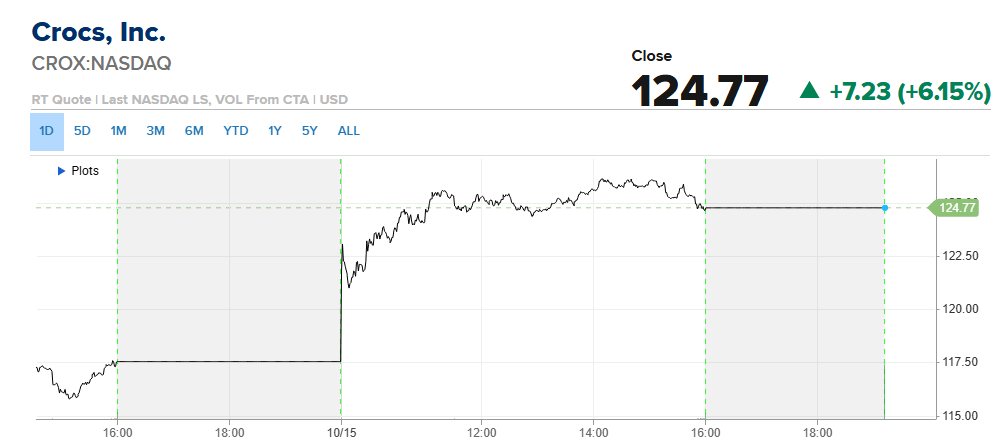
Crocs shares spiked 6% after Barclays upgraded the stock to overweight from equal weight. Analyst Adrienne Yih lifted her price target 18%, to $139 from $118, saying the company's multiyear growth story has come into sharper view. She pointed to strength in direct-to-consumer sales, tighter promotions and better inventory management, and she expects the HeyDude brand to return to growth in the second half. International, still young in markets such as China, India, Japan and Western Europe, is an underappreciated opportunity in her view.
Sector Analysis:
Best-Performing Sectors
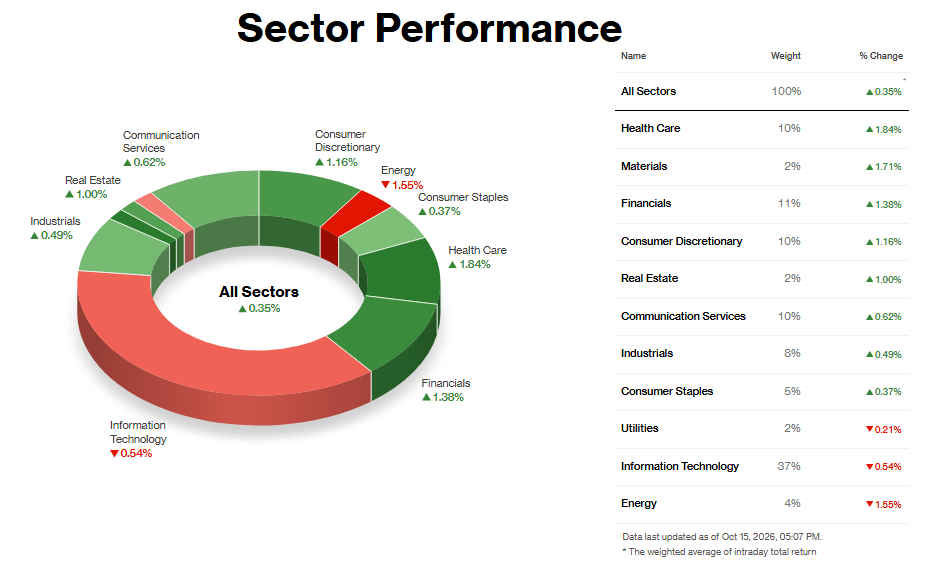
Investors went hunting for earnings that don’t hinge on AI, and Health Care (+1.84%) was where they landed. Eli Lilly rose more than 3% and UnitedHealth 2.8%, and the sector’s benchmark ETF hit a record high. The trigger was back-to-back hotter-than-expected inflation reports, CPI on Wednesday and PPI on Thursday, which raised the odds of a Fed rate hike. At record levels, this looks like a broader defensive rotation, not a one-day bounce.
Materials (+1.71%) was a metals story. Gold and silver rebounded after Wednesday’s drop as the dollar eased from an 18-month high and Treasury yields fell, lifting miners such as Newmont and Agnico Eagle. Commercial Metals added a quarterly beat, though FMC’s deep guidance cut showed the strength wasn’t universal. The rally leans on a soft dollar, which makes it fragile.
Financials (+1.38%) had earnings behind them. BNY and PNC topped estimates, U.S. Bancorp raised its revenue outlook, and the 10-year yield slid from above 5.32% to about 5.05%, easing rate pressure. Schwab, on a narrow revenue miss, was the exception.
Worst-Performing Sectors
Technology (-0.54%) carried the most weight, literally. At 37% of the index, even a modest slip drags. Chip stocks fell for a seventh straight session after an overnight rout in Asian chip hubs, as worries grew over financing the AI boom at higher interest rates. TSMC beat and guided above consensus, yet its cautious tone on 2027 and its flagged margin pressure from 2nm and overseas fabs kept buyers away. A software rally pulled the Nasdaq off its early lows. The problem is sector-wide funding anxiety, not one company.
Energy (-1.55%) had no single dominant driver. Crude fell overnight on talk of easing restrictions on Russian shadow-fleet tankers and a reported IEA projection on stock releases, then recovered to settle higher on Middle East tanker attacks and Ukrainian strikes on Russian energy infrastructure. Stocks lagging a rising commodity suggest positioning more than the oil price.
Utilities (-0.21%) barely budged and had no clear catalyst. The AI-linked power complex was under pressure on financing worries and political pushback against data centers.
Two directions in one week
Through Thursday, the Dow is up 1% for the week while the Nasdaq is down 2.4%. A gap like that rarely sits still. The Fed meets Oct. 27 and 28, and until then the market has to decide which of the two it believes.