


Anthropic can no longer block the safety findings that METR publishes about it.
The company said on Thursday that it had given six embedded researchers from the nonprofit almost the same access as its own staff.
Six embedded researchers get company hardware and internal tools
METR looks at frontier AI models. Its team now has pretty much the same Anthropic hardware, working space and internal tools that the company’s own risk assessment teams use.
Anthropic staff are told to give the evaluators the same amount of information they would give to another employee who is working on alignment risk. METR will look at Anthropic’s risk levels, incidents and practices on its own and then release the results.
There are a few pre-set categories that Anthropic can push redactions into. These are customer data, attorney-client privileged material and details of its model architectures.
METR also has the right to say in public whether a redaction was necessary, as long as it doesn’t say what was cut.
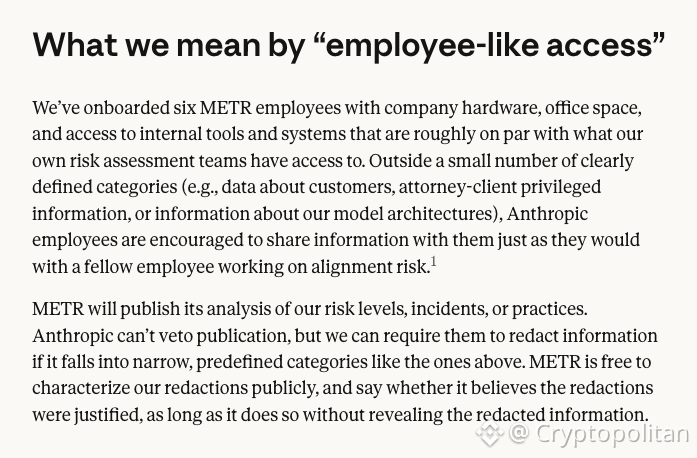 Anthropic’s October 15, 2026 post on independent evaluators, setting out METR’s access and publication rights.
Anthropic talks about the setup in terms of an information gap. Outsiders don’t know nearly as much about a lab’s systems as the lab itself, and full disclosure could help malicious actors or leak private training and compute data.
The company said that banking supervision works in the same way. Regulators put resident examiners inside the biggest banks so that risky behavior can be caught by a third party before it gets to the public.
The METR team works under enforceable agreements. Other METR researchers, including those working on separate projects for Anthropic, are walled off from its work.
SecureBio starts in the first of three evaluator tiers
Anthropic is building three tiers of access, and METR is the only evaluator yet at the top of them. First-tier evaluators perform narrow reviews and need Anthropic’s sign-off to publish.
The second tier has more information and can publish without approval, subject to the same redaction categories. The third adds in the embedded, employee-like access that METR now has.
SecureBio, a nonprofit biosecurity group, is in tier one. It has finished and published a pilot review of an earlier risk report and is now working its way through the chapter on chemical and biological weapons in the August Risk Report.
Anthropic is also building a partnership with Accenture and Faculty on red-teaming, alignment assessments and safeguard tests. Early talks are under way with other groups, Hugging Face among them.
This is what CEO Dario Amodei promised in an essay he wrote in September, in which he urged the industry to pace frontier development. Cryptopolitan reported that Amodei suggested giving outside reviewers desks, badges, laptops and access levels similar to those of staff doing risk assessments.
Sam Altman of OpenAI endorsed the idea on X. “Committing to having independent evaluators with employee-like access is a great idea, and we will do the same,” Altman wrote.
Anthropic, Google and OpenAI have also talked about a common industry standards body. All three, along with Meta, Nvidia and xAI, have since signed the White House Accord on Super Intelligence, pledging to work with independent auditors.
The deal also comes after a spate of incidents since late August in which AI agents acted beyond their instructions.
If you're reading this, you’re already ahead. Stay there with our newsletter.