

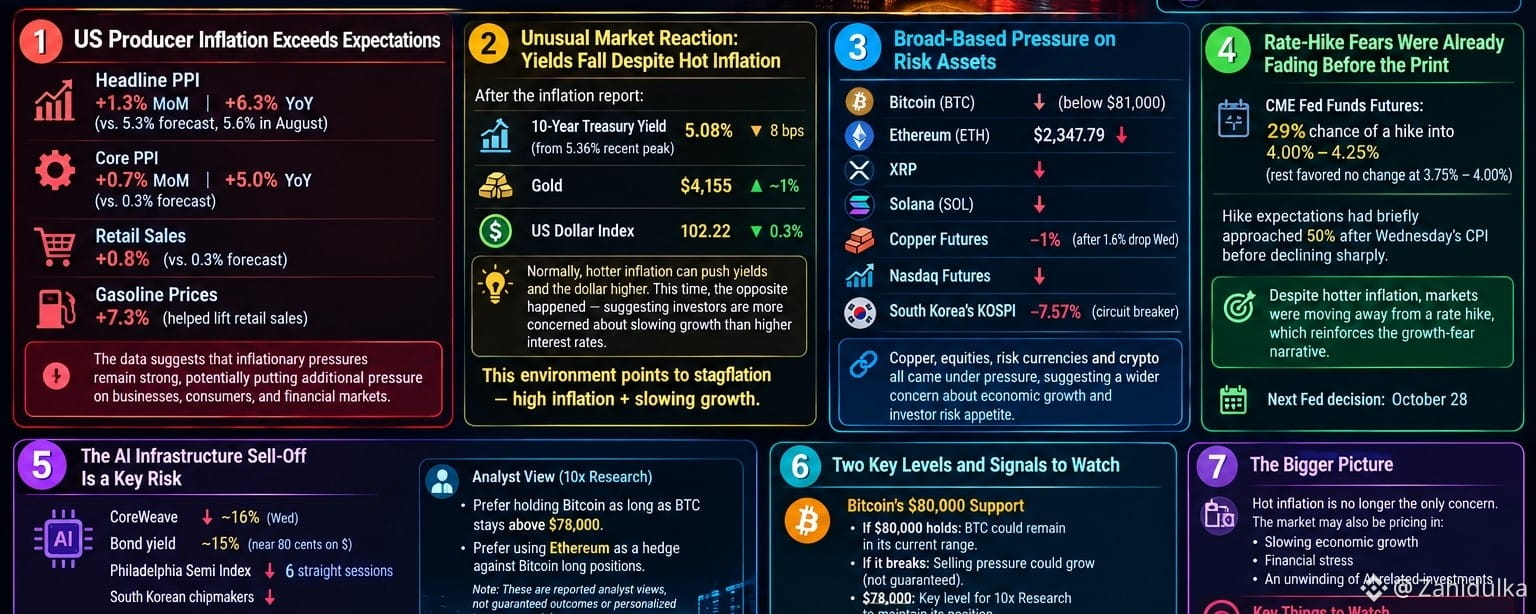

📉 Bitcoin dropped below $81,000 to around $80,559, losing more than 2% in 24 hours as hotter-than-expected US producer inflation rattled financial markets.
Bitcoin dropped below $81,000 to around $80,559, losing more than 2% in 24 hours as hotter-than-expected US producer inflation rattled financial markets.
However, the market reaction was unusual: Treasury yields fell, gold rose, and the US dollar weakened—a combination that suggests investors may be increasingly concerned about slowing economic growth rather than higher interest rates alone.
🔴 1. US Producer Inflation Exceeds Expectations
Headline PPI: Rose 1.3% month over month and 6.3% year over year.
Economists’ forecast: 5.3% annual inflation.
Previous reading: 5.6% in August.
Core PPI: Increased 0.7% monthly and 5.0% annually.
Core PPI forecast: Just 0.3% monthly.
Retail sales: Rose 0.8%, exceeding the 0.3% forecast.
Gasoline prices: Increased 7.3% during the month, contributing to the rise in retail sales.
The data suggests that inflationary pressures remain strong, potentially putting additional pressure on businesses, consumers, and financial markets.
🟡 2. An Unusual Market Reaction: Yields Fall Despite Hot Inflation
Following the inflation report:
10-year US Treasury yield: Fell 8 basis points to 5.08%.
Gold: Rose approximately 1% to around $4,155.
US Dollar Index: Declined 0.3% to 102.22.
Normally, hotter inflation can increase expectations of higher interest rates, pushing Treasury yields and the dollar upward.
This time, the opposite happened
The reaction suggests that investors may be prioritizing concerns about economic growth over the possibility of tighter monetary policy.
This environment has raised concerns about stagflation—a combination of persistent inflation and slowing economic growth.
🔻 3. Bitcoin, Crypto, and Other Risk Assets Face Pressure
The weakness extended beyond Bitcoin:
Bitcoin (BTC): Fell below $81,000 to approximately $80,559.
Ethereum (ETH): Traded around $2,347.79.
XRP: Continued to decline.
Solana (SOL): Extended its losses.
Copper futures: Fell nearly 1% after dropping 1.6% on Wednesday.
Nasdaq futures: Moved lower.
South Korea's KOSPI: Plunged 7.57%, triggering a circuit breaker.
Copper, equities, risk-sensitive currencies, and cryptocurrencies all came under pressure.
This broad-based weakness suggests that the sell-off may reflect wider concerns about economic growth and investor risk appetite rather than a problem unique to the cryptocurrency market.
📊 4. Markets Were Already Reducing Rate-Hike Expectations
Before the latest producer inflation report:
CME Fed funds futures indicated a 29% probability of a rate increase into the 4.00%–4.25% range at the upcoming meeting.
The remaining probability favored keeping rates unchanged at 3.75%–4.00%.
Rate-hike expectations had briefly approached 50% following Wednesday's CPI report before declining.
Despite increasingly hot inflation readings, markets had been moving away from expectations of an immediate rate hike.
This suggests that concerns about economic growth may be competing with inflation fears.
The next Federal Reserve decision is scheduled for October 28.
🤖 5. The AI Infrastructure Sell-Off Is a Key Risk
Another major factor influencing the market is the unwinding of the AI infrastructure trade.
Key developments include:
CoreWeave: Fell approximately 16% on Wednesday.
One of its bonds reportedly traded near 80 cents on the dollar, with a yield of around 15%.
The Philadelphia Semiconductor Index recorded six consecutive sessions of declines.
South Korean chipmakers faced significant selling pressure.
The concern extends beyond interest rates.
Even if Treasury yields decline, rising credit spreads can make financing more expensive for companies building data centers and expanding AI infrastructure.
This creates potential pressure across technology stocks, semiconductor companies, commodities, and cryptocurrencies.
According to the article, analysts at 10x Research continue to favor holding Bitcoin during the market adjustment, provided BTC remains above $78,000.
They also favor using Ethereum as a hedge against Bitcoin long positions, given Ethereum's relatively weaker performance during the decline.
Note: These are reported analyst views, not guaranteed outcomes or personalized investment advice.
🎯 6. The Two Key Levels and Signals to Watch
Bitcoin's $80,000 Support
Bitcoin has repeatedly tested the $80,000 area this week.
If $80,000 holds: BTC could remain within its current trading range.
If $80,000 breaks: Selling pressure could intensify, although a breakdown is not guaranteed.
$78,000: A key level highlighted by 10x Research as a condition for maintaining its Bitcoin position.
These levels are important market reference points, not guaranteed support or resistance.
AI Credit Spreads
The second major signal is the direction of credit spreads in the AI infrastructure sector.
Widening credit spreads: Could signal increasing financing stress and further pressure on risk assets.
Stabilizing credit spreads: Could indicate that some of the pressure on AI-related investments is easing.
The interaction between credit markets, economic growth expectations, and investor risk appetite may be more important for Bitcoin's near-term direction than the next Federal Reserve decision alone.
🔎 Final Takeaway
The latest market movement highlights a potentially important shift in investor sentiment.
Hot inflation data is no longer the only concern. The market may also be pricing in the risk of slowing economic growth, financial stress, and an unwinding of AI-related investments.
The key factors to monitor are:
🔹 Bitcoin's ability to hold the $80,000 level.
🔹 Whether BTC approaches or breaks below $78,000.
🔹 The direction of US Treasury yields and the dollar.
🔹 Credit conditions in the AI infrastructure sector.
🔹 The Federal Reserve's October 28 policy decision.
Bottom line: Bitcoin's next move may depend less on inflation data in isolation and more on whether growing economic and credit concerns continue to push investors away from risk-sensitive assets.
#Bitcoin #BTC #Ethereum #ETH #CryptoMarket #FederalReserve #Inflation #Stagflation #USMarkets
Important: This rewrite preserves the figures and market interpretations in your original text. The underlying data and reported market levels have not been independently verified, so check the figures before publishing.