

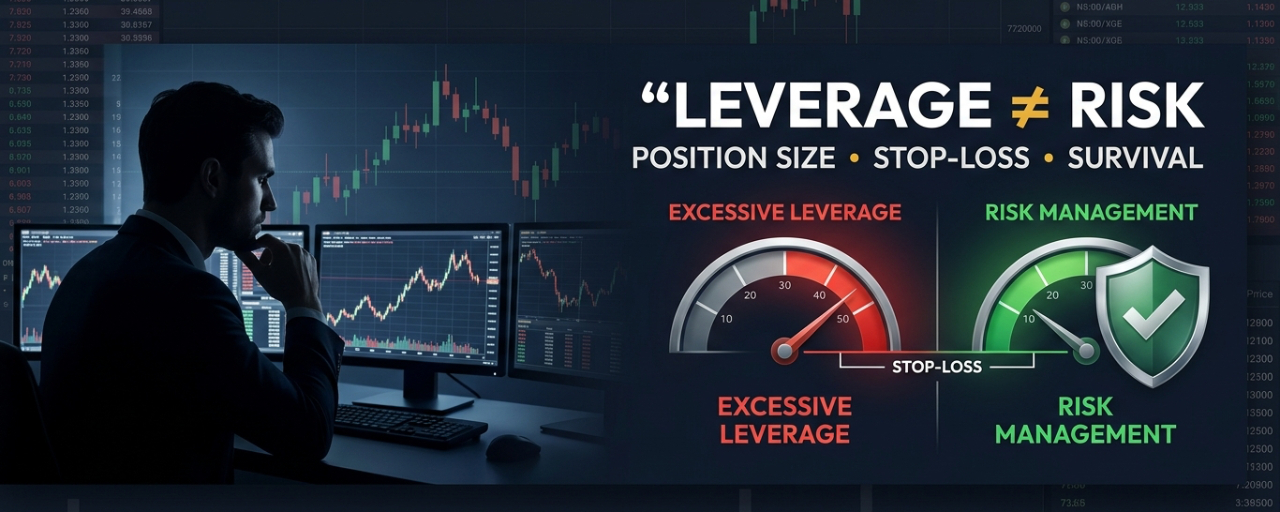

Many traders choose 50x or 100x leverage without understanding how much they're actually risking.
Here's the difference:
Leverage: Determines the position size you can control with your margin.
Risk per trade: The percentage of your account you lose if your stop-loss is hit.
The formulas:
Risk amount = Account balance × Risk %
Position size = Risk amount ÷ Stop-loss distance (%)
Example: $1,000 account, risking 2%, with a 1% stop-loss.
Risk = $1,000 × 2% = $20
Position size = $20 ÷ 1% = $2,000
At 10x leverage, that position requires approximately $200 in initial margin, excluding fees and maintenance margin.
How much should you risk?
Low RR (1:1): You generally need a higher WR to remain profitable.
High RR (1:3): You can tolerate a lower WR, provided the strategy delivers that RR consistently.
Low WR or long losing streaks: Consider reducing risk to protect your capital.
For a strategy with win rate (WR) and reward-to-risk ratio (RR):
Expectancy = (WR × RR) − (1 − WR)
This is the expected profit in units of risk per trade, before fees and slippage.
Don't choose leverage first. Calculate your risk, determine your position size, then choose appropriate leverage.
Trade the numbers, not your emotions.