


Binance will shut down its Bitcoin mining pool on November 10, 2026, at 07:00 UTC. The exchange plans to expand its AI tools and traditional assets trading. Miners will have a few weeks to move to other mining pools.
What closes on November 10
Binance said in a notice released on October 13 that Pool, Cloud Mining, Pool Savings and Transaction Accelerator will shut down, together with Stratum connections, APIs, and email and Telegram alerts.
The exchange warned in its official announcement:
Hashrate submissions and mining shares submitted after this time will no longer be accepted, processed, or credited.
Before the closure, miners must transfer to another pool and close their Pool Savings accounts. Pending rewards or refunds will be processed based on existing product terms and after checking for compliance.
Users will still be able to access their transaction history until November 24, 07:00 UTC. Binance said the closure was part of a broader product review. However, it did not explain the financial reasons behind its decision.
From ninth place to the bottom of the dashboard
Binance Pool started its operations in April 2020, advocating the Full Pay-Per-Share model for Bitcoin miners.
Hashrate Index rank for December 31, 2025 had it at number 9 with a hashrate of 26 EH/s and a market share of 2.3%. Its dashboard for October 14, 2026, ranked Binance Pool on the 11th position with a hashrate of about 9.1 EH/s and a market share of 0.85%, in comparison with total network hashrate of approximately 1,013 EH/s.
The numbers involve different times and measurement durations and thus cannot be interpreted as the performance history.
Where the hashrate goes next
It is possible for mining rigs to link up with an alternative pool while remaining a part of Bitcoin’s network. However, concentration might become a problem. Foundry USA make up about 25% of recently mined blocks, while AntPool hold around 22%. In case Binance miners became part of those pools, those shares would increase more.
According to calculations made by Luxor, hashprice in September was $39.33 per PH/s per day. This figure refers to mining economics in general, as Binance Pool’s profitability remains unknown.
Trading tools over mining rigs
Meanwhile, Binance released its free AI market assistant on October 12 after a beta involving roughly 150,000 users. It provides market guidance, not autonomous trading.
Binance has also expanded into U.S. equities through Nest Trading and announced plans for physically settled options on more than 1,000 U.S. stocks and ETFs. Its reported TradFi perpetual-futures volume climbed from $29.5 billion in January to $433.4 billion in August, according to The Block.
It was also reported by Cryptopolitan that Binance commanded 25.3% liquidity in Bitcoin on the exchanges studied. On another note, CoinGecko estimated that there was $1.45 trillion in traditional-asset trading across six crypto exchanges during the first half of 2026.
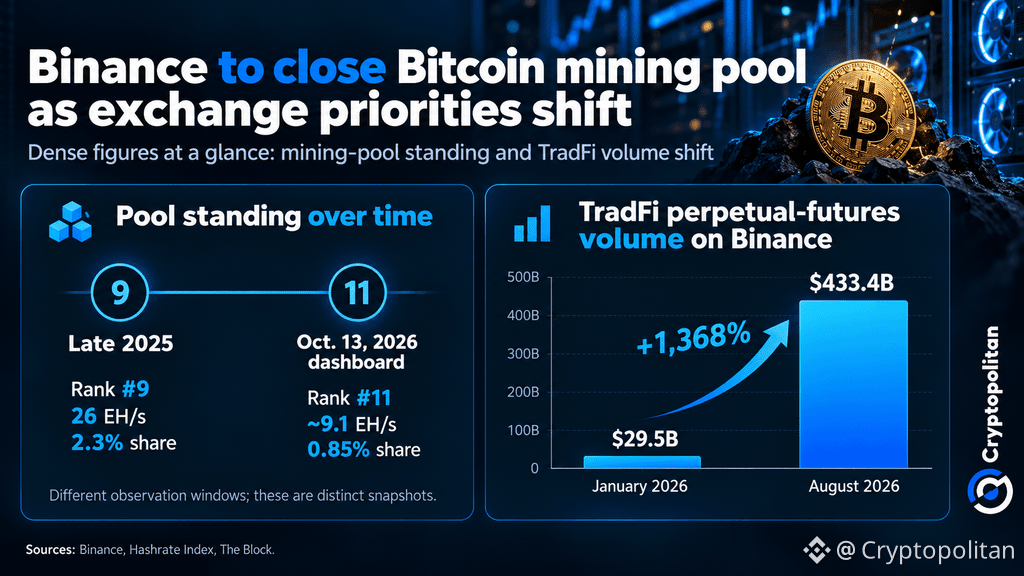 Binance Mining Pool Rank Drops to 11th as TradFi Trading Volume Reaches $433.4 Billion
Bitcoin and AI, close but not the same trade
Perception found that one in eight Bitcoin mentions in the third quarter also referenced AI, up from one in 37 in 2022. Much of this growing interest comes from Bitcoin miners turning to AI data centers. They already have access to the power and infrastructure these facilities need.
So far, however, the shift has not paid off for everyone. Bitcoin gained 43% during the quarter, while five miners with major AI deals saw their stocks fall 30%. Their share prices now track Nvidia more closely than Bitcoin.
Binance is taking a different path. While some miners are betting on AI infrastructure, the exchange is closing its mining pool and expanding its trading services. Both developments show how the crypto industry is exploring new sources of growth beyond Bitcoin mining.
The smartest crypto minds already read our newsletter. Want in? Join them.