


I’ve been looking at Solana’s push toward 200ms block times, and I think this could be an important step in the evolution of blockchain infrastructure.
But in my view, this isn’t just about making blocks faster. The real challenge is delivering reliable execution when the market gets volatile. 👀
📊 Here’s why I think this upgrade matters:
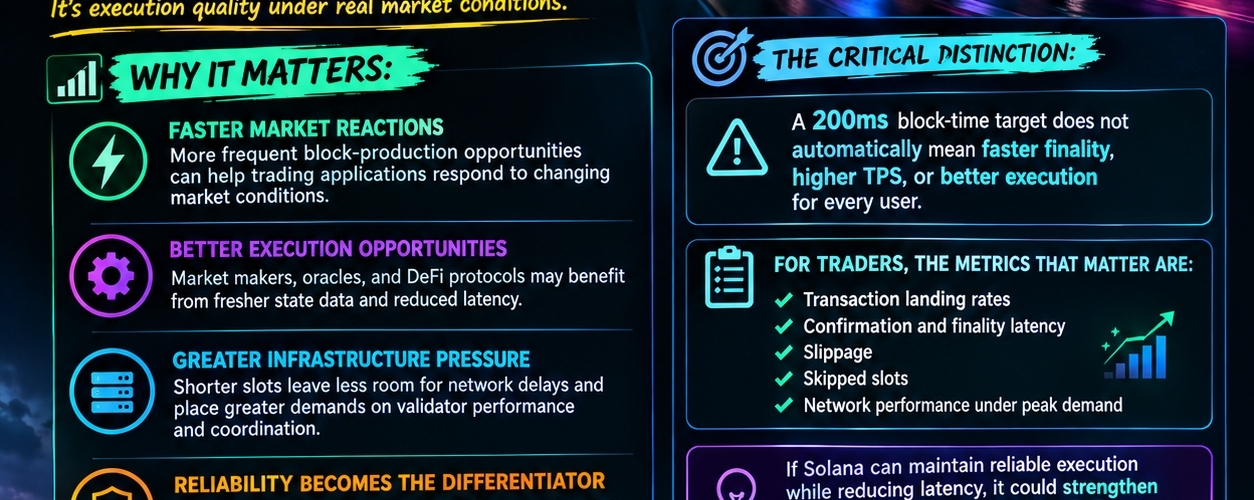
🔹 Faster Market Response: Shorter block times could help trading applications react more quickly to changing market conditions.
🔹 Better DeFi Opportunities: Market makers, oracles, and DeFi protocols could benefit from lower latency and more up-to-date blockchain data.
🔹 More Pressure on Validators: Faster block production demands stronger coordination and consistent validator performance, leaving less room for network delays.
🔹 Reliability Is the Real Test: Speed means very little if transactions fail, get delayed, or struggle to land during periods of high volatility.
One important thing to understand: A 200ms block-time target doesn’t automatically guarantee faster finality, higher TPS, or better execution for every trader.
For me, the metrics worth watching are transaction landing rates, confirmation and finality times, slippage, skipped slots, and network performance during peak demand.
If Solana can reduce latency while maintaining consistent execution, it could strengthen its position in high-speed DeFi and on-chain trading.
However, I wouldn’t assume that faster infrastructure automatically means greater adoption or a higher $SOL price. Real-world performance and user demand will ultimately matter more than the headline numbers.
💡 My takeaway:
Speed gets attention. Consistent execution builds trust.
Now I’m curious about your perspective 👇
What matters most in real trading conditions: higher TPS, faster finality, or reliable transaction execution when volatility spikes?
#Solana #SOL #Crypto #DeFi #Trading #Blockchain #MarketStructure
Not financial advice. Always do your own research.
$SOL $RLC $KAIA