


Within 3 hours, the funds had moved across 4 blockchains.
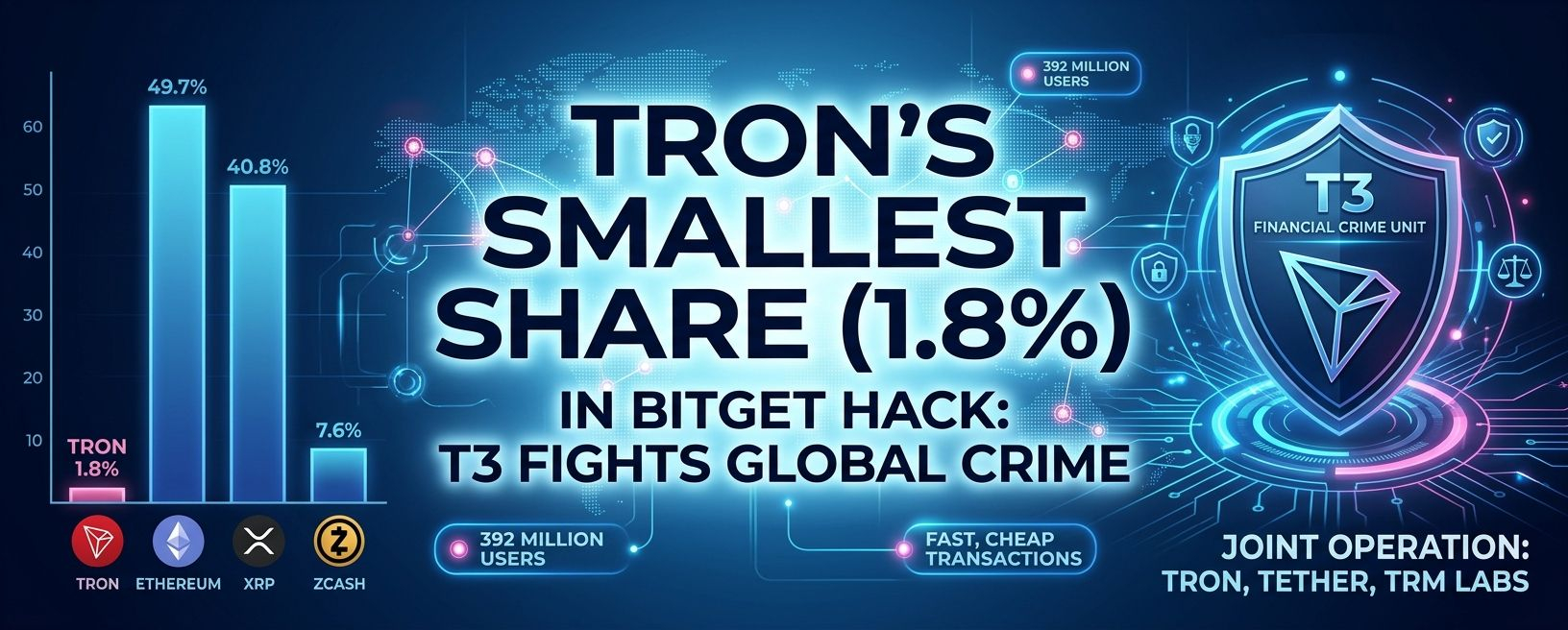
TRON carried 1.8% of it — about $7 million.
That's actually the smallest share. Ethereum took 49.7%, XRP 40.8%, Zcash 7.6%.
So why does this matter for TRON specifically? 🧵
The honest answer: it doesn't, not directly.
TRON being used to launder $7M out of $387M isn't a TRON story. It's a North Korea story. Chainalysis traced the funds using AI tools in under 10 minutes — across all four chains, not just TRON.
But there's a more interesting question buried here.
Why does North Korea use multiple chains at all?
The laundering playbook is well-documented: move fast, fragment across chains, use no-KYC cross-chain protocols like THORChain to obscure the trail.
TRON gets used because it's fast, cheap, and has enormous liquidity — the same reasons 392 million legitimate users choose it. The properties that make a network useful for remittances also make it useful for money laundering. That's not unique to TRON. It's true of every high-liquidity, low-fee settlement network.
Cash has the same problem. It doesn't make cash evil.
What's actually working
TRON's T3 Financial Crime Unit — a joint operation with Tether and TRM Labs — has frozen over $450 million in criminal assets across 5 continents since 2024.
The Bitget hack was traced in minutes. Funds were flagged. That's the opposite of a network that enables crime — it's a network with functioning forensic infrastructure.
North Korea stole $1 billion+ in crypto in 2026. Most of it moved through Ethereum. The story isn't about which chain — it's about an adversary that exploits every available network, and an industry that's getting faster at catching them.
$TRON $TRX @TRON DAO @TronDao_JPN @JustinSun @TRON DAO