



#vitalikwarnsaicouldweakencryptographysecurity
Vitalik Buterin: AI could weaken cryptographic security
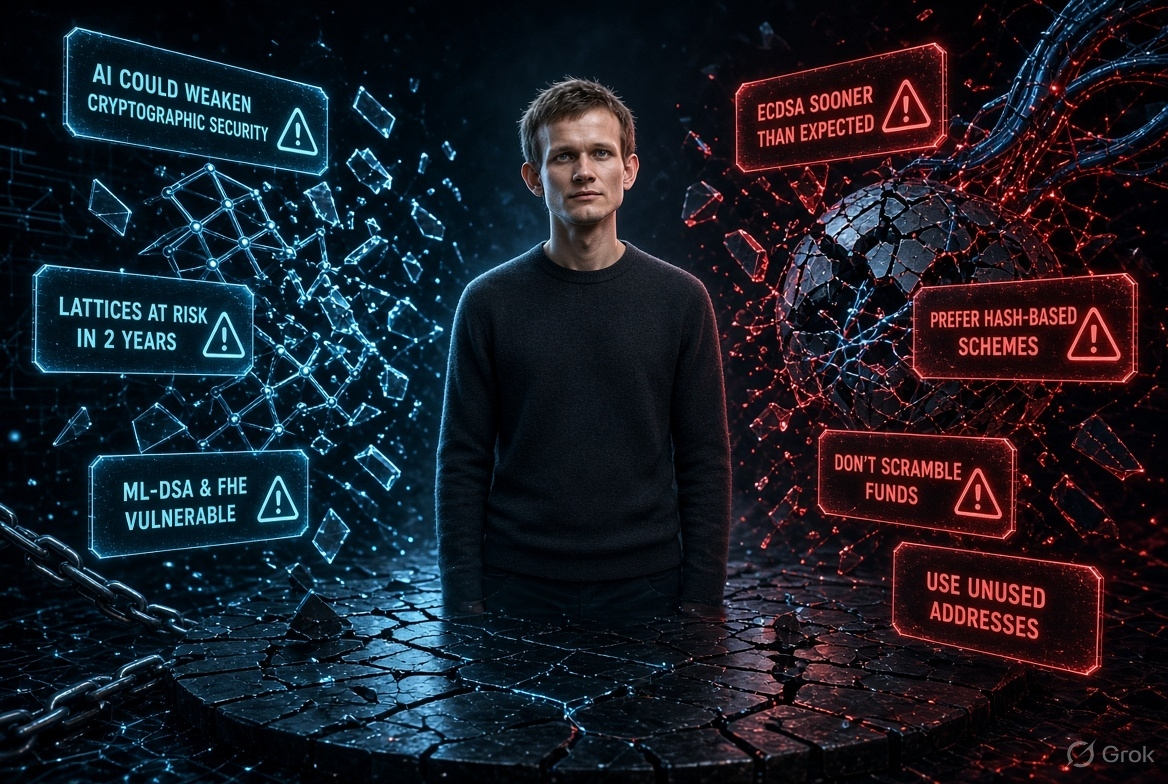
Vitalik Buterin warned that AI-assisted mathematical research could challenge assumptions behind crypto security faster than many expect. The concern is not that AI has already broken major cryptography, but that it may discover new mathematical attacks or shortcuts that reduce the security margin of systems previously viewed as resilient.
What Vitalik reportedly highlighted
He said there is a “good chance” that rapid AI progress in mathematics could seriously weaken some lattice-based cryptography within roughly the next two years.
The concern extends beyond today’s familiar quantum-risk narrative. Lattice schemes are widely used in post-quantum designs because they are intended to resist quantum attacks; Vitalik’s point is that an AI-driven mathematical breakthrough could pose a different kind of threat.
Systems cited in reporting include ML-DSA—a post-quantum digital-signature family—and fully homomorphic encryption (FHE), which enables computation on encrypted data.
He also raised the possibility that AI could shorten the expected security lifetime of structured systems such as ECDSA, the signature technology historically used by Bitcoin and Ethereum wallets.
His practical stance was preparedness, not panic: avoid rushing wallet migrations or treating a hypothetical timeline as a confirmed compromise. The security work should focus on upgrade paths, cryptographic agility, and alternatives with different assumptions—especially hash-based approaches.
Why lattice cryptography matters
Lattice cryptography is a broad family of schemes based on hard problems involving high-dimensional mathematical structures. It has become central to post-quantum planning because conventional public-key cryptography—such as elliptic-curve systems—could be vulnerable to a sufficiently capable quantum computer.
Vitalik’s warning is therefore more nuanced than “AI will break crypto.” It is about concentration risk: if the industry shifts heavily toward one family of mathematical assumptions, a major analytical advance against that family could have wide-reaching consequences.
Vitalik’s broader AI perspective
Vitalik has generally treated AI as a dual-use technology rather than simply a bullish or bearish narrative for crypto:
Useful when AI is constrained and verifiable: He has supported directions where AI helps with code review, formal verification, security analysis, and user-facing interfaces—but where results can be independently checked.
Dangerous when AI becomes an opaque authority: His recurring concern is that systems should not ask users to trust an unaccountable AI output, especially for money, identity, governance, or security-critical decisions.
AI can improve both defense and offense: The same models that may help audit protocols can also accelerate exploit discovery, phishing, code-generation errors, and mathematical cryptanalysis.
Crypto’s role is verification: In his broader writing on AI and crypto, a key theme has been using blockchains, cryptography, and zero-knowledge proofs to make claims more auditable—not merely putting “AI” and “blockchain” together as a marketing label.
How this compares with other researchers and intellectuals
Justin Drake / Ethereum security researchers: The more urgent camp argues the ecosystem should plan for a “bunker mode” mentality: map cryptographic dependencies now, rehearse migration routes, and reduce the chance that a sudden breakthrough forces a chaotic response. Vitalik broadly agrees the risk deserves serious preparation, while resisting panic-driven moves.
Post-quantum cryptography community: The standard view is not that lattice cryptography is known to be broken. It remains a major post-quantum approach, alongside hash-based, code-based, multivariate, and other families. The prudent engineering response is diversity and ongoing cryptanalysis rather than assuming one construction is permanently safe.
AI-safety thinkers: Many researchers share the underlying “capability overhang” concern: AI may accelerate discovery in domains where progress has historically been slow and hard to forecast. The disagreement is mostly over timelines and severity—not whether stronger AI can change the economics of research and cyber offense.
Security engineering view: The durable response is crypto-agility: make signatures, wallets, validators, bridges, and protocols upgradeable before an emergency, rather than betting everything on a single forecast. Ethereum research has previously explored emergency migration and recovery ideas for quantum-related cryptographic failures, which fits this same preparation-first logic.
Key takeaway
This is a scenario-risk warning, not evidence that ML-DSA, FHE, ECDSA, Bitcoin, or Ethereum has already been broken. The market-relevant implication is that post-quantum readiness may increasingly be judged not only by resistance to quantum computers, but also by resilience to unexpected AI-accelerated mathematical progress.


#FedMinutesFocusOnOctoberPause #XRPSpotETFsHold$1.7BWeeklyInflowsSlow #FrenchHillUrgesCLARITYActPassageInLameDuck #SP500AndNasdaqHitRecordHighs