





Privacy has always had a problem on the internet: the moment you want software to do something useful with your data, you usually have to give that software access to the data itself.
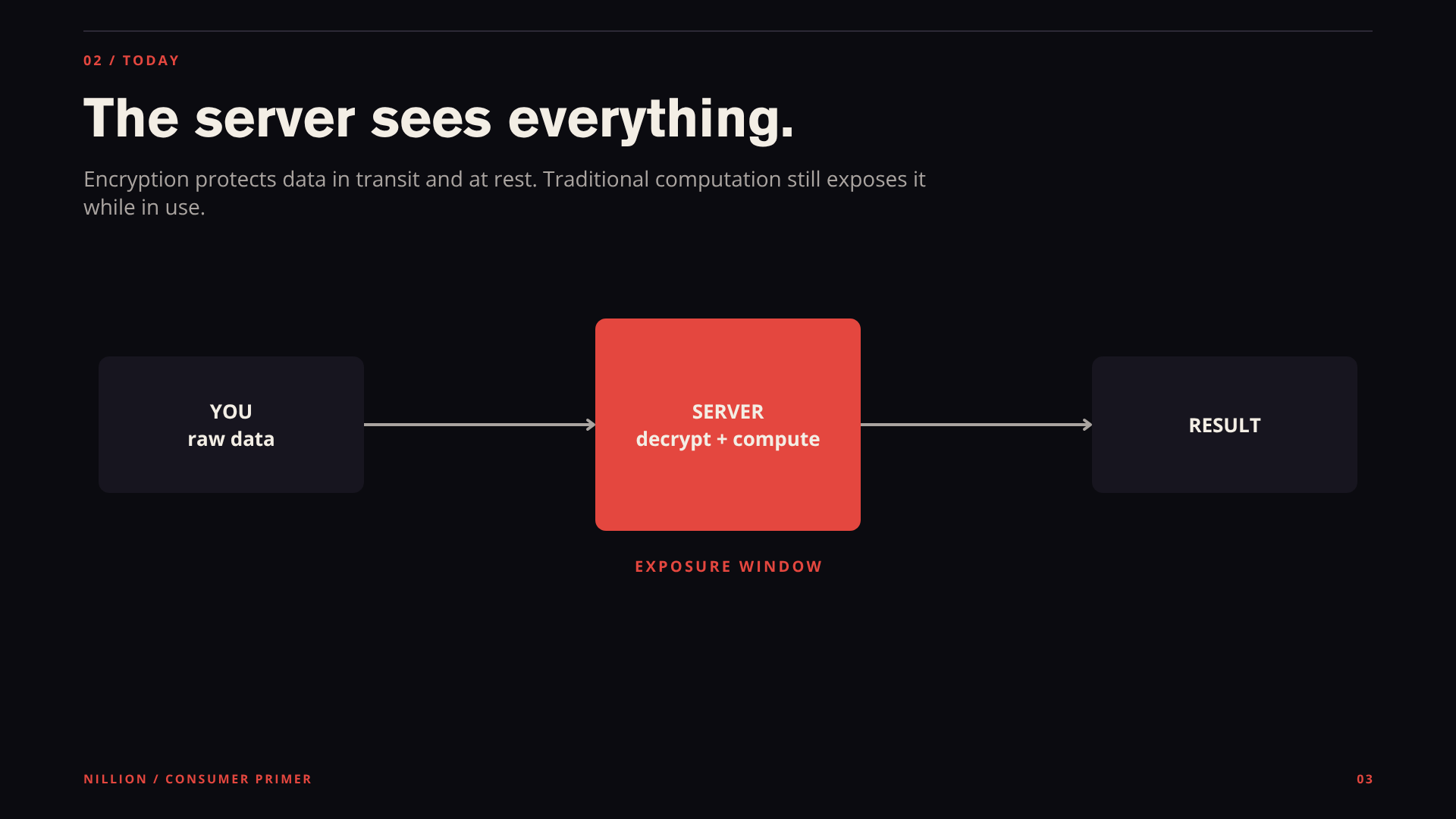
That trade-off was manageable when most software was simple. You searched for something, opened a website, sent an email, or uploaded a document. But the internet is changing rapidly. AI systems are becoming more personalized, applications are becoming more autonomous, and AI agents are expected to work with increasingly sensitive information. The more useful these systems become, the more context they need. And much of that context is private.
Your financial information is private. Your medical records are private. Your work documents are private. Your personal conversations are private. Even something as simple as your preferences, browsing history, or instructions to an AI can reveal a surprising amount about you.
So we have a problem.
We want software to use more of our data, but we don't necessarily want the software infrastructure processing that data to see everything inside it.
This is where Nillion comes in.
Nillion is building what it calls a Blind Computer, a decentralized network designed to store and process sensitive information while keeping that information protected from application backends and the operators running the underlying infrastructure. Its central idea is straightforward: make data usable without requiring the raw data to be exposed.
That sounds simple.
The technology underneath it is not.
The Problem Nillion Is Trying to Solve
Most modern applications follow a familiar model. You provide some information, the application sends it to a backend, the backend processes it, and you receive a result.
For example, imagine uploading a private document to an AI application and asking:
"Summarize this document and tell me what I need to do next."
The AI needs to process the document to answer your question. Traditionally, that means the service needs access to the document in a form it can actually read and compute over.
That creates a trust relationship.
You are effectively saying:
"Here is my sensitive information. I trust your infrastructure to process it correctly, protect it from unauthorized access, and not expose it."
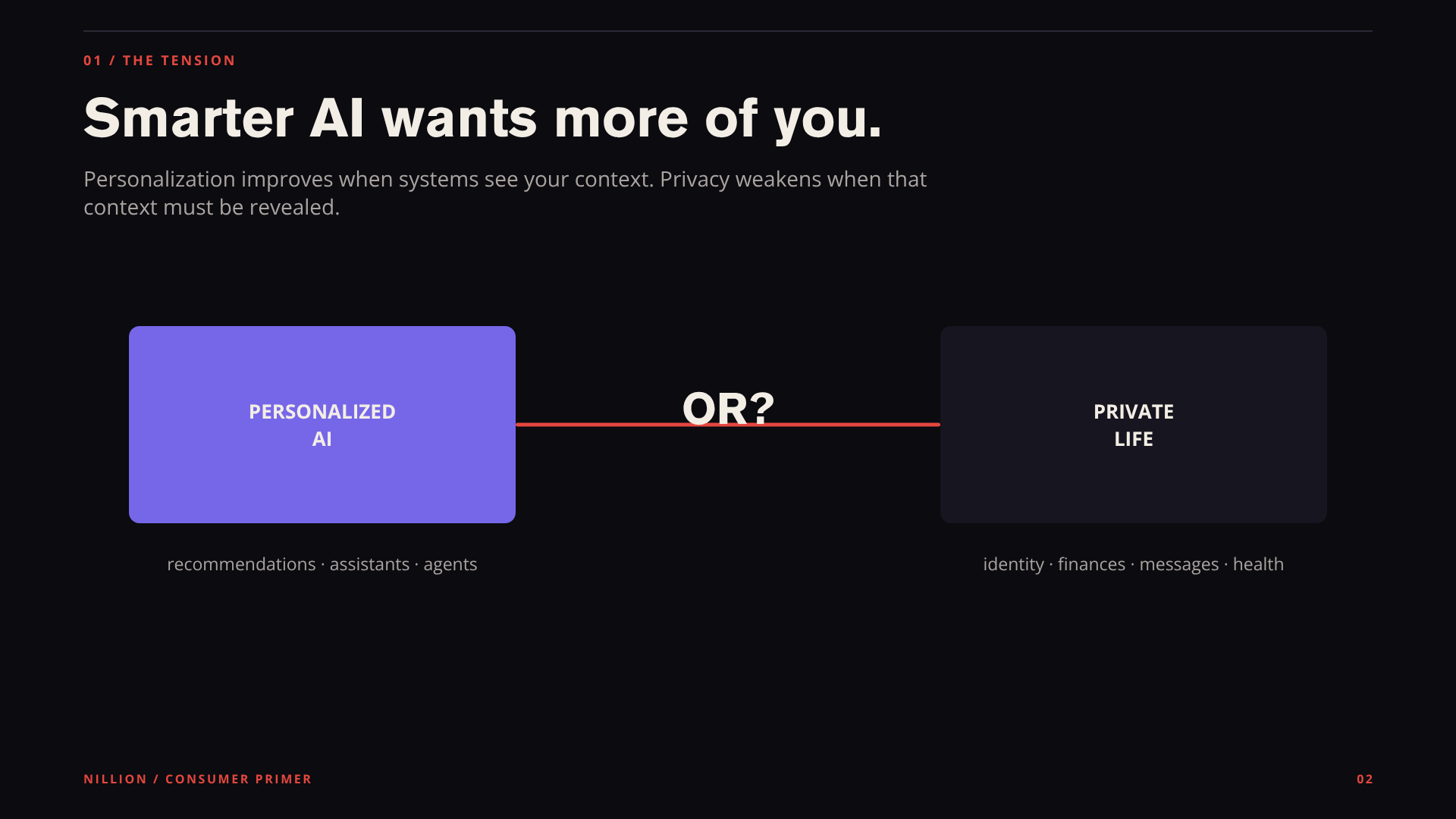
Encryption helps protect information while it is being transmitted or sitting in storage. But historically, there has been a difficult point in the middle: computation.
At some point, the system has to do something with the data.
The traditional pattern is essentially:
Encrypt → Decrypt → Compute → Encrypt again.
The problem is that during the computation stage, the information may exist in a form that the infrastructure can potentially access.
Nillion is trying to change that model.
Its Blind Computer combines privacy-enhancing technologies such as secure multi-party computation, homomorphic encryption and trusted execution environments to allow sensitive information to be stored and processed while reducing the need to expose the underlying data to infrastructure operators.
The philosophical shift is important.
Instead of saying:
"Trust us with your data."
The goal becomes:
"Trust the technology protecting the computation."
Think of Nillion as a Privacy Layer for Computation
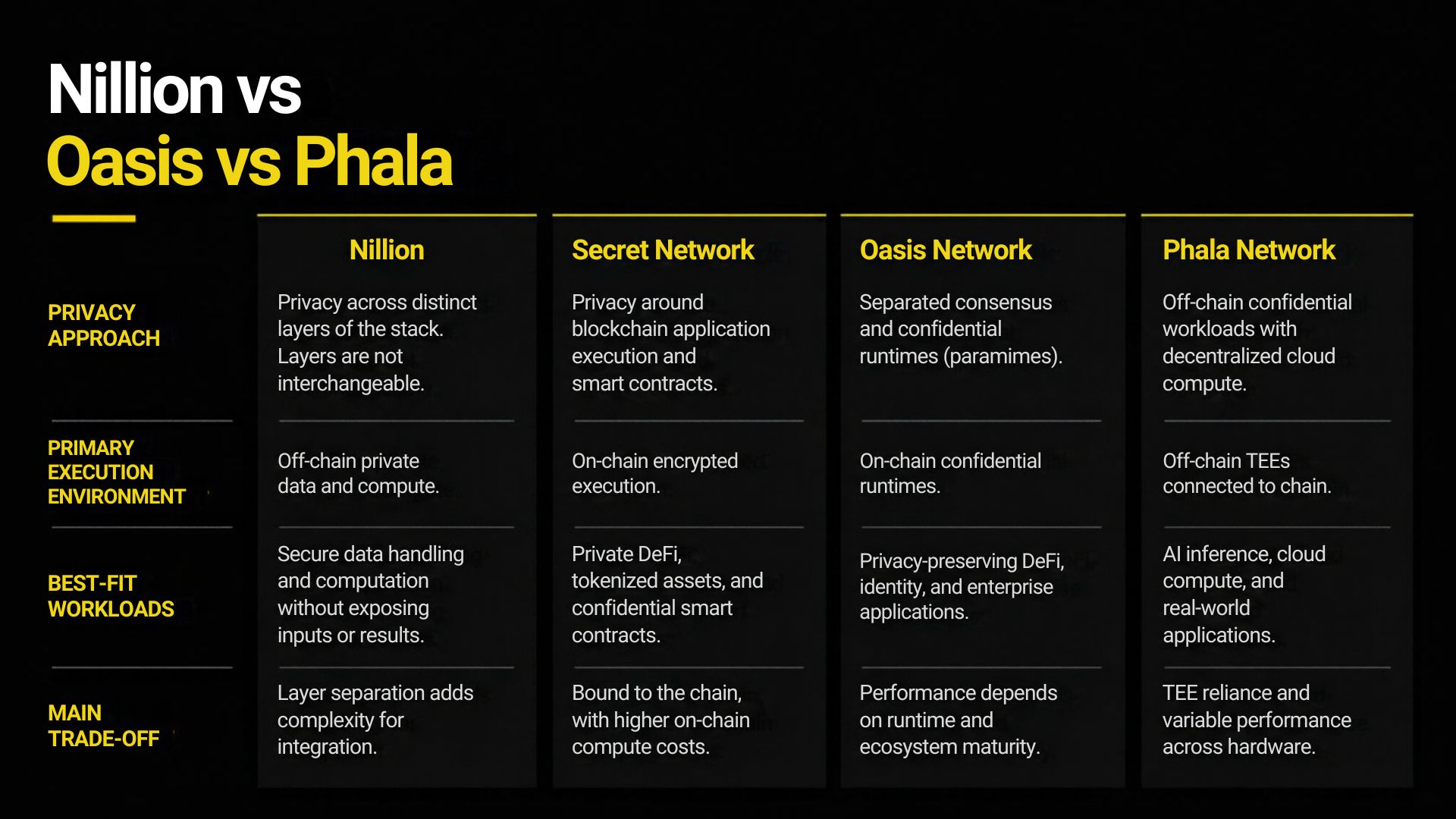
One of the easiest ways to misunderstand Nillion is to think of it as simply another blockchain.
That's not really the interesting part.
Blockchains are exceptionally good at creating shared, transparent state between parties that do not necessarily trust each other. But transparency is not always desirable. There are plenty of situations where you want the result of a computation to be useful without exposing all of the information that produced that result.
Nillion is targeting that other side of the equation.
Blockchains made it possible to coordinate without trusting a central intermediary. Nillion is trying to make computation possible without exposing sensitive information to the infrastructure performing it.
That makes the concept particularly interesting in a world where AI is becoming more important.
An AI model is only as useful as the context it receives.
Give an AI generic information and you get a generic assistant.
Give it your actual documents, preferences, financial information, work history, personal goals and other context, and it can potentially become much more useful.
But that creates an uncomfortable question:
How much of your life are you willing to hand over to an AI provider?
Nillion's answer is to build infrastructure where sensitive information can remain protected while still being used by applications.
That is the bigger idea behind the Blind Computer.
Enter Nillion
This is where Nillion's core proposition becomes clearer.
The goal isn't to stop applications from using sensitive information. It is to change how that information is made available to computation.
Instead of treating privacy as a feature added at the end, Nillion wants privacy to exist inside the computing infrastructure itself.
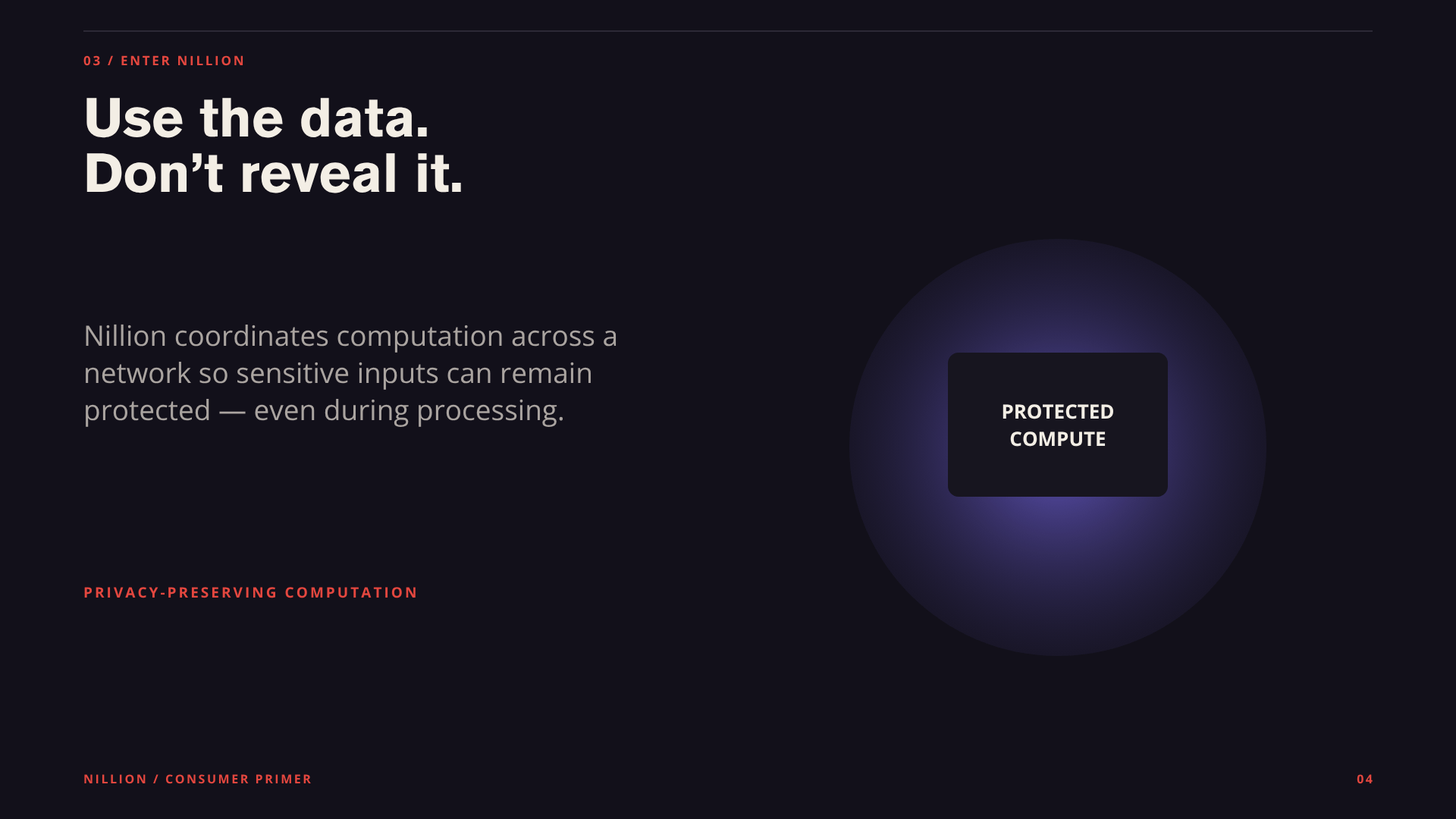
The result Nillion is aiming for can be summarized very simply:
Protect the input.
Compute privately.
Reveal only the useful result.
That sounds straightforward, but achieving it requires several different technologies and infrastructure components working together.
How Does Nillion Actually Do It?
Nillion doesn't rely on one single privacy technology. Its current Blind Computer stack is divided into different modules that handle different parts of the problem.
Three of the most important are nilDB, nilCC and nilAI.
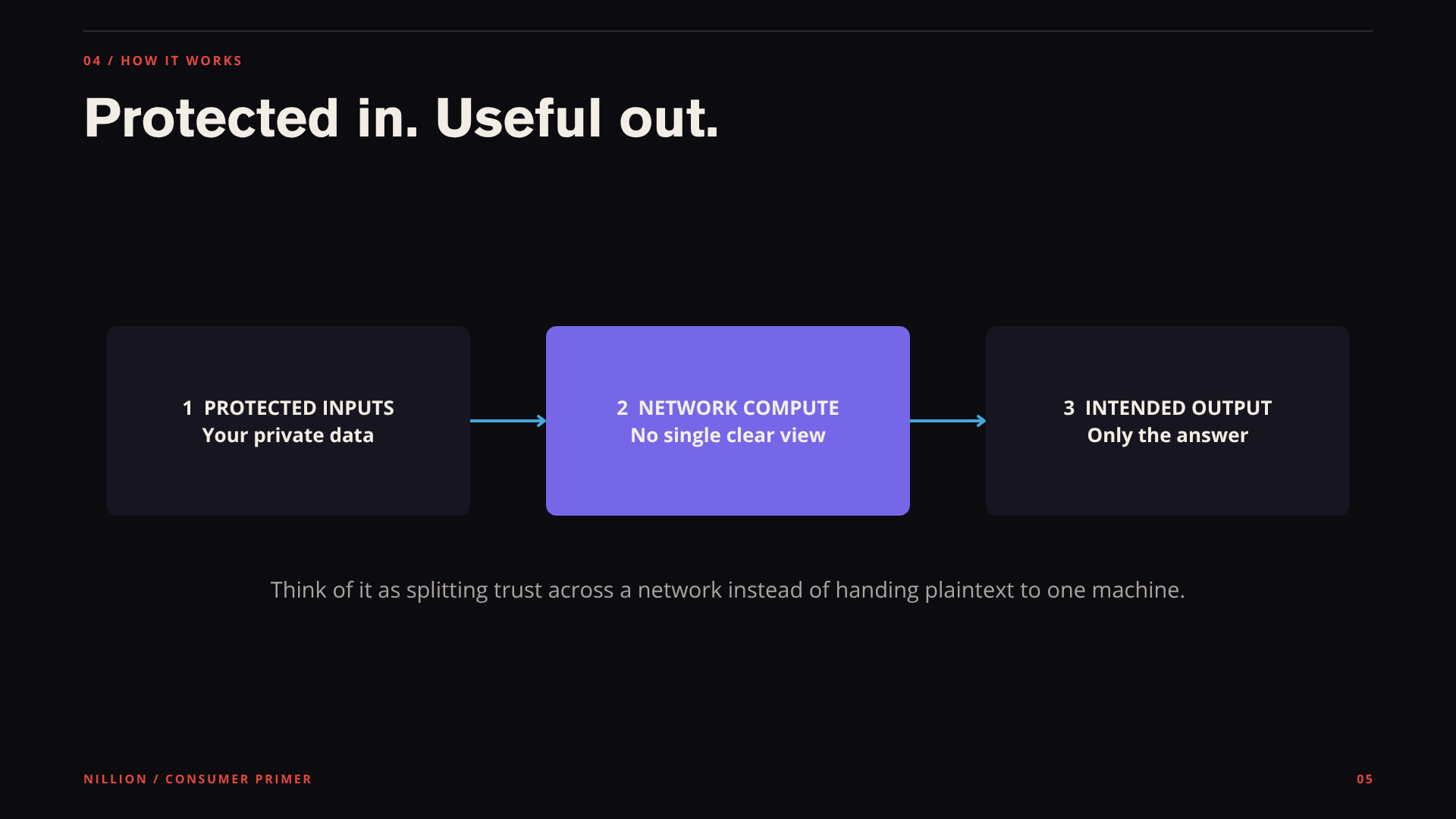
At a high level, the process looks something like this:
Your sensitive information → protected infrastructure → private computation → useful result
The important part is that the application doesn't need to treat the underlying raw information as ordinary, openly accessible server data throughout the process.
That is what makes Nillion different from simply putting another database behind an application.
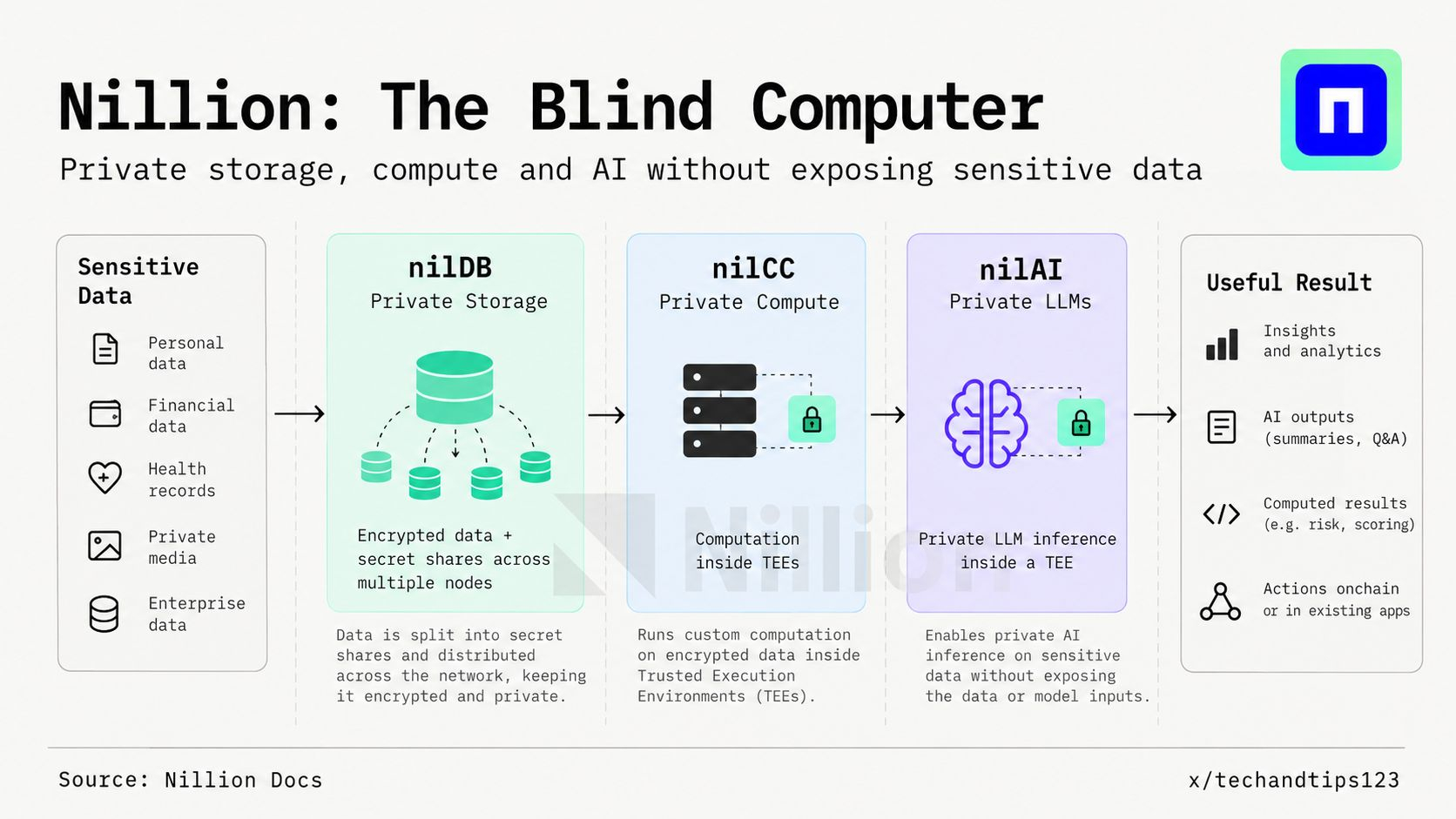
nilDB: Private Storage
nilDB is Nillion's private storage layer. Data can be encrypted and split into secret shares before those shares are distributed across multiple nodes. The idea is that an individual node should not be able to simply look at the complete original information sitting inside the system.
This is important because centralized databases create a very obvious target.
If a company stores millions of users' sensitive information in one place, compromising that database can potentially expose an enormous amount of information.
With secret sharing, the system can distribute pieces of protected information across different nodes. The individual pieces are not useful on their own, and the original information can be reconstructed when an authorized application needs it.
So instead of thinking:
"My entire secret lives inside one database."
Think:
"The system has distributed protected pieces that can be used through controlled computation."
That is the role nilDB plays in the larger Nillion architecture.
nilCC: The Part That Actually Computes
Storage alone doesn't solve the problem.
You could encrypt everything on earth, but if you have to completely decrypt it every time you want to use it, you've only solved part of the privacy equation.
This is where nilCC, Nillion's confidential compute layer, becomes important.
nilCC allows developers to run general-purpose workloads inside Trusted Execution Environments, or TEEs. These environments are designed to isolate sensitive workloads and provide cryptographic attestation that the expected software is running inside the protected environment.
For a developer, the idea is surprisingly practical.
A workload can be packaged as a Docker application, deployed to a nilCC node, and executed inside a protected environment. The developer then receives the result without needing to expose the sensitive inputs to ordinary infrastructure.
This matters because it moves privacy closer to the computation itself.
Instead of protecting data only when it is sitting still, the system is designed to protect it while useful work is being performed on it.
That is a much harder problem.
And it is also much more useful.
Then There Is nilAI
This is where Nillion's idea becomes much easier for normal people to understand.
nilAI is Nillion's private AI layer, built on top of nilCC. It allows developers to run compatible AI models inside confidential compute environments so that sensitive prompts and data can be processed without being exposed in unencrypted form to the infrastructure handling the workload.
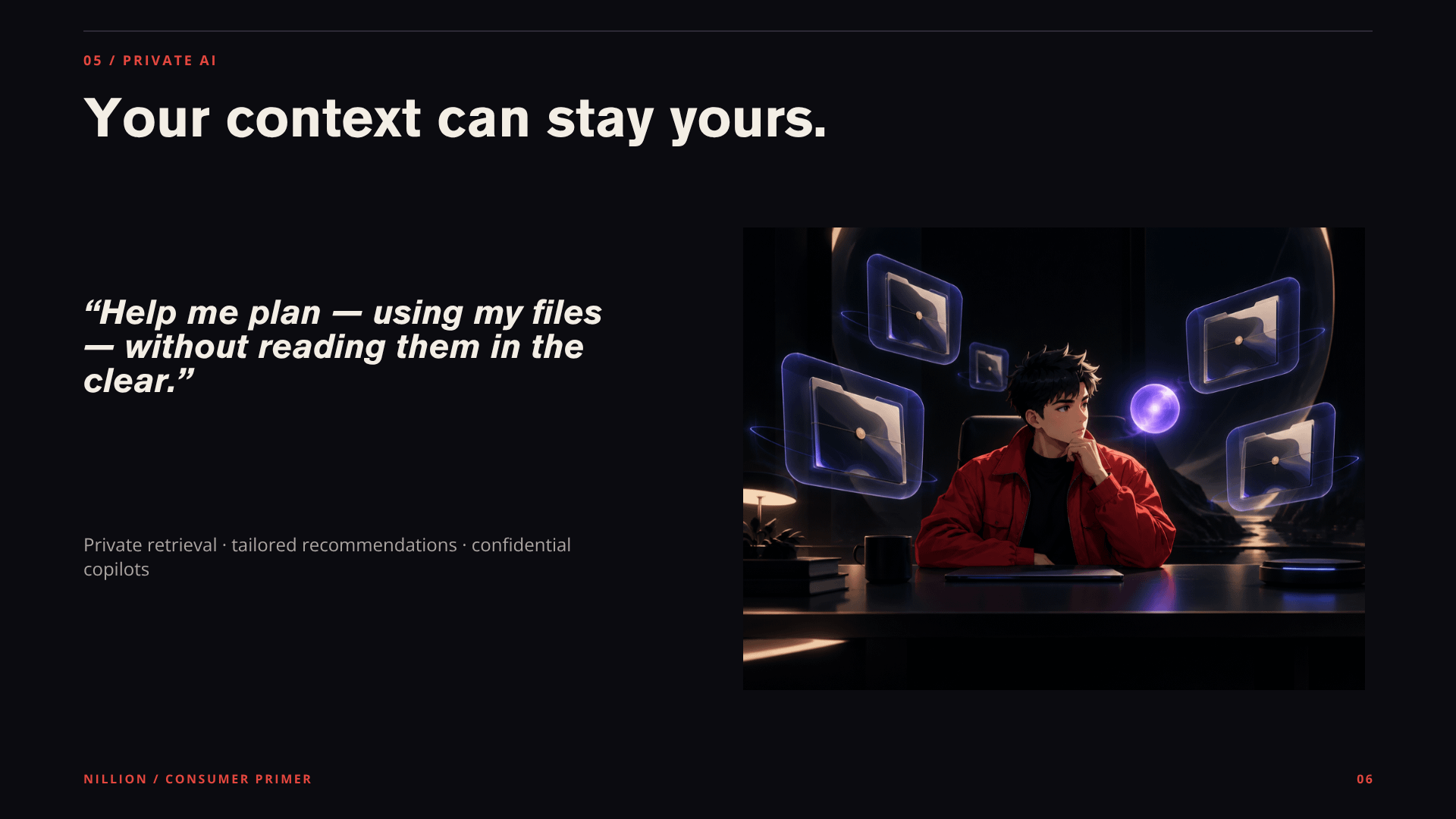
Imagine you have a folder containing ten years of personal documents.
You want an AI to analyze them.
You might ask:
"What are the biggest financial mistakes I've made over the last five years?"
A normal AI service needs access to the information required to answer that question.
A privacy-focused AI system should ideally be able to use that information without turning your entire private archive into readable data sitting on someone else's infrastructure.
That's the type of application Nillion is trying to enable.
And the implications become much larger when we stop thinking about AI as a chatbot.
The Real Opportunity Is AI Agents
The next generation of AI is unlikely to be limited to answering questions.
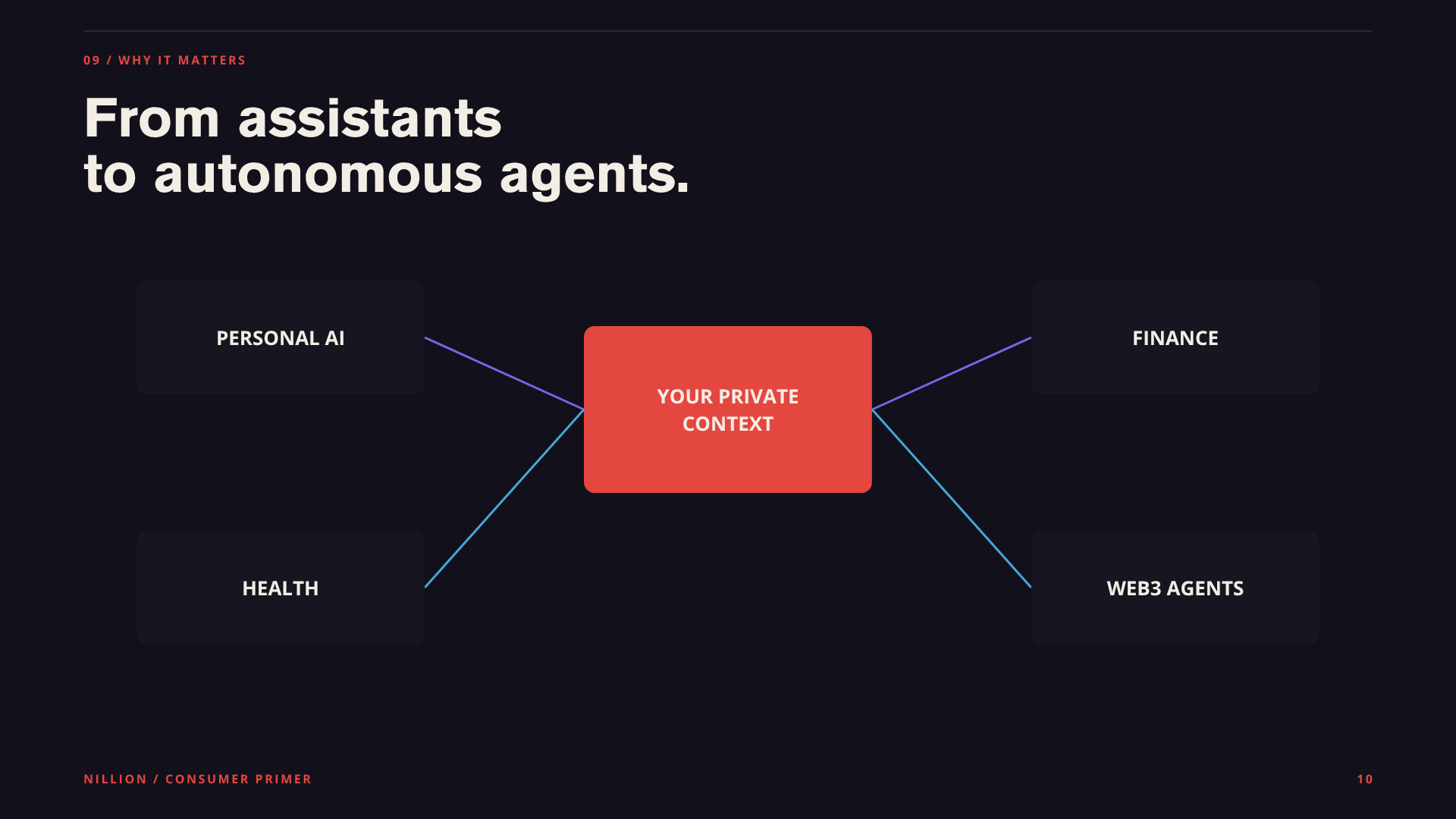
AI agents are being designed to act on behalf of users. They may eventually manage workflows, interact with applications, analyze information, make recommendations, and execute tasks based on a user's instructions.
But an agent that can actually do things for you needs context.
A financial agent might need to understand your spending.
A work agent might need access to company documents.
A personal assistant might need your schedule and preferences.
A healthcare application might need sensitive medical information.
The problem is obvious: the more capable the agent becomes, the more sensitive the information it needs.
This creates what could become one of the biggest infrastructure problems of the AI era.
We want AI to know enough to be useful.
We don't want every system involved in running that AI to know everything about us.
That's where private computation becomes important.
Nillion is essentially betting that privacy will become an infrastructure requirement for AI, rather than a feature added to an application later.
And It Goes Beyond AI
AI is probably the easiest use case to understand, but Nillion's Blind Computer is not designed exclusively for AI.
The same basic problem exists anywhere organizations need to perform useful computation on sensitive information.
Healthcare is a strong example. Hospitals, researchers and pharmaceutical companies have access to enormous datasets, but medical information is among the most sensitive categories of data that exists.
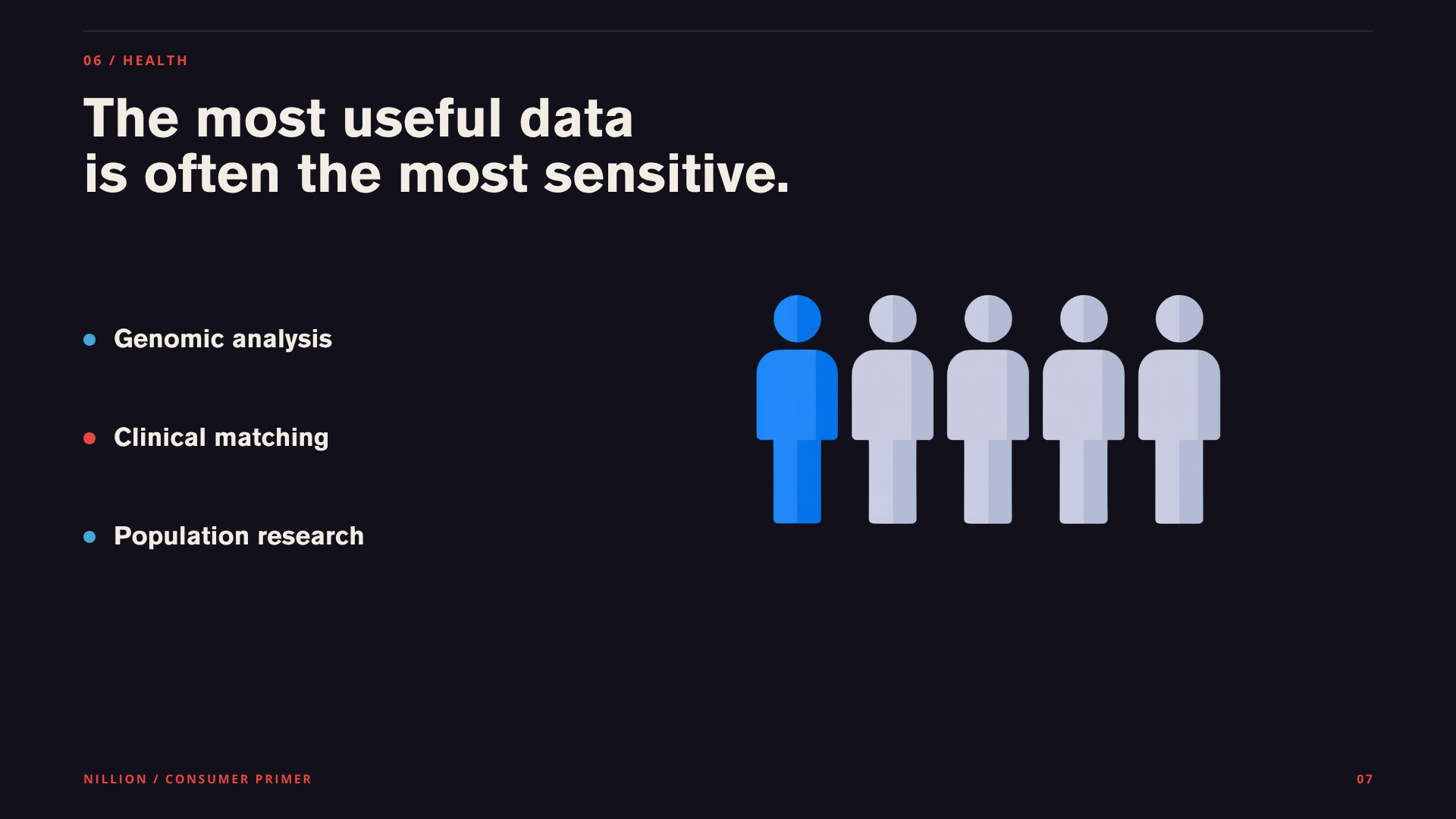
Nillion highlights private healthcare research as one potential use case for its infrastructure, where organizations could collaborate on sensitive datasets without simply pooling raw patient information into one exposed database.
Finance presents another obvious application. Institutions often need to coordinate around information that cannot simply be made public. Private computation could allow parties to perform calculations or coordinate strategies while reducing unnecessary exposure of their underlying data.
Identity is another interesting area. In a traditional system, proving something about yourself often means revealing far more information than is actually necessary. Privacy-preserving infrastructure could eventually allow applications to verify specific facts without requiring users to expose their complete identity.
And then there is Web3.
Public blockchains are powerful precisely because transactions and state can be verified publicly. But not every input into an application needs to be public.
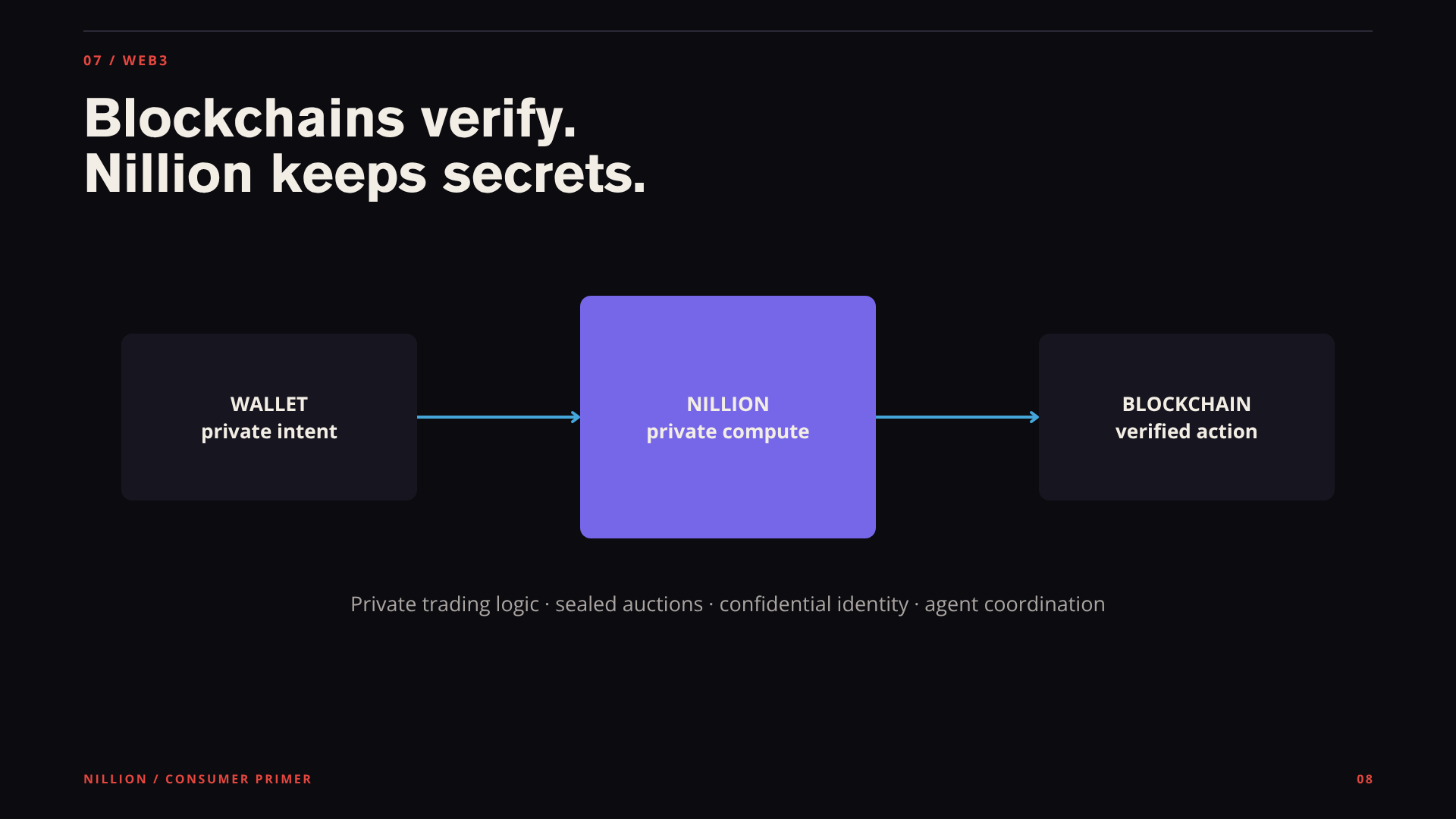
Private credentials, confidential strategies, sensitive business logic, private identity and AI agents could all benefit from infrastructure capable of interacting with decentralized systems without making every piece of underlying information transparent.
Nillion is positioning its Blind Computer for precisely these kinds of applications.
The Nillion Stack
All of this can sound complicated when the technologies are discussed separately.
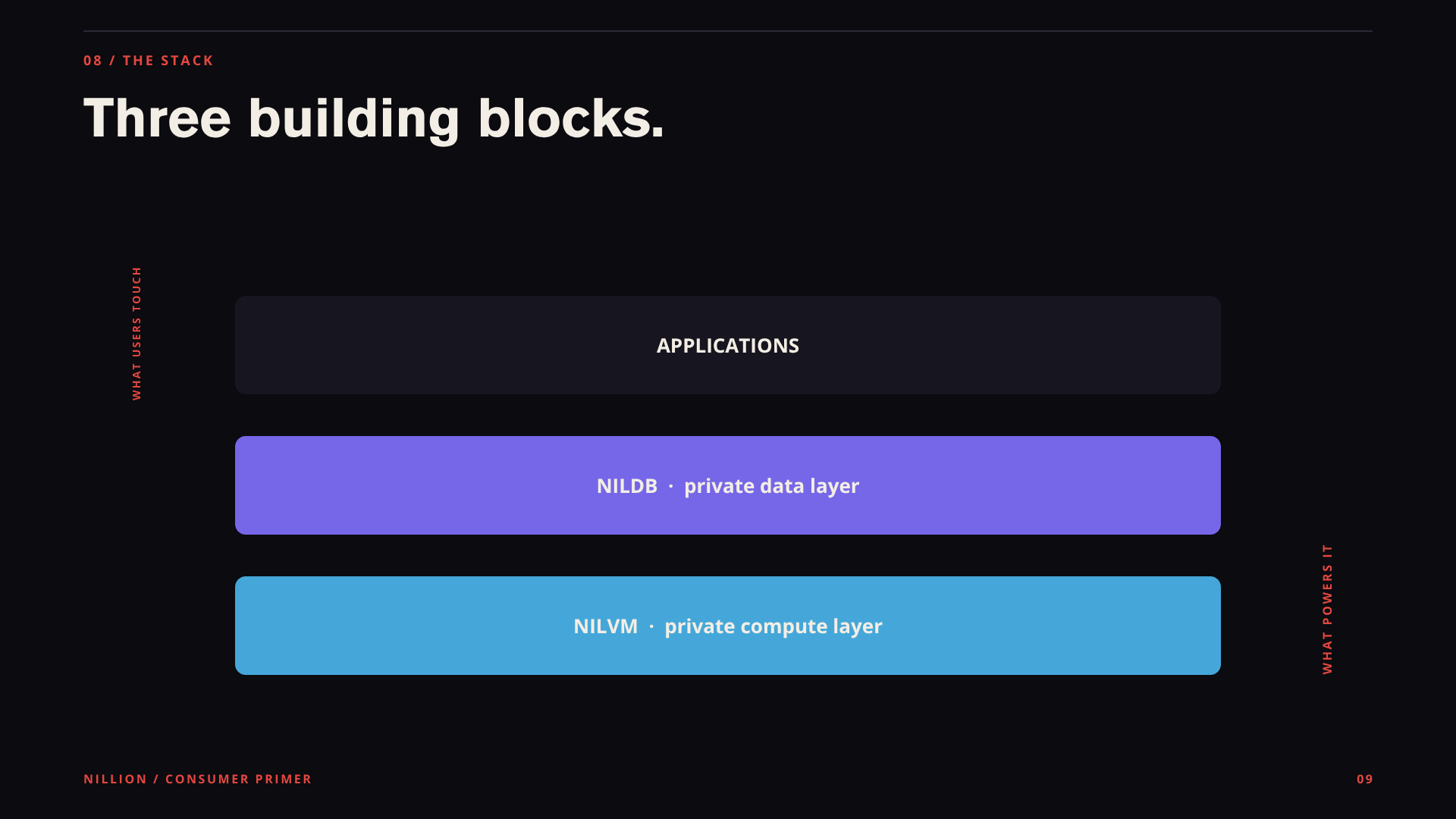
The easiest way to understand the architecture is to think of Nillion as a stack.
nilDB handles private data storage.
nilCC handles confidential computation.
nilAI brings private AI workloads into that environment.
Together, they form the core of Nillion's Blind Computer architecture.
The important thing is that these components aren't isolated ideas.
Private storage is useful because applications need somewhere to keep sensitive information.
Private computation is useful because applications need to actually do something with that information.
Private AI is useful because increasingly, the thing doing that computation will be an AI model.
The stack connects those pieces.
There is also another important part of Nillion's architecture: verification.
Because once computation becomes private, another question appears.
How do you know the computation was actually performed correctly?
That's where Nillion's verification infrastructure, including Blacklight, becomes relevant.
Privacy alone isn't enough.
Private computation needs a way to be trusted without simply asking users to trust the operator.
So What Does Nillion Actually Do for You?
This is probably the most important question.
If you're not a developer, why should you care about Nillion?
Because you are already generating enormous amounts of data.
Every day you create:
Financial information
Search history
Messages
Documents
Location information
Health information
Work data
Personal preferences
AI conversations
And AI is going to make that data even more valuable.
The more AI understands about you, the more useful it can become.
But that creates a fundamental choice.
Do we make AI powerful by giving centralized systems access to everything?
Or can we build AI systems that can work with sensitive information while keeping that information protected?
Nillion is betting on the second option.
That is why its technology matters beyond crypto.
The consumer doesn't necessarily need to interact with Nillion directly.
Instead, the user could interact with an application built on Nillion's infrastructure.
The privacy layer works underneath.
And ideally, the user gets the benefit without having to understand the underlying cryptography.
Nillion Isn't the App. It's the Infrastructure Underneath the App.
This distinction is worth remembering.
Nillion isn't trying to become the next consumer social network.
You probably won't wake up tomorrow and open "Nillion" to check your messages.
Instead, the long-term vision is that developers build applications on top of Nillion.
You use the application.
The application uses Nillion.
Nillion handles parts of the private storage, computation or AI workload underneath.
You may never even know it is there.
That's actually what good infrastructure looks like.
Nobody thinks about the servers running their favorite application.
Nobody thinks about the database behind the website.
And eventually, users may not think about the privacy infrastructure protecting their data either.
They'll simply use an application that can do something useful with sensitive information without requiring them to expose everything.
The Bigger Bet
Nillion is ultimately making a bet about where computing is going.
The first era of the internet was about making information accessible.
The next era was about making applications programmable and decentralized.
The next era may be about making applications intelligent.
But intelligence requires data.
A lot of data.
And much of that data will be extremely sensitive.
If AI agents are going to become personal, they need personal context. If healthcare AI is going to become useful, it needs medical context. If financial AI is going to manage money, it needs financial context. If enterprise AI is going to work with proprietary information, it needs access to proprietary information.
The obvious solution is to simply give AI everything.
The better solution would be to make the data usable without making the data itself unnecessarily exposed.
That's the problem Nillion is trying to solve.
Its Blind Computer combines private storage, confidential computation and private AI into a single infrastructure stack, with verification adding another layer of trust around private workloads.

The technology is complex.
The idea isn't.
Nillion wants to make it possible for software to work with your most sensitive information without requiring the infrastructure behind that software to see everything.
And if AI really does become the interface through which we interact with much of the digital world, that could become one of the most important infrastructure problems to solve.
Because the future isn't just going to need smarter computers. It is going to need computers that can be trusted with the things we cannot afford to expose.
