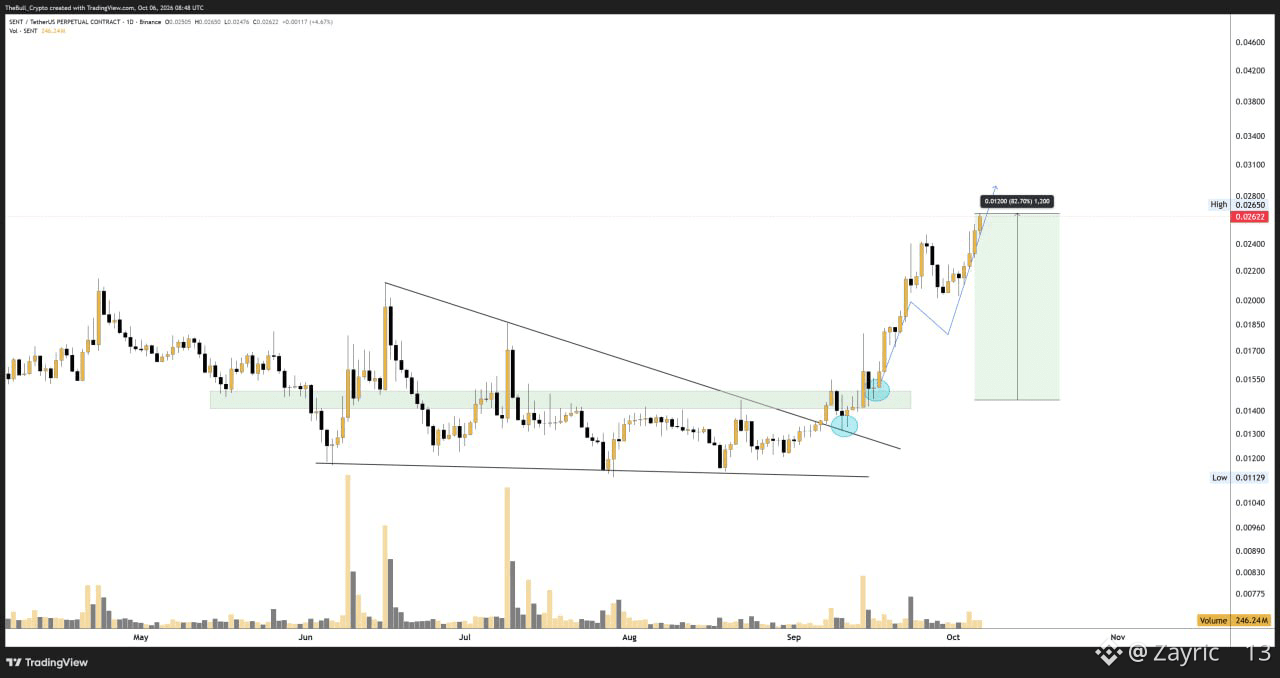

$SENT is up 82% — but the more interesting number isn’t the percentage on the chart.
Sentient’s Ethereum token currently shows roughly 3,600–3,700 holders on Etherscan, while CoinGecko lists about 7.24B SENT circulating against a 34.36B total supply. That distinction matters, especially for a token whose pitch is an open, community-built AGI network.
Here’s the part that gets lost when a holder-growth chart is treated as demand: an Ethereum holder count is simply an address-level snapshot. It doesn’t tell you how many of those addresses are active users, how much each wallet holds, or whether the same economic holder is represented through exchange and custody infrastructure. SENT also uses an 18-decimal ERC-20 contract, so tiny residual balances can remain in wallets after swaps, transfers or other activity. Etherscan itself shows addresses holding amounts as small as 20 SENT or even fractions of a token.
So an apparent jump in holders can look impressive without necessarily representing the same increase in genuine economic participation. I can’t confirm the exact reason for the +82% move from on-chain data alone, and I wouldn’t pretend a holder chart can prove it.
The more meaningful numbers are circulating supply, actual token distribution and how SENT is being used inside the network. Sentient defines SENT as the coordination layer for its chain, GRID and incentive systems, with a fixed total supply of 34,359,738,368 SENT.
If the token is up 82%, the real question isn’t how many wallets appeared — how much actual economic activity came with them?
Sentient’s Ethereum token currently shows roughly 3,600–3,700 holders on Etherscan, while CoinGecko lists about 7.24B SENT circulating against a 34.36B total supply. That distinction matters, especially for a token whose pitch is an open, community-built AGI network.
Here’s the part that gets lost when a holder-growth chart is treated as demand: an Ethereum holder count is simply an address-level snapshot. It doesn’t tell you how many of those addresses are active users, how much each wallet holds, or whether the same economic holder is represented through exchange and custody infrastructure. SENT also uses an 18-decimal ERC-20 contract, so tiny residual balances can remain in wallets after swaps, transfers or other activity. Etherscan itself shows addresses holding amounts as small as 20 SENT or even fractions of a token.
So an apparent jump in holders can look impressive without necessarily representing the same increase in genuine economic participation. I can’t confirm the exact reason for the +82% move from on-chain data alone, and I wouldn’t pretend a holder chart can prove it.
The more meaningful numbers are circulating supply, actual token distribution and how SENT is being used inside the network. Sentient defines SENT as the coordination layer for its chain, GRID and incentive systems, with a fixed total supply of 34,359,738,368 SENT.
If the token is up 82%, the real question isn’t how many wallets appeared — how much actual economic activity came with them?