$10,000 in SanDisk by 2030 — Could It Really Become $30,000?
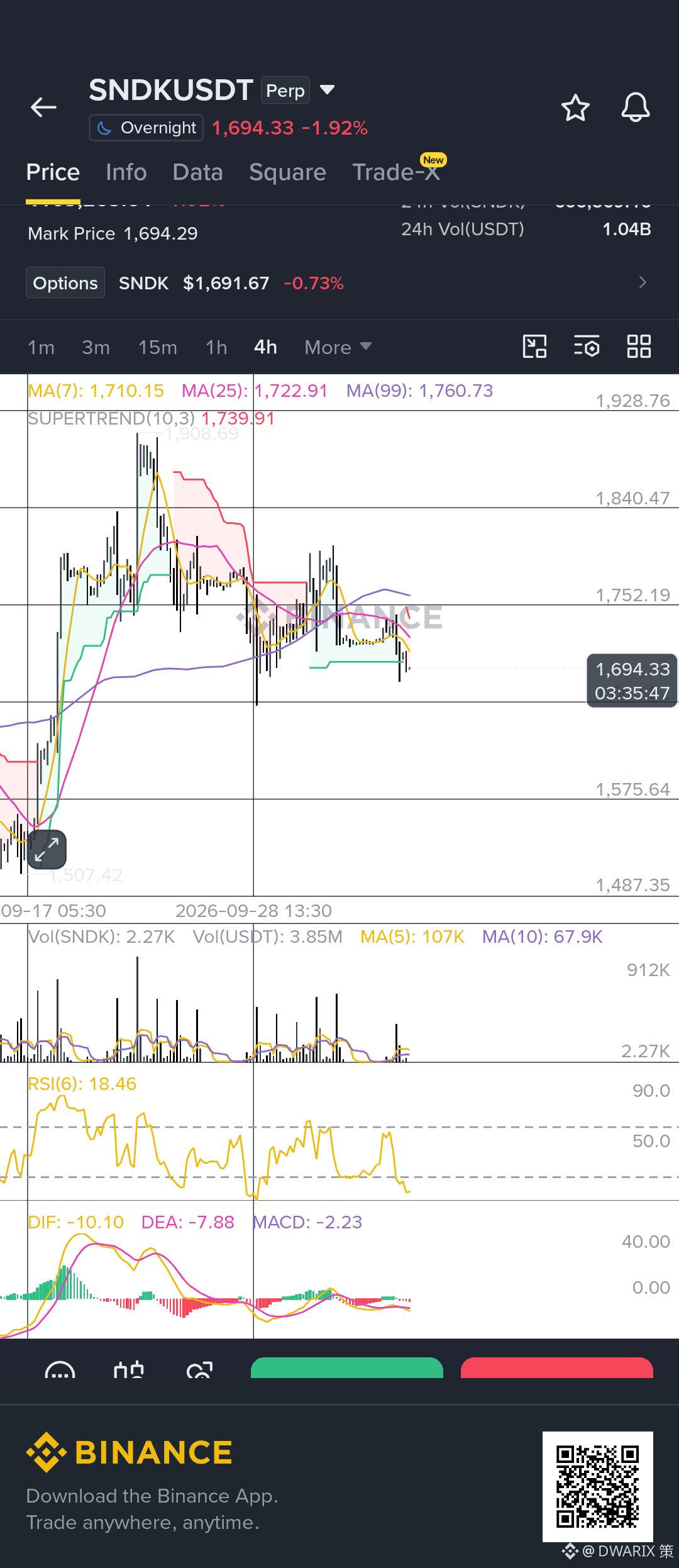
SanDisk ($SNDK ) has quietly become one of the biggest beneficiaries of the AI infrastructure boom.
The interesting part isn't simply that the stock has already rallied sharply. The bigger question is whether the memory-demand cycle can remain strong enough through 2030 to justify another major leg higher.
SanDisk's own long-term outlook is aggressive: it expects mid-to-high teens revenue growth from FY2028–FY2030, with gross margins around 80% and operating margins around 75%. It also expects enterprise data-center flash demand to become dramatically larger as AI inference expands.
And there's an important supply-side factor.
AI doesn't only need GPUs.
It needs enormous amounts of storage to handle models, datasets, inference workloads and rapidly growing data volumes. SanDisk says customer demand is currently growing faster than its available supply, with bits expected to remain allocated beyond 2027.
That's where the bull case comes from:
AI demand → higher storage requirements → tighter NAND supply → stronger pricing → higher earnings.
One recent analysis takes an even more optimistic route. If SanDisk can expand its valuation multiple and continue growing earnings, it estimates that a $10,000 investment could potentially reach around $30,000 by 2030.
But there's a catch.
Memory is historically cyclical. Today's shortage can eventually become tomorrow's oversupply. Competition, NAND pricing, capital expenditure and AI spending all matter.
So the real investment thesis isn't simply:
"AI is growing, therefore SNDK goes up."
It's whether SanDisk can turn today's AI-driven demand into durable earnings and cash flow rather than a temporary memory-cycle spike.
My takeaway:
SanDisk is an interesting example of how the AI trade is expanding beyond the obvious GPU names. The next phase of AI infrastructure may be just as dependent on where the data is stored as where it is processed.
$10K → $30K is a scenario, not a guarantee.
DYOR $SNDK
SanDisk ($SNDK ) has quietly become one of the biggest beneficiaries of the AI infrastructure boom.
The interesting part isn't simply that the stock has already rallied sharply. The bigger question is whether the memory-demand cycle can remain strong enough through 2030 to justify another major leg higher.
SanDisk's own long-term outlook is aggressive: it expects mid-to-high teens revenue growth from FY2028–FY2030, with gross margins around 80% and operating margins around 75%. It also expects enterprise data-center flash demand to become dramatically larger as AI inference expands.
And there's an important supply-side factor.
AI doesn't only need GPUs.
It needs enormous amounts of storage to handle models, datasets, inference workloads and rapidly growing data volumes. SanDisk says customer demand is currently growing faster than its available supply, with bits expected to remain allocated beyond 2027.
That's where the bull case comes from:
AI demand → higher storage requirements → tighter NAND supply → stronger pricing → higher earnings.
One recent analysis takes an even more optimistic route. If SanDisk can expand its valuation multiple and continue growing earnings, it estimates that a $10,000 investment could potentially reach around $30,000 by 2030.
But there's a catch.
Memory is historically cyclical. Today's shortage can eventually become tomorrow's oversupply. Competition, NAND pricing, capital expenditure and AI spending all matter.
So the real investment thesis isn't simply:
"AI is growing, therefore SNDK goes up."
It's whether SanDisk can turn today's AI-driven demand into durable earnings and cash flow rather than a temporary memory-cycle spike.
My takeaway:
SanDisk is an interesting example of how the AI trade is expanding beyond the obvious GPU names. The next phase of AI infrastructure may be just as dependent on where the data is stored as where it is processed.
$10K → $30K is a scenario, not a guarantee.
DYOR $SNDK