



I’ve been looking at the headline #ETHUp70%InQ3ButLiquidityFalls, and honestly, I keep getting stuck on the second half.
$ETH gaining around 70% in Q3 looks extremely bullish at first.
But then I noticed the liquidity side moving differently.
And I’m not sure that contradiction is getting enough attention. 🤔
Usually, when an asset rallies this hard, I’d expect deeper liquidity, more participation, and stronger market depth.
Instead, we’re looking at a strange situation where price is getting stronger while the market underneath it may be getting thinner.
That makes me ask a different question:
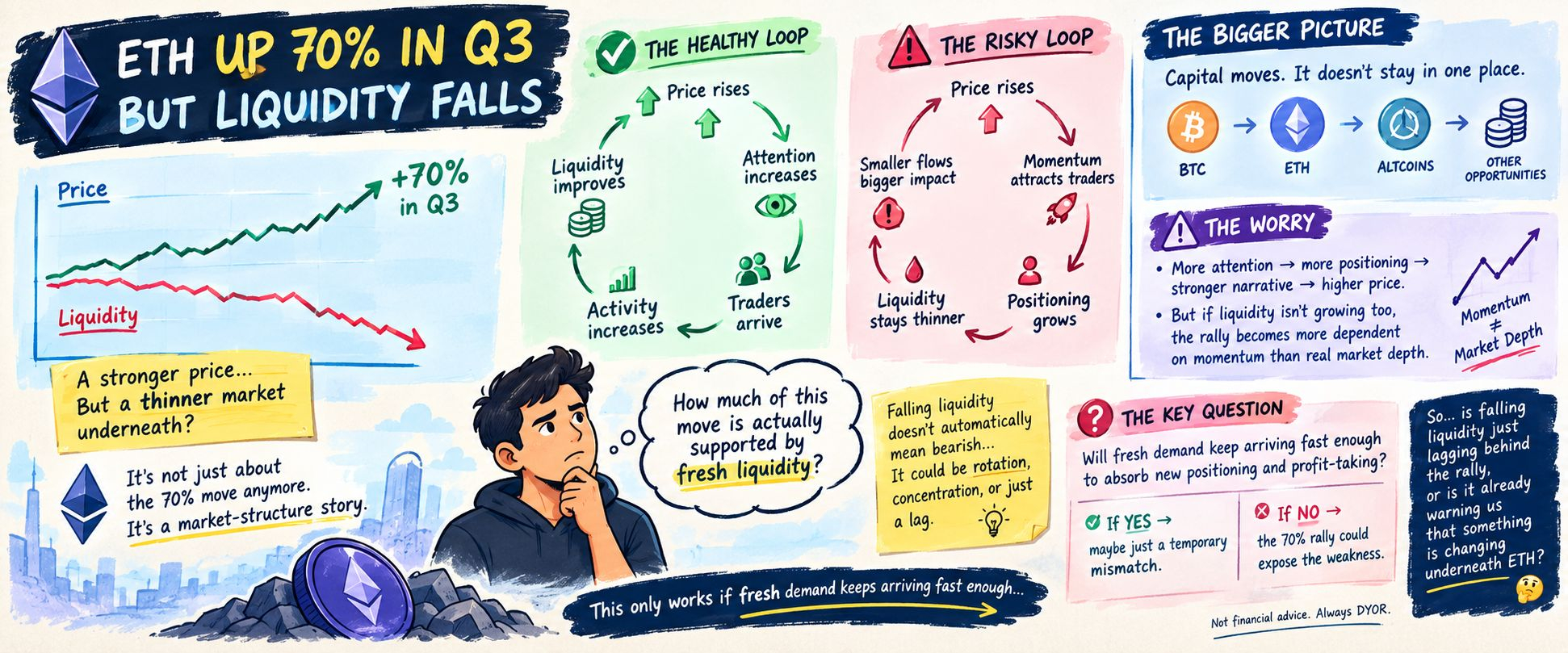
How much of this move is actually being supported by fresh liquidity?
Because there are two loops here.
The obvious one is:
Price rises → attention increases → traders arrive → activity increases → liquidity improves.
That’s the healthy version.
But there’s another loop I can’t ignore.
Price rises → momentum attracts traders → positioning grows → liquidity stays thinner → smaller flows can have a bigger impact.
That second one makes me a little nervous. 📉
Not because falling liquidity automatically means $ETH is bearish.
It doesn’t.
Capital could simply be rotating, traders could be concentrating elsewhere, or market depth could just be lagging behind the price move.
But the divergence still matters.
I’ve started thinking about this less as a price story and more as a market-structure story.
A chart can look stronger while the underlying ability to absorb buying and selling becomes weaker.
That’s a very different kind of strength.
And here’s what worries me most:
If ETH keeps attracting attention faster than it attracts actual liquidity, expectations can start rising faster than the market’s ability to absorb exits.
More price appreciation → more attention → stronger expectations → more positioning.
Then someone starts taking profit.
What makes this more interesting to me is the broader liquidity rotation happening across crypto.
Capital doesn’t stay in one place forever. It moves toward the assets with the strongest momentum, narratives, and perceived opportunity.
And that might explain part of what we’re seeing with $ETH.
More attention → more positioning → stronger narrative → higher price.
But if liquidity isn’t expanding alongside that attention, the rally may be becoming increasingly dependent on momentum rather than actual market depth.
That’s why I’m watching the liquidity divergence more closely than the 70% number itself.
And honestly, I’m still not sure what to make of it.
Maybe falling liquidity is simply temporary, and deeper capital eventually follows the price.
Or maybe the market is showing us something before the chart does.
Because if $ETH keeps attracting attention faster than it attracts liquidity, the same momentum pushing the price higher could eventually make the move more fragile.
That creates an uncomfortable possibility:
The stronger the narrative becomes, the more liquidity it may need to sustain it.
But if that liquidity doesn’t arrive, what happens when positioning starts unwinding?
That’s the part I can’t really answer yet. 👀
This only works if fresh demand keeps arriving fast enough to absorb both new positioning and eventual profit-taking.
So I’m not really asking whether $ETH can keep going.
I’m wondering whether the liquidity underneath the move can keep up with the narrative around it.
If it can, maybe the current liquidity weakness is just a temporary mismatch.
If it can’t, then the 70% rally might eventually be what exposes the weakness.
And honestly, I’m not sure which one we’re watching yet.
What do you think — is falling liquidity simply lagging behind the rally, or is it already warning us that something underneath $ETH is changing?
Not financial advice. Always DYOR.