


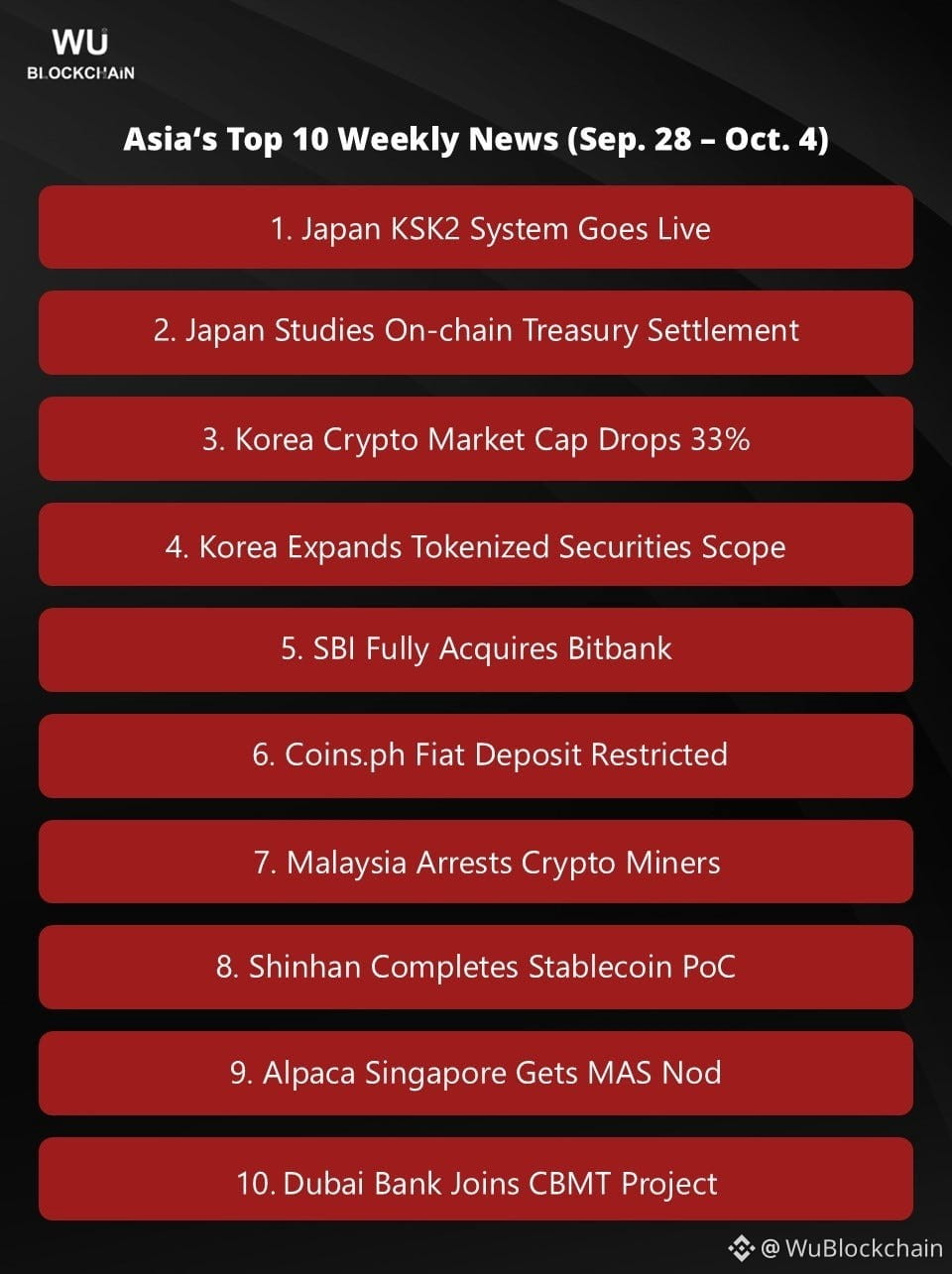
1. Japan’s NTA Officially Rolls Out KSK2 System to Strengthen Detection of Undeclared Crypto Asset Declarations link
Japan’s National Tax Agency officially launched its new-generation core tax system KSK2 on September 24, consolidating previously scattered data and applications for different tax types to strengthen tax information analysis and return verification. Citing tax authority documents, CoinPost reported that annual transaction reports from crypto asset exchanges, bank fund records and overseas tax information exchange data can be used to identify potential omissions in crypto asset transaction filings. Japan’s National Tax Agency confirmed the completion of the KSK2 system update on September 24, though the announcement did not disclose specific AI analysis rules targeting crypto assets.
2. Japan’s Ministry of Finance Establishes Research Panel for Real-Time On-Chain Government Bond Settlement link
Japan’s Ministry of Finance announced on September 30 the establishment of the “On-Chain Application Research Group” to study the feasibility of real-time settlement for government bond transactions, with its first meeting scheduled for October 8. Centered on the existing T+1 settlement system, the research group will analyze the pros, cons and implementation challenges of on-chain real-time settlement. Operated by the Ministry of Finance, it will host discussions with participation from the Bank of Japan and the Financial Services Agency. Members include professors Takahito Kato and Akira Kamo from the University of Tokyo, associate professor Junnosuke Shino from Waseda University, and private-sector strategist Shotaro Morita from an asset management firm. The Ministry of Finance noted that the United States already has money market fund products backed by treasury securities that can be traded on blockchains. The group will reference such cases and aims to compile key discussion points within the year.
3. South Korea’s Virtual Asset Market Cap Drops 33% in Half-Year to 58.9 Trillion Won link
Data from South Korea’s Financial Services Commission (FSC) shows that as of the end of June 2026, the total market capitalization of South Korea’s virtual asset market stood at 58.9 trillion won (approximately 43.4 billion US dollars), down 33% from 87.2 trillion won six months earlier. Over the same period, the average daily trading volume dropped from 5.4 trillion won to 3.1 trillion won, and the total KRW deposits held by traders fell by 35% to 5.2 trillion won. Nevertheless, the number of market users edged up 0.4% to roughly 11.17 million. As of the end of June, South Korea had 26 virtual asset operators, including 17 crypto exchanges.
4. South Korea’s FSC Proposes Expanding Tokenized Securities to Stocks, Bonds and Funds link
South Korea’s Financial Services Commission (FSC) has unveiled draft revisions to subsidiary regulations for security tokens (ST), proposing to expand the scope of tokenizable assets from fractional investment products such as non-monetary trust beneficial rights and investment contract securities to traditional securities including stocks, bonds and funds. The revisions to the Electronic Securities Act and the Capital Markets Act will take effect on February 4, 2027. The draft also stipulates that retail investors shall have an annual net purchase cap of 100 million won per over-the-counter trading platform for tokenized securities. Issuers may apply to act directly as account management institutions upon meeting requirements including a minimum capital of 4 billion won and deployment of qualified professionals. The draft will be open for public comment from October 2 to November 11.
5. SBI Completes Full Acquisition of Japanese Crypto Exchange Bitbank for Approximately 46.7 Billion Yen link
Japan’s major licensed crypto exchange Bitbank announced on October 1 the completion of its full subsidiary acquisition by SBI Holdings. Bitbank repurchased shares held by MIXI and Ceres, finalizing all previously planned transactions. Bitbank is now a 100% indirectly owned subsidiary of SBI Holdings. SBI previously disclosed that the total consideration for the share acquisition and capital increase was approximately 46.7 billion yen. Noriyuki Hirosue remains CEO of Bitbank. Bitbank stated that the transaction will not disrupt existing exchange services, and it will leverage SBI’s financial capabilities, customer base and resources to expand its digital asset business.
6. Philippine Central Bank Restricts Fiat Deposit Channels for Local Crypto Exchange Coins.ph link
The Bangko Sentral ng Pilipinas (BSP) has imposed a partial suspension on DCPay Philippines, the e-money entity behind Coins.ph, barring it from receiving incoming funds via InstaPay and PESONet, including personal transfers, InstaPay QR credits and InstaPay for Business. The restriction applies to DCPay’s peso payment and clearing operations. Coins.ph’s crypto trading business is operated by another licensed entity, Betur Inc., and is not directly suspended by the directive, though users’ peso cash-ins to Coins.ph via local banks will be affected. The regulatory order still permits DCPay to process outgoing transfers and QRPh merchant payments. Coins.ph’s official status page shows that the relevant InstaPay and PESONet cash-in services are currently under maintenance, while withdrawal services remain functional. Founded in 2014, Coins.ph is one of the Philippines’ leading local crypto platforms.
7. Malaysian Police Detain Two Men Suspected of Electricity Theft for Crypto Mining link
Police in Malaysia’s Perak state discovered a suspected Bitcoin mining site operating with illegally tapped electricity in Seri Iskandar and detained two local men for investigation. In a joint operation with Tenaga Nasional Berhad (TNB), authorities seized 30 Bitcoin mining machines, one router, one network switch and a roll of electrical wiring. The case is being investigated under Section 427 of the Penal Code and Section 37(1) of the Electricity Supply Act 1990. Police stated that crypto mining involving electricity theft is not only illegal but may also cause substantial losses to power suppliers and raise fire hazards.
8. Shinhan Bank and Solana Foundation Complete PoC for Corporate Cross-Border Stablecoin Remittances link
Shinhan Bank and the Solana Foundation have completed a proof-of-concept (PoC) for corporate cross-border stablecoin remittances based on Solana’s private solution, marking the first validation of this solution for remittance services by an Asian financial institution. Transactions are processed through a private channel accessible only to authorized participants; sensitive data such as counterparties and transfer amounts are not directly recorded on the Solana mainnet, while connectivity to mainnet liquidity is retained. The test covered the full workflow including corporate-initiated remittances, bank execution, fund conversion and transfer, receipt and refunds, and verified a processing structure without traditional correspondent banks.
9. Alpaca’s Singapore Subsidiary Receives In-Principle MAS License Approval link
Global brokerage infrastructure provider Alpaca announced that its Singapore subsidiary Alpaca Securities Pte. Ltd. has obtained in-principle approval for a Capital Markets Services (CMS) licence from the Monetary Authority of Singapore (MAS). Upon satisfying relevant conditions and securing the full licence, the firm plans to offer brokerage and custody services in Singapore and act as a regulated local counterparty serving financial institutions and fintech firms across Southeast Asia. Alpaca stated that Singapore will serve as its key hub for expanding into the Southeast Asian market. This in-principle approval is not equivalent to a full licence.
10. Commercial Bank of Dubai Joins Germany’s CBMT Tokenized Deposit Project link
Commercial Bank of Dubai (CBD) announced its participation in Germany’s CBMT tokenized deposit initiative, becoming the first bank outside Europe to join. It will enter the CBMT Sandbox to test corporate cross-border payments, trade settlement, treasury management and working capital optimization for the Europe-Gulf corridor. Driven by German banks, CBMT’s participants include Commerzbank, UniCredit, BNP Paribas and ABN AMRO, DNB. The core concept is to tokenize commercial bank deposits for on-chain settlement. Such assets remain on the issuing banks’ balance sheets, differing from stablecoins issued outside the banking system.
Follow us
Twitter: https://twitter.com/WuBlockchain
Telegram: https://t.me/wublockchainenglish