



Chainalysis Ties $387M Bitget Hack to North Korea as AI Tracing Collapses a 20-Hour Hunt Into Minutes
North Korea's 2026 crypto theft ledger just crossed $1 billion — and the forensic trail was closed by machines, not analysts.
Cold Open
$387 million. 23 transfers. Three hours. Four blockchains.

That is the operational tempo of the Sept. 24 Bitget breach, now formally attributed by Chainalysis to North Korea-linked actors. The attribution matters less than the mechanics: Pyongyang's 2026 crypto haul has now cleared $1 billion, and the laundering playbook has evolved into something that looks less like theft and more like high-frequency exfiltration.
The headline number is the AI angle. Chainalysis says its in-house models compressed 20+ hours of manual tracing work into minutes — a race-condition arms deal in which defenders now deploy machine-speed forensics against machine-speed laundering.
The Chronological Breakdown
Sept. 24 — The Breach
Bitget is drained of $387 million. Within the first three hours, the funds exit across 23 separate transfers, fanning out onto four networks in a deliberately asymmetric split:
Ethereum: 49.7% (~$192M)
XRP: 40.8% (~$158M)
Zcash: 7.6% (~$29M)
Tron: 1.8% (~$7M)
The distribution is not random. Nearly half parked on Ethereum gives attackers access to the deepest DeFi liquidity and the widest bridge surface. The XRP allocation — the second-largest slice — is the tell that something more sophisticated than a simple mixer run is underway.
Hours 3–36 — The Laundering Engine
From the initial four-chain spread, the attackers route funds through cross-chain liquidity and messaging protocols, instant swaps, and laundering services. This is the modern obfuscation stack: no single choke point, no single jurisdiction, no single asset to freeze.
The XRP tranche draws specific attention. Rather than pushing stolen XRP to a centralized exchange — the classic, heavily-monitored exit — the attackers ran it through a cross-chain liquidity protocol and pulled Bitcoin out the other side. Tens of millions of dollars moved this way over roughly a day and a half, terminating in attacker-controlled Bitcoin addresses that are now under active surveillance.
That XRP-to-Bitcoin conversion is the structural innovation worth studying. It converts a traceable, issuer-adjacent asset into the most liquid, most decentralized, and most censorship-resistant settlement layer in the market — while breaking the on-chain continuity that legacy tracing tools depend on.
Oct. 1–3 — The Attribution Consensus Hardens
Chainalysis publishes its report, formally pinning the breach on DPRK-linked actors and confirming it had been working with Bitget and law enforcement since the attack. The firm's assessment echoes earlier DPRK attributions from Bitget's CEO and Elliptic — a three-way convergence that effectively closes the attribution question.
The AI disclosure is the operational headline: Chainalysis states its in-house models accelerated tracing by collapsing 20+ hours of analyst work into minutes. In a laundering window measured in hours, that compression is the difference between following the money and losing it.
Trading Angle
What this means for market structure, open interest, and key tokens.
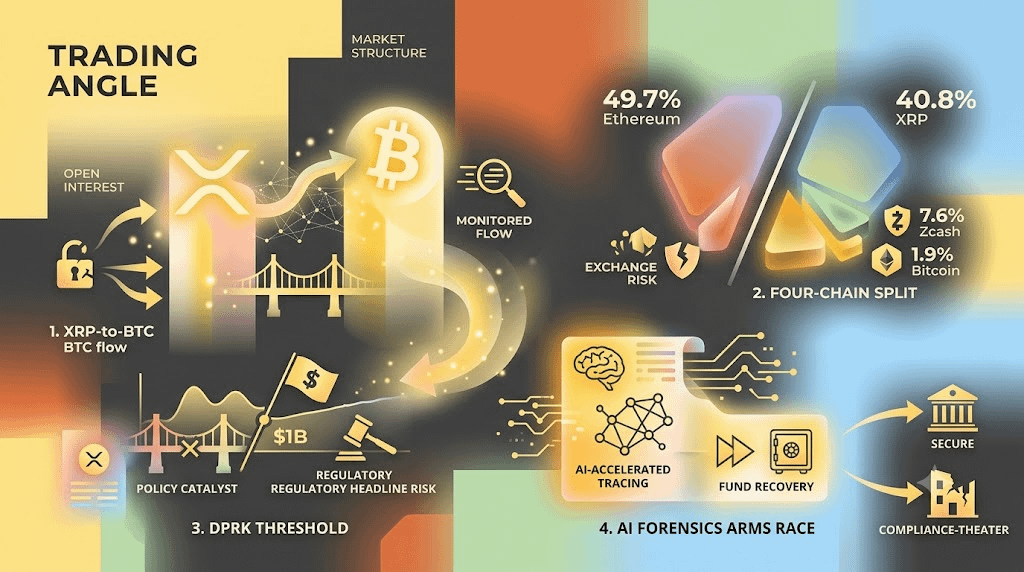
The Bitget event is a supply-side story disguised as a security story. Here is how to read it.
1. The XRP-to-Bitcoin pipeline is now a monitored flow, not a black box.
Tens of millions in stolen XRP were converted into Bitcoin over ~36 hours. That is real, if modest, buy-side pressure on BTC and sell-side pressure on XRP during the conversion window — but the more durable signal is behavioral. Attackers now treat Bitcoin as the terminal settlement asset of choice. Expect Chainalysis and peer firms to build dedicated detection heuristics around cross-chain liquidity protocol outflows into BTC. Watch large, rapid XRP-to-BTC conversion patterns on cross-chain venues as a leading indicator of active laundering campaigns — and by extension, of near-term headline risk for exchanges.
2. The four-chain split is a template, and it changes how you read exchange risk.
Ethereum at 49.7% and XRP at 40.8% is a near-even two-chain hedge with a Zcash privacy tail. Zcash's 7.6% allocation is small in dollar terms but strategically significant — it signals that privacy assets retain a role in the laundering stack even as cross-chain swaps mature. For traders, this means exchange solvency risk is no longer a single-chain question. Due diligence on any venue now requires understanding its multi-chain hot wallet exposure, not just its BTC and ETH reserves.
3. The $1 billion DPRK threshold is a policy catalyst.
North Korea-linked theft crossing $1 billion in 2026 gives regulators and law enforcement a fresh, quantified mandate. Expect accelerated pressure on cross-chain bridges, messaging protocols, and instant-swap venues — the exact infrastructure the attackers exploited. Regulatory headline risk is now concentrated in the bridge and cross-chain liquidity sector. Protocols with weak compliance postures face elevated delisting, banking, and enforcement risk. Position accordingly.
4. The AI forensics arms race is a structural tailwind for compliance-native infrastructure.
Chainalysis compressing 20+ hours into minutes is not just a PR win — it is a competitive moat. Exchanges that integrate AI-accelerated tracing will recover funds faster and retain institutional counterparties. Exchanges that don't will become laundering conduits by default and get priced for it. The market is beginning to differentiate between compliance-native venues and compliance-theater venues — and that spread will widen.
Key levels and monitoring priorities:
Bitcoin: The stolen XRP conversion created a measurable BTC bid over ~36 hours. Watch for recurrence patterns — repeated cross-chain inflows into BTC addresses flagged by analytics firms often precede broader risk-off sentiment in altcoins.
XRP: The 40.8% allocation and subsequent conversion out of XRP is a reminder that the asset's deep liquidity cuts both ways. Large unexplained XRP movements through cross-chain protocols should be treated as a volatility flag.
Zcash: The 7.6% privacy-asset allocation keeps ZEC on the compliance radar. Expect elevated scrutiny and potential exchange-level restrictions.
Cross-chain liquidity and messaging protocols: This is where the regulatory hammer lands. Sector-wide de-rating risk is live.
The broader tape:
The Bitget attribution lands alongside two other data points worth folding into your framework. Drift has opened exploit recovery claims with initial payouts of just over 1% of user losses — a stark reminder that post-hack recovery is structurally inadequate, and that prevention (not reimbursement) is the only real risk management. Meanwhile, the observation that crypto's billions are back but the premiums aren't signals that capital has returned to the asset class without the valuation froth of prior cycles. That is a market where security failures get punished harder, because there is less speculative cushion to absorb them.
Net positioning read: The DPRK attribution is bearish for cross-chain bridge tokens and privacy assets on regulatory grounds, neutral-to-mildly-constructive for Bitcoin as the terminal settlement asset, and structurally bullish for compliance-native analytics and exchange infrastructure. The AI tracing disclosure is the most underappreciated signal in the stack — it marks the moment forensic defense reached parity with laundering offense, and the market has not yet priced the winners.
Sources
Decrypt: Chainalysis Used AI to Trace the $387M Bitget Hack Back to North Korea
The Block: Drift opens exploit recovery claims with initial payouts of just over 1% of user losses
Cointelegraph: Crypto's billions are back, but the premiums aren't
💡 Disclaimer: This analysis compiles verified media reports and open-source intelligence for independent research (DYOR). Digital asset markets are highly volatile; scenarios discussed do not constitute financial advice or investment recommendations.
#CryptoNews #BinanceSquare #MarketUpdate #Bitcoin #NorthKorea