

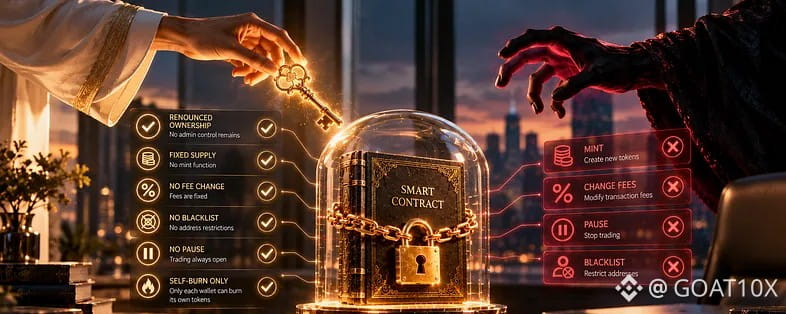

Most people check the price. Almost no one checks who still has the keys.
When people hear a token has an “owner,” they often picture something like a company CEO. In smart contracts, ownership means something much narrower — and much easier to verify.
What “Owner” Means in a Smart Contract
In most token contracts, the “owner” is simply an address with permission to call certain administrative functions written into the code — nothing more, nothing less. It doesn’t mean that address holds all the tokens, or that it has unlimited power. What it can do is defined entirely by what functions the contract allows the owner to call.
This is why reading the contract matters more than reading a project’s description of itself. The code is the actual rulebook.
Why Ownership Design Is a Red Flag Checklist in Itself
A few ownership patterns are worth knowing, because they tell you how much trust a project is actually asking for:
No owner functions at all. Fully immutable contracts with zero admin control. Maximum trustlessness, but also no ability to fix bugs later.
A single owner wallet with broad powers (mint new tokens, change fees, pause trading). This is the highest-risk pattern, since one compromised or malicious key can affect everyone.
A single owner with narrow, limited powers, often ones that can only be used once or within strict bounds.
Multisig ownership, where several independent parties must all approve before any admin action executes — reducing single-point-of-failure risk.
Renounced ownership, where the owner address is permanently given up, so no admin functions can ever be called again by anyone.
None of these is automatically “best” — a contract with zero admin functions can’t fix a bug if one is found later. The right question isn’t “does it have an owner,” but “what can that owner actually do, and has it already used that power?”
A Real Example
GOLDITY (GDTY) is a useful case because its contract never granted broad administrative powers to begin with. From deployment, the owner had no ability to mint new tokens, change fees, blacklist addresses, or pause trading — none of those functions exist anywhere in the code. The contract does include a burn function, but it only lets each wallet destroy its own tokens; there is no function, for the owner or anyone else, that can burn tokens out of another wallet. The owner’s only administrative capability, ever, was a single narrow function unrelated to any of this: registering four vesting contract addresses, usable exactly once.