
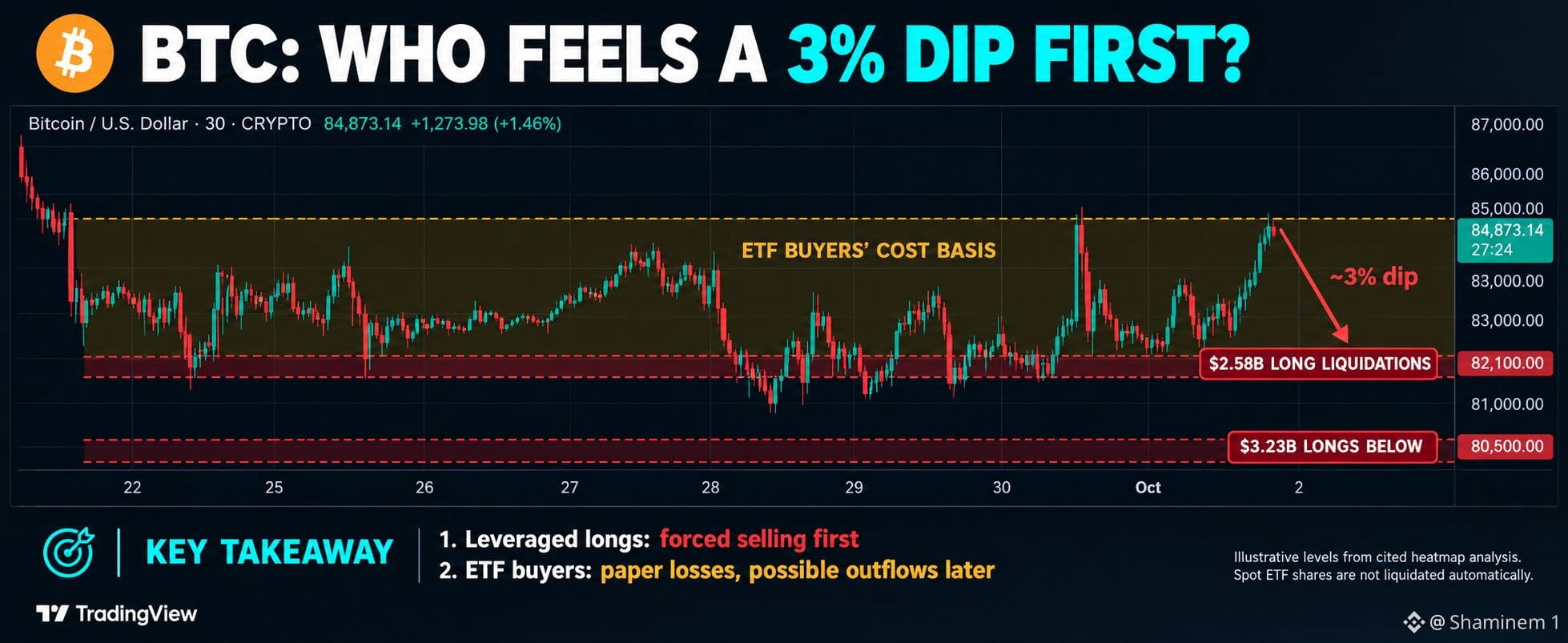
Different kinds of pain, and that's the actual answer. Leveraged longs get hit first, mechanically and instantly. The heatmap shows roughly $2.58 billion in long liquidations clustered right around $82,100, with another $3.23 billion stacked just below $80,500. A 3% dip in $BTC from current levels in the low $84,000s lands almost exactly on that first cluster. Those positions close the moment price touches them, no decision involved. ETF buyers don't get liquidated in that mechanical sense, there's no forced selling button on a spot ETF share. But they're not immune either. The $82,000 to $85,000 zone has become the densest cost basis band from September's rally, meaning a dip through $82K would push the most recent buyers straight into a loss. That's where the real second-order risk sits, not a forced close, but the kind of paper loss that shows up as outflows a day or two later if the dip holds. Worth knowing why $82K specifically matters so much. Below it, liquidation clusters thin out fast, so losing the level tends to accelerate a move rather than cushion it. ETF flows already cooled hard into month end too, from $999 million on September 21 down to just $31 million a few days later, so there's less fresh buying ready to absorb a flush than there was two weeks ago. So on a 3% dip Longs liquidate first, in minutes. The newest ETF buyers are the ones who actually feel it next, not through forced selling, but through being underwater and deciding whether to hold. #BTC Price Analysis#


Veröffentlichen
Haftungsausschluss: Enthält Meinungen von Drittanbietern. Keine Beratung. Binance AI wird ohne Gewähr bereitgestellt. Siehe AGB.