

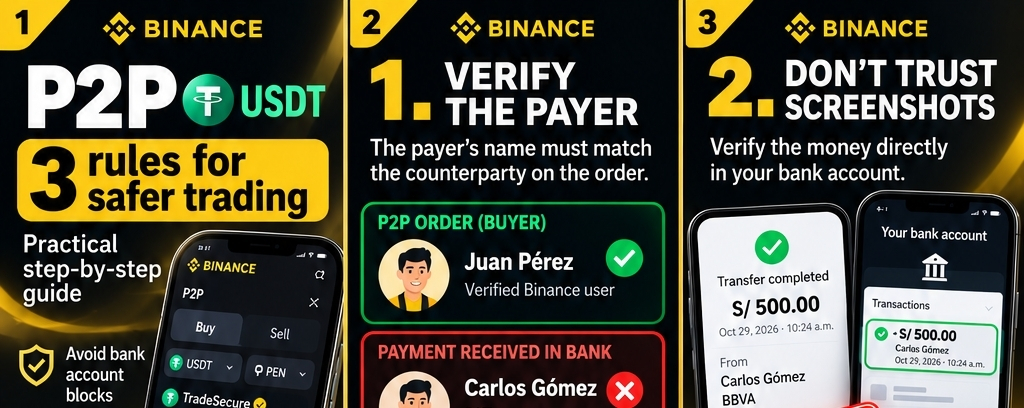

🚨 Binance P2P: 3 Mistakes That Can Put Your Funds at Risk — and How to Avoid Them
Binance P2P (Peer-to-Peer) provides a practical way to buy and sell cryptocurrencies directly with other users. But convenience also requires discipline. A seemingly small mistake—such as accepting a payment from a third party or releasing crypto before properly verifying the payment—can create financial or dispute-related problems.
Here are three common mistakes and simple ways to reduce the risk.
1️⃣ Accepting Third-Party Payments
❌ The mistake
You are trading with John Smith, but the payment comes from a bank account belonging to Michael Brown.
The buyer might say:
“It's my brother's account.”
“My wife made the payment.”
“My friend is helping me.”
The problem is that the name of the person making the payment does not match the verified name of the counterparty.
✅ What should you do?
Before releasing your crypto:
1. Check the buyer's name.
2. Check the name of the bank account that sent the payment.
3. Verify the exact amount received.
4. If the information does not match, do not release the crypto immediately.
📌 Practical example
P2P order: John Smith — 1,000 USDT
Payment received from: Michael Brown — S/ 3,500
🚨 Do not automatically complete the transaction.
Keep your evidence and use Binance's appeal/support process when appropriate.
2️⃣ Failing to Keep Evidence of Your Transactions
❌ The mistake
After completing a transaction, you delete:
Screenshots
Chat conversations
Bank receipts
Order numbers
Dates and times
Payment information
Everything may seem fine at the time, but if a dispute arises later, having an organized record can help establish what actually happened.
✅ A simple solution
Create a folder such as:
📁 BINANCE P2P — OCTOBER 2026
Inside, create a folder for each transaction:
📂 Transaction 001
Order screenshot
Bank receipt
Relevant chat screenshots
📂 Transaction 002
Order screenshot
Payment receipt
Relevant evidence
This gives you a clear record of your P2P activity.
3️⃣ Moving the Negotiation Outside Binance
❌ The mistake
A buyer or seller tells you:
“Let's talk on WhatsApp.”
Or:
“I'll send you my details on Telegram.”
Or:
“Make the payment directly and we'll finish the order afterward.”
Moving the negotiation outside the platform can make the transaction harder to document and resolve if something goes wrong.
✅ The practical rule
P2P Order → P2P Chat → Payment → Verification → Release
Keep the relevant communication inside the Binance P2P chat whenever possible.
And one very important point:
💰 Never release crypto simply because someone sends you a screenshot.
Check your actual bank account and confirm that the money has arrived and that the amount matches the P2P order.
🛡️ My P2P Checklist Before Releasing Crypto
Before clicking “Release”, ask yourself:
☑️ Has the money actually arrived in my bank account?
☑️ Does the amount match the order?
☑️ Does the payer's name match the counterparty?
☑️ Is the transaction still being handled through Binance P2P?
☑️ Have I kept the relevant evidence?
☑️ Is there anything unusual or pressure to release the crypto quickly?
If something doesn't match, stop and review the situation before releasing the funds.
🚨 What If Something Goes Wrong?
Don't try to resolve a suspicious transaction by improvising.
Keep all relevant evidence, use the order's chat, and, when appropriate, submit an appeal through Binance P2P.
The goal is simple:
Verify → Document → Communicate → Then Release.
🎯 Conclusion
P2P trading isn't only about finding a good price. It also requires verification, documentation, and transaction traceability.
Remember these three rules:
👤 1. IDENTITY
Avoid third-party payments and verify that the relevant names match.
📂 2. EVIDENCE
Keep receipts, orders, and relevant conversations.
💬 3. TRACEABILITY
Keep the transaction and communication within Binance P2P whenever possible.
A safer P2P transaction starts before the money arrives: verify who you are dealing with, confirm the payment independently, preserve your evidence, and only then release the crypto.