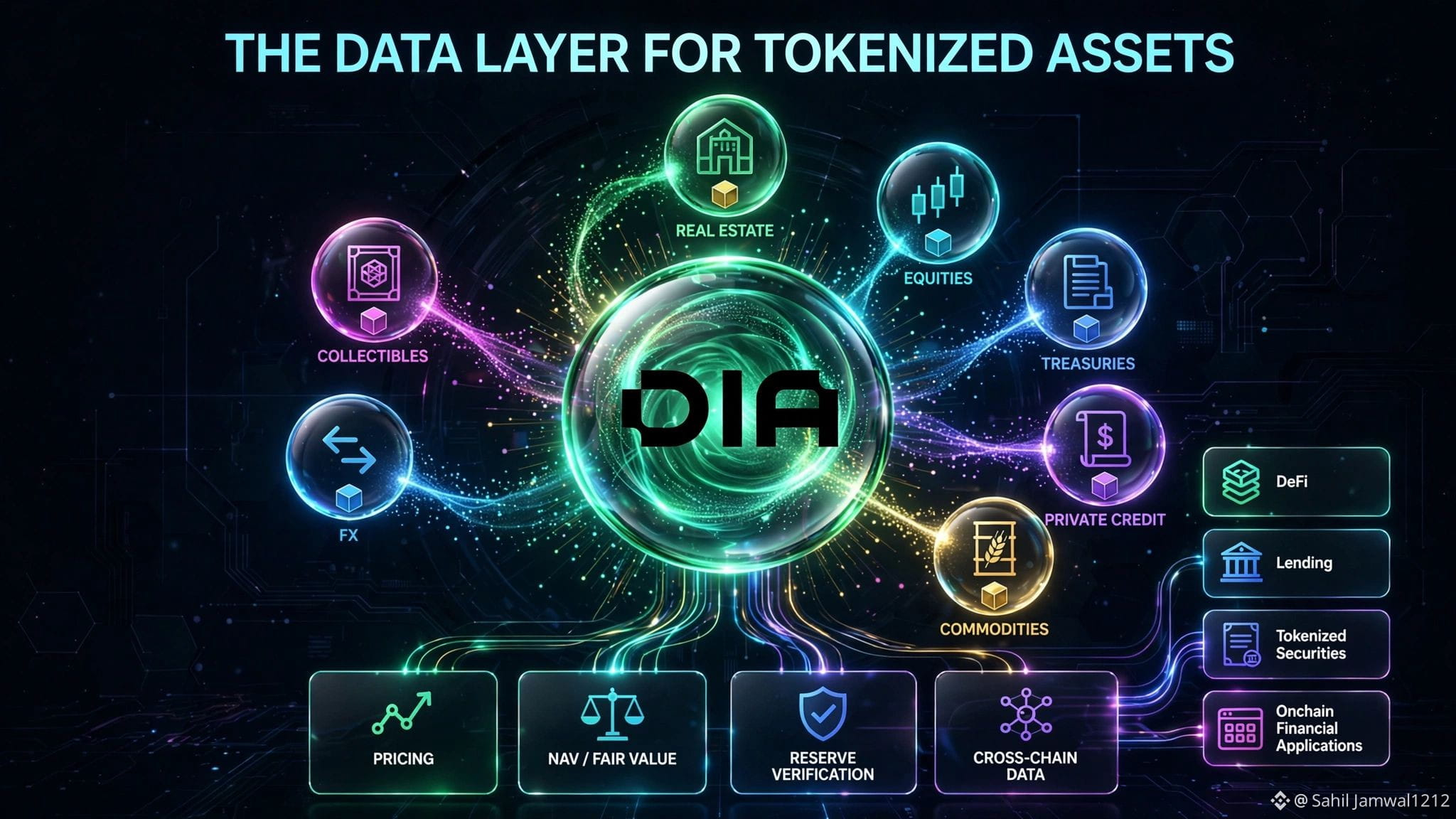
I keep coming back to one macro trend when researching DIA:
What happens when more of the global financial system becomes tokenized?
We're already seeing tokenization across:
🏠 Real estate
📈 Equities
🏦 Treasuries
💰 Private credit
🌾 Commodities
💱 Foreign currencies
And tokenization creates a data problem.
A token representing an asset still needs reliable information about that asset.
Depending on the application, that could mean:
→ Price discovery
→ Fair-value/NAV calculations
→ Reserve verification
→ FX data
→ Collateral valuation
→ Cross-chain oracle delivery
This is where DIA's RWA infrastructure gets interesting.
DIA isn't limited to basic crypto price feeds. Its broader stack includes RWA data, fundamental valuation and verification-oriented products.
There are already examples such as ST0x using DIA data for tokenized securities and Twin Finance using DIA oracles for local-currency stablecoin markets.
The macro opportunity is much bigger than today's market.
Some industry forecasts project tokenized real-world assets reaching multi-trillion-dollar valuations by 2030, although estimates vary considerably depending on definitions and assumptions.
I wouldn't translate that directly into a DIA valuation.
The more useful question is:
If trillions of dollars of assets eventually become programmable, how much of the supporting data infrastructure will oracle networks capture?
That's the part of the RWA thesis I'm watching.
DIA is positioning itself for that transition beyond crypto-native DeFi. $DIA
What happens when more of the global financial system becomes tokenized?
We're already seeing tokenization across:
🏠 Real estate
📈 Equities
🏦 Treasuries
💰 Private credit
🌾 Commodities
💱 Foreign currencies
And tokenization creates a data problem.
A token representing an asset still needs reliable information about that asset.
Depending on the application, that could mean:
→ Price discovery
→ Fair-value/NAV calculations
→ Reserve verification
→ FX data
→ Collateral valuation
→ Cross-chain oracle delivery
This is where DIA's RWA infrastructure gets interesting.
DIA isn't limited to basic crypto price feeds. Its broader stack includes RWA data, fundamental valuation and verification-oriented products.
There are already examples such as ST0x using DIA data for tokenized securities and Twin Finance using DIA oracles for local-currency stablecoin markets.
The macro opportunity is much bigger than today's market.
Some industry forecasts project tokenized real-world assets reaching multi-trillion-dollar valuations by 2030, although estimates vary considerably depending on definitions and assumptions.
I wouldn't translate that directly into a DIA valuation.
The more useful question is:
If trillions of dollars of assets eventually become programmable, how much of the supporting data infrastructure will oracle networks capture?
That's the part of the RWA thesis I'm watching.
DIA is positioning itself for that transition beyond crypto-native DeFi. $DIA