I've been looking deeper into DIA's approach to oracle verification, and I think the more interesting question is bigger than simply:
“How do you get data onchain?”
It's:
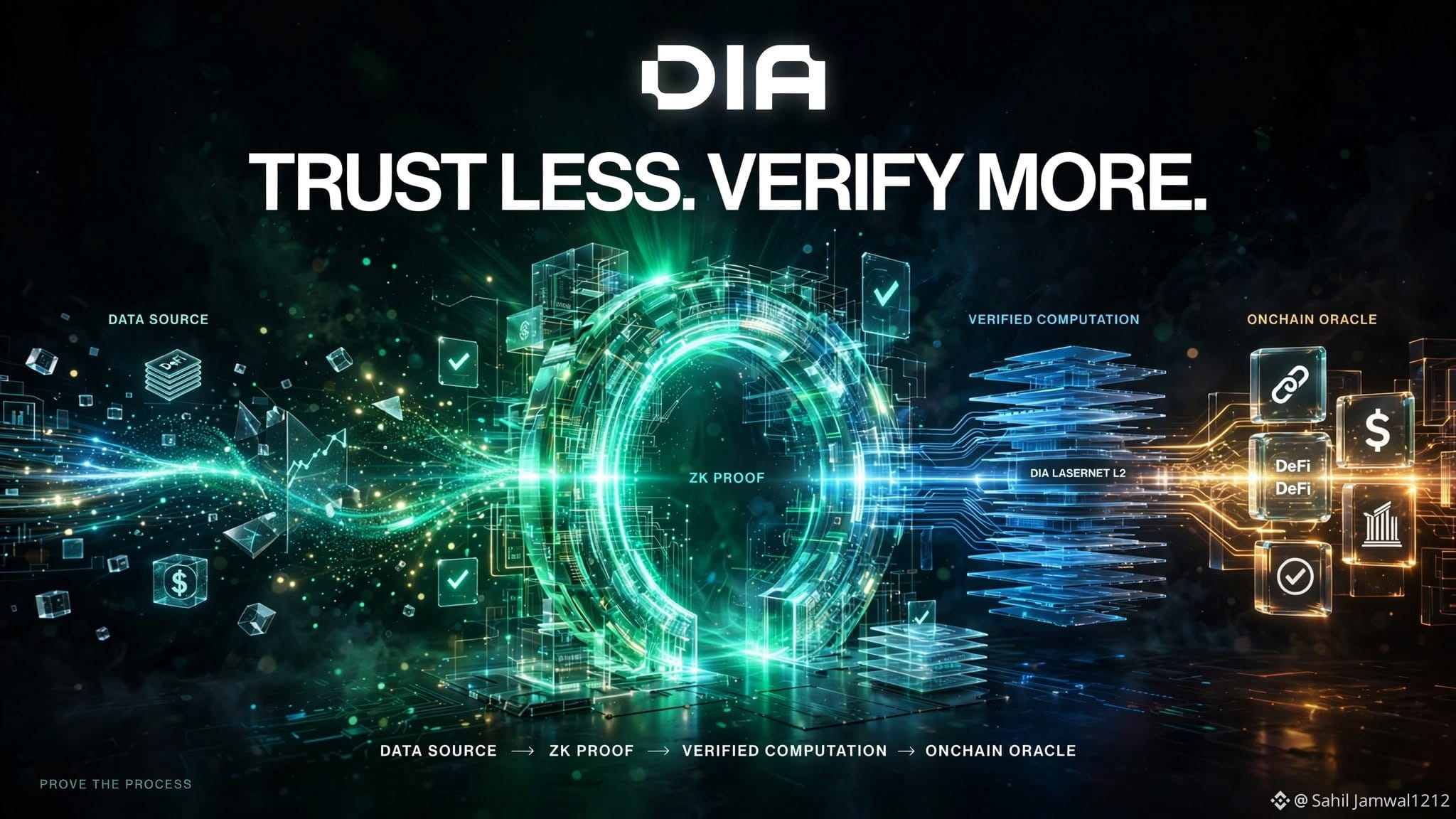
“How much of the journey from source to final value can be independently verified?”
DIA Lumina already takes a different approach from traditional offchain aggregation.
Independent feeders submit data to DIA's Lasernet, where critical processing and aggregation happen onchain. The methodology and feed construction can therefore be inspected rather than relying entirely on an opaque offchain aggregation layer.
Then there's DIA ZK.
Launched in July 2026, DIA ZK adds cryptographic verification for offchain data using mechanisms such as zkTLS.
It can help prove:
→ The value came from the stated source
→ The data wasn't altered before reaching the chain
→ The proof is tied to the relevant source session
→ A specific condition is true without revealing the underlying number
Think about reserves.
Instead of exposing an exact balance, a protocol could prove:
Reserves > Supply
The market gets the information it needs without necessarily seeing the sensitive figure.
That's particularly relevant for stablecoins, tokenized funds, vaults, lending markets and other applications that depend on offchain information.
But there is an important boundary.
Cryptographic verification doesn't magically make the underlying source truthful.
If the source reports incorrect information, the proof can verify that the reported value came from that source without proving the real-world claim itself.
DIA is explicit about this limitation.
So I wouldn't frame the goal as “100% trustless data” in an absolute sense.
I'd frame it differently:
Reduce the amount of trust required by replacing opaque steps with verifiable ones.
That's the part of DIA's architecture I think is worth watching. $DIA
“How do you get data onchain?”
It's:
“How much of the journey from source to final value can be independently verified?”
DIA Lumina already takes a different approach from traditional offchain aggregation.
Independent feeders submit data to DIA's Lasernet, where critical processing and aggregation happen onchain. The methodology and feed construction can therefore be inspected rather than relying entirely on an opaque offchain aggregation layer.
Then there's DIA ZK.
Launched in July 2026, DIA ZK adds cryptographic verification for offchain data using mechanisms such as zkTLS.
It can help prove:
→ The value came from the stated source
→ The data wasn't altered before reaching the chain
→ The proof is tied to the relevant source session
→ A specific condition is true without revealing the underlying number
Think about reserves.
Instead of exposing an exact balance, a protocol could prove:
Reserves > Supply
The market gets the information it needs without necessarily seeing the sensitive figure.
That's particularly relevant for stablecoins, tokenized funds, vaults, lending markets and other applications that depend on offchain information.
But there is an important boundary.
Cryptographic verification doesn't magically make the underlying source truthful.
If the source reports incorrect information, the proof can verify that the reported value came from that source without proving the real-world claim itself.
DIA is explicit about this limitation.
So I wouldn't frame the goal as “100% trustless data” in an absolute sense.
I'd frame it differently:
Reduce the amount of trust required by replacing opaque steps with verifiable ones.
That's the part of DIA's architecture I think is worth watching. $DIA