

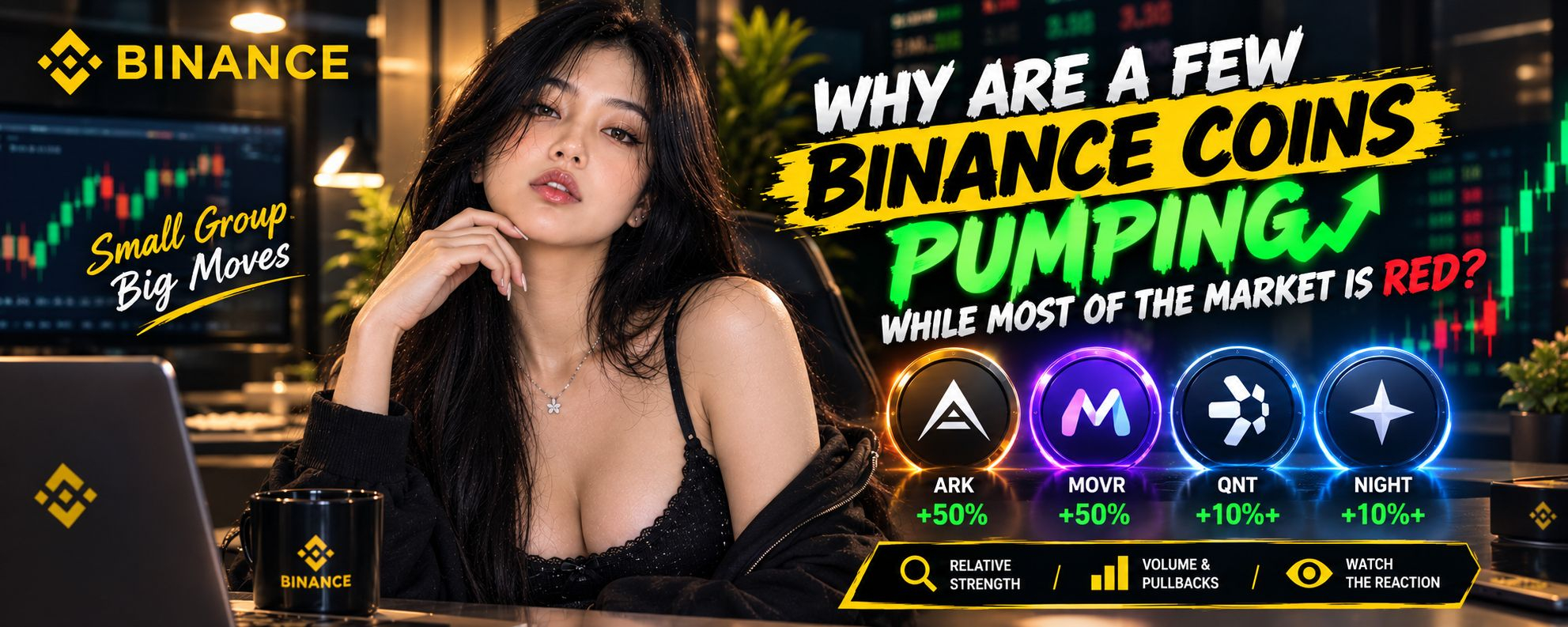

Something unusual is happening across Binance today.
The majority of the market is under pressure, yet a small group of coins is moving aggressively higher.
ARK is up more than 50%.
MOVR is also up more than 50%.
Meanwhile, QNT and NIGHT are showing double-digit gains.
That creates a much more interesting market question than simply asking whether crypto is bullish or bearish.
Why are buyers choosing these coins while so many others are being sold?
This is where market breadth becomes important.
If hundreds of coins are rising together, a strong altcoin move isn't particularly unusual.
But when most coins are falling and only a small group continues to attract buyers, those coins are showing relative strength.
And relative strength can be worth watching.
But there is another side to it.
A coin that is already up 50% isn't automatically a better trade than one that is up 10%.
After a huge move, early buyers may start taking profits while late buyers begin chasing the candle.
That's where the next reaction becomes important.
Can buyers defend the breakout?
Does volume remain strong?
Does the first pullback get absorbed?
Or does the entire move begin to unwind?
These questions matter more than the headline percentage.
Today's market is therefore creating two different groups of traders.
One group is looking at the biggest green candles and thinking:
“I missed it.”
The other group is waiting for the market to show whether those moves can actually hold.
The second approach gives us something much more useful to watch.
If ARK, MOVR, QNT or NIGHT continue outperforming while the broader market remains weak, their relative strength becomes increasingly difficult to ignore.
But if the leaders begin losing their breakout areas while market breadth remains weak, the current moves could simply be short-lived bursts of speculation.
So today's lesson is simple:
Don't just watch what's pumping.
Watch what is pumping while everything else is struggling.
Then watch what happens after the first wave of excitement disappears.
That's where the market starts telling us whether the move has real strength—or whether traders were simply chasing the biggest green candles.