
The tokenized stock market has crossed a major milestone.
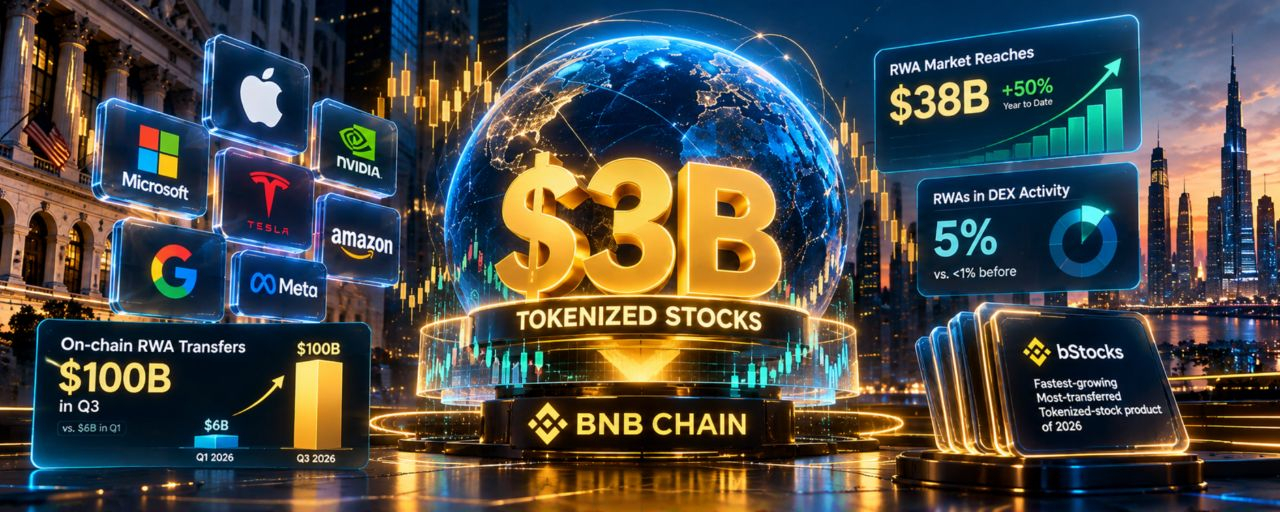
In the fourth week of September 2026, tokenized stocks surpassed $3 billion in total market capitalization, marking another step in the transformation of traditional financial assets into blockchain-based instruments.
But the bigger story is not the $3 billion figure alone.
The data underneath it shows that real-world assets (RWAs), tokenized equities, and blockchain-based financial markets are moving beyond an experimental phase and becoming part of a growing on-chain economy.
Tokenized Stocks Cross the $3 Billion Milestone
For years, tokenized stocks were often discussed as a future concept: traditional shares represented digitally on blockchain networks, potentially enabling faster settlement, broader accessibility, and programmable financial infrastructure.
That future is increasingly becoming the present.
Crossing $3 billion in tokenized-stock market capitalization demonstrates that demand for blockchain-based exposure to traditional equities is no longer limited to small experiments.
The growth also fits into a much larger expansion of tokenized real-world assets.
On-chain RWA transfers reached approximately $100 billion in Q3, compared with around $6 billion in Q1. At the same time, RWAs increased their share of decentralized exchange activity to approximately 5%, up from less than 1%.
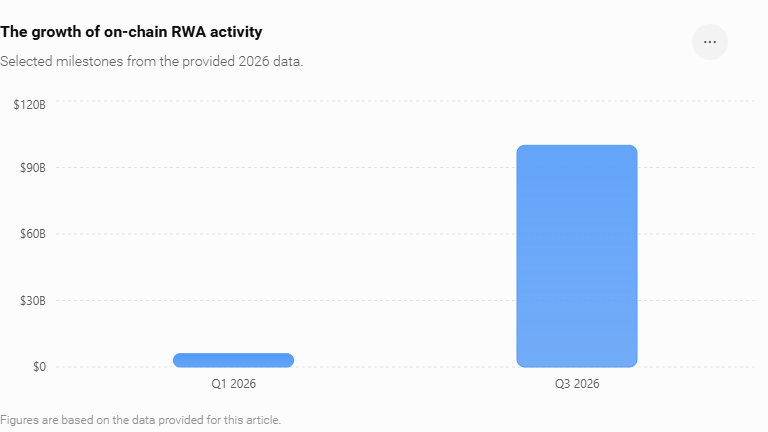
That is a significant change in the composition of blockchain activity.
The RWA Market Reaches $38 Billion
The broader RWA market has also expanded rapidly.
By September 2026, the market had reached approximately $38 billion, representing a 50% increase year to date.
Real-world assets can include tokenized securities, funds, commodities, credit products, and other financial instruments represented on blockchain networks.
The attraction is straightforward: blockchain technology can potentially make financial assets more programmable.
Instead of an asset simply existing as a record in a traditional database, a tokenized asset can become part of a broader digital financial ecosystem — potentially interacting with wallets, decentralized applications, trading platforms, lending protocols, and other blockchain infrastructure.
This creates the foundation for what could become an on-chain financial economy.
BNB Chain Emerges as a Key Hub
One blockchain is particularly prominent in the tokenized-stock market: BNB Chain.
BNB Chain ranks #1 for tokenized-stock market capitalization and holders, placing it at the center of the growing tokenized-equity ecosystem.
Among the products driving this activity, bStocks has emerged as the fastest-growing and most-transferred tokenized-stock product of 2026.
This is important because tokenization is not only about putting a stock price on a blockchain.
The real opportunity is building an infrastructure where tokenized assets can become part of a broader digital financial system.
Imagine a future where an investor can hold tokenized equities in a blockchain wallet, use them within supported financial applications, transfer them through blockchain rails, and interact with other digital assets — all through programmable infrastructure.
That is a fundamentally different financial architecture.
Why Tokenized Stocks Matter
The appeal of tokenized stocks goes beyond simply buying exposure to traditional companies.
Blockchain-based financial assets can introduce several potential advantages, including:
24/7 digital market infrastructure
Faster and more programmable settlement
Blockchain-based ownership records
Integration with digital wallets
Greater interoperability with Web3 applications
Programmable financial products
Potentially broader global access, subject to jurisdiction and eligibility
The technology does not eliminate the regulatory and legal requirements surrounding securities. Instead, it provides a new technological rail through which compliant financial products can potentially operate.
This distinction is critical as tokenized securities move from proof-of-concept projects toward larger markets.
From Speculation to Financial Infrastructure
Crypto's first major growth cycle was heavily associated with speculative assets.
The next phase could look very different.
Stablecoins, tokenized stocks, tokenized funds, on-chain credit, and other RWAs are bringing traditional financial value onto blockchain networks.
The numbers show this transition happening across multiple dimensions: tokenized stocks have passed $3 billion, RWA transfers have reached $100 billion in Q3, RWA activity represents about 5% of DEX volume, and the broader RWA market has reached $38 billion.
These developments suggest that blockchain is increasingly being used not only to create new digital assets, but also to rebuild existing financial infrastructure on programmable rails.
The Bigger Picture: Finance Moves On-Chain
The most important question is no longer whether stocks can be tokenized.
They can.
The emerging question is what happens when tokenized financial assets become interconnected with the rest of the on-chain economy?
That could include tokenized equities interacting with stablecoins, decentralized applications, AI agents, on-chain lending, collateral systems, and automated financial strategies.
This is where the concept of on-chain finance becomes much larger than cryptocurrency trading.
The $3 billion tokenized-stock milestone may therefore be less about the number itself and more about what it represents: traditional financial assets are increasingly finding a home on blockchain infrastructure.
And with BNB Chain, bStocks, and the broader RWA ecosystem accelerating this transition, the line between traditional finance and Web3 is becoming increasingly digital.
The on-chain economy isn't just being imagined anymore. It's being built.
#TokenizedStocks #BStocks #DEX