

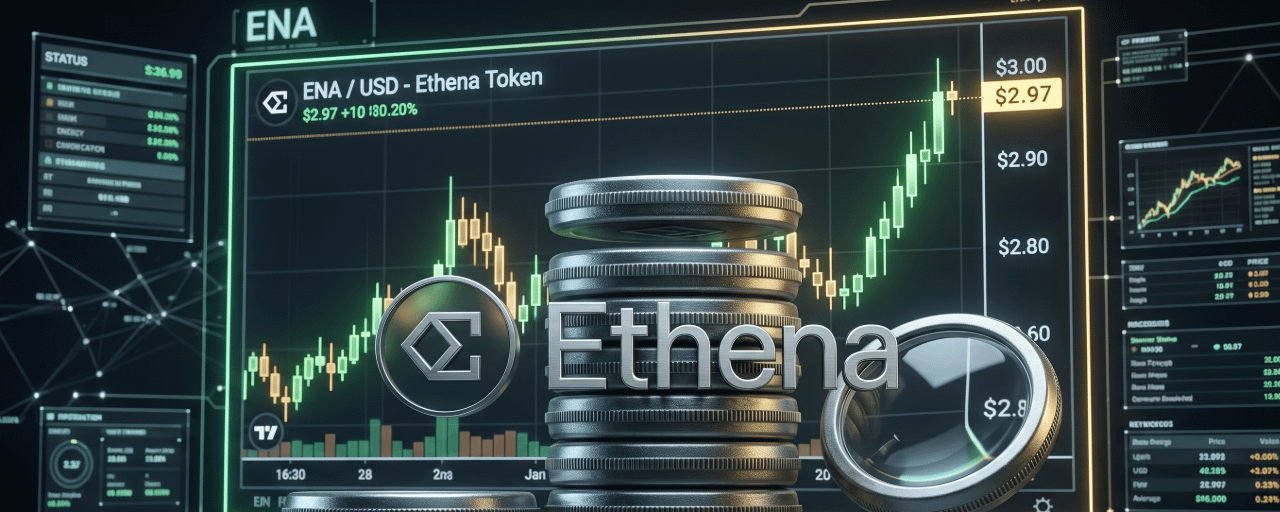

Standard Chartered's 600% $ENA Call: $2 Target by 2028 as USDe Eyes $40B 😁😁😁

Standard Chartered just planted a flag that most of the market isn't positioned for: Ethena's ENA at $2 by end-2028, implying over 600% upside from current levels, anchored to a forecast that the protocol's synthetic dollar, USDe, scales eightfold to $40 billion over the same window. This isn't a momentum note dressed up as research — it's a structural bet on buybacks, supply mechanics, and whether a yield-bearing stablecoin can hold its peg through a full macro cycle. Traders who dismissed Ethena as a funding-rate arbitrage trade with a governance token bolted on need to re-read the thesis.
Cold Open: The Buyback Is the Trade
The headline number is $2. The real signal is the mechanism behind it.
Standard Chartered's framework doesn't rely on multiple expansion or narrative rotation. It relies on USDe supply growth translating directly into protocol revenue, and that revenue being routed into ENA buybacks. If USDe goes from roughly $5 billion to $40 billion, the fee engine scales with it — and the token becomes a claim on that cash flow rather than a governance souvenir.
That's the entire bull case in one sentence. Everything else is execution risk.
Chronological Facts & Verified Data
September 29, 2026 — Anthropic's IPO prospectus surfaces, revealing the AI lab lost $42 billion last year while targeting a public listing at a $2 trillion valuation. The number is staggering on its own, but it sets the tone for the week: private markets are pricing AI at multiples that make crypto's wildest cycles look conservative.
September 30, 2026, 05:45 UTC — Reuters reports that Kalshi is in advanced talks to raise new funding at a $40 billion valuation. The prediction-market operator's ascent matters for crypto market structure — event contracts are increasingly competing with perpetual futures for speculative flow, and Kalshi's valuation validates that thesis.
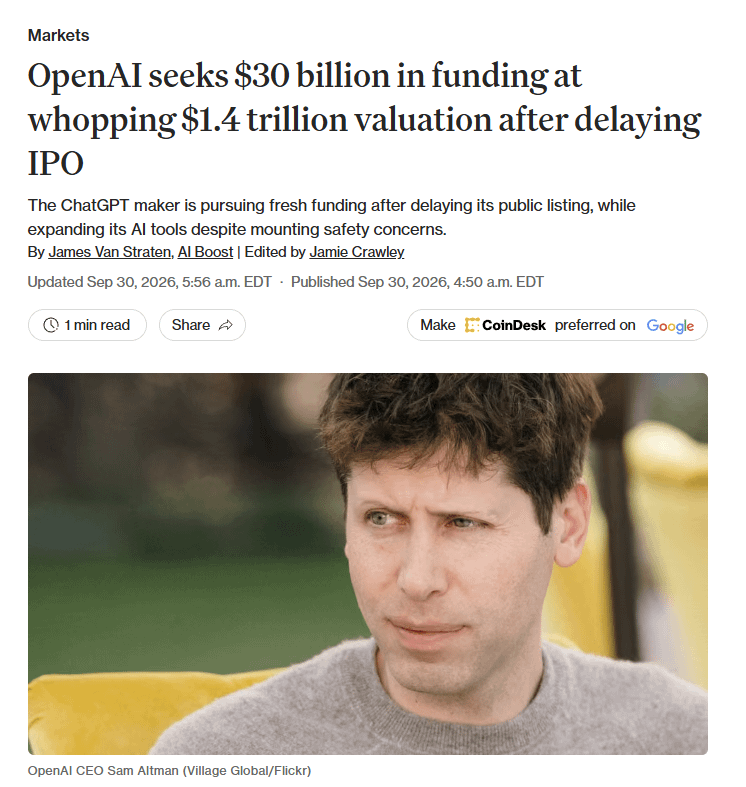
September 30, 2026, 08:50 UTC — CoinDesk reports OpenAI is seeking at least $30 billion in fresh funding at a valuation of roughly $1.4 trillion, excluding new capital, after postponing its IPO beyond 2026. CEO Sam Altman cited AI safety concerns and the difficulty of adapting to increasingly capable systems. The revenue detail is the one that matters: OpenAI's annualized run rate exceeded $40 billion over the summer, up 70% since July. The company also unveiled an always-on AI agent called Dots and a $500 subscription tier.
September 30, 2026, 12:00 UTC — The Block publishes Standard Chartered's Ethena coverage: ENA to $2 by end-2028, USDe to $40 billion by 2028, with buybacks reshaping the token's value accrual.
Read those four data points together and a pattern emerges. Capital is rotating toward cash-flow-generating infrastructure — whether that's AI compute, prediction markets, or yield-bearing stablecoins. The era of pure narrative tokens is being repriced in real time.
Why Ethena's Model Is Different This Cycle
Ethena's core product is a delta-neutral synthetic dollar. Users deposit collateral, the protocol shorts perpetual futures against it, and the funding rate earned on those shorts becomes yield. It's a carry trade wrapped in a stablecoin wrapper.
The model has two failure modes, and both are worth naming explicitly:
First, funding rate compression. In a flat or persistently negative funding environment, the yield collapses and USDe's supply contracts. The 2024–2025 period tested this repeatedly.
Second, exchange counterparty risk. The collateral sits across centralized venues. A major exchange failure or a withdrawal freeze is an existential scenario, not a tail risk.
Standard Chartered's $40 billion USDe forecast implicitly assumes both risks are managed. That's a strong assumption — but it's also the same assumption that institutional allocators are increasingly willing to underwrite, provided the custody and hedging infrastructure matures.
The buyback component is what changes the ENA calculus. If protocol revenue is used to repurchase ENA from the open market, supply becomes deflationary in proportion to USDe growth. That's a reflexive loop: more USDe supply → more revenue → more buybacks → higher ENA price → more attention → more USDe supply.
Reflexive loops cut both ways. That's the point.
Trading Angle
What this means for market structure:
Standard Chartered's call is a medium-term structural thesis, not a trade signal. The $2 target sits at end-2028 — roughly 27 months out. Anyone treating this as a reason to ape into leveraged ENA longs is misreading the timeframe entirely.
That said, the note matters for positioning in three concrete ways:
1. ENA's orderbook dynamics will shift. A tier-1 bank publishing a 600% upside target forces sell-side desks to at least model the token. Expect increased options activity on ENA — particularly longer-dated calls — as market makers reprice tail scenarios. Watch for open interest expansion on ENA perpetuals without corresponding spot volume; that's the signature of leveraged narrative chasing, and it typically precedes liquidation cascades.
2. USDe supply becomes a leading indicator. The single most important metric to track is USDe circulating supply. If it climbs steadily toward $10 billion, $15 billion, $20 billion, the buyback thesis gains credibility. If it stalls or contracts, the entire Standard Chartered model breaks. This is a weekly chart, not a daily one.
3. The AI capital rotation is the macro backdrop. OpenAI at $1.4 trillion, Anthropic targeting $2 trillion, Kalshi at $40 billion — these valuations signal that institutional capital is paying up for revenue-generating platforms. Ethena fits that mold better than most DeFi protocols. If the market continues rewarding cash flow over narrative, ENA benefits. If risk appetite compresses, high-beta DeFi gets hit first.
Key levels and metrics to monitor:
ENA spot price action around prior range highs — a clean breakout on rising spot volume validates the thesis; a rejection on declining volume suggests the market isn't buying it yet.
USDe supply trajectory — the single cleanest read on whether the $40 billion forecast has any grounding.
Funding rates across major perpetual venues — persistently negative funding compresses Ethena's yield and undermines the supply growth assumption.
Exchange reserve transparency — any shift in how Ethena custodies collateral is a risk signal worth front-running.
ENA buyback wallet activity — on-chain tracking of protocol treasury flows will confirm or refute the value-accrual mechanism in real time.
The contrarian read: Standard Chartered's target requires USDe to grow eightfold in a market where stablecoin competition is intensifying and regulatory scrutiny of yield-bearing dollar instruments is unresolved. If USDe stalls at $10 billion, the $2 ENA target is dead on arrival. The buyback mechanism is only as strong as the revenue feeding it.
Position accordingly. Size for the thesis, not the headline.
Sources
The Block: Standard Chartered sees over 600% upside for ENA, expects USDe to hit $40 billion by 2028
CoinDesk: OpenAI seeks $30 billion in funding at $1.4 trillion valuation after delaying IPO
Cointelegraph: Kalshi in advanced talks to raise new funding at $40B valuation (Reuters)
Decrypt: Anthropic lost $42 billion last year, targets $2 trillion IPO
💡 Disclaimer: This analysis compiles verified media reports and open-source intelligence for independent research (DYOR). Digital asset markets are highly volatile; scenarios discussed do not constitute financial advice or investment recommendations.
#CryptoNews #BinanceSquare #MarketUpdate #Ethena #Stablecoins