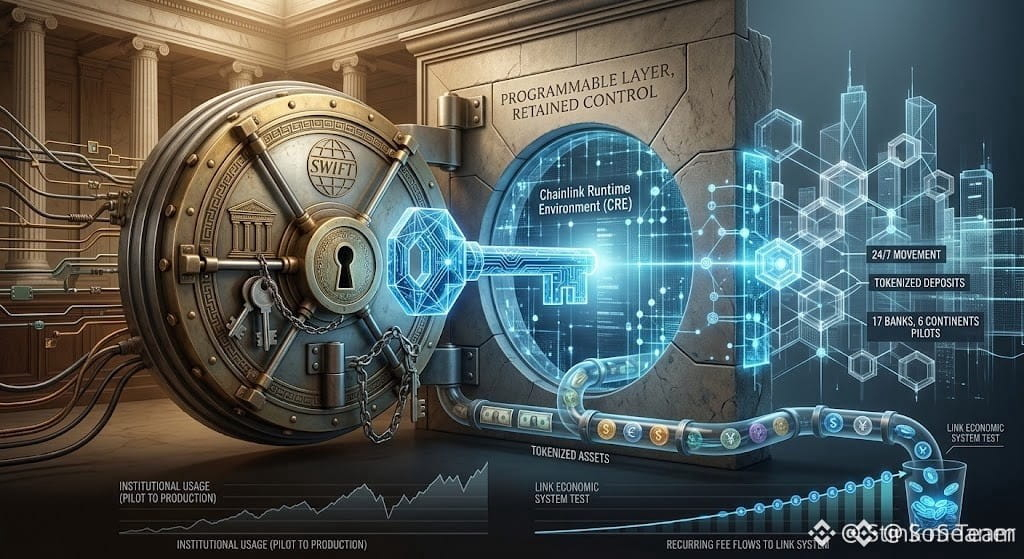
Last week a quiet announcement from Chainlink showed banks how to keep their SWIFT rails while dropping settlements onto actual blockchain ledgers.
Most traders still treat every partnership headline as a buy signal, pile into $LINK , then watch it fade while they sit underwater from the last three cycles of the same story. The real frustration is never knowing which institutional move is noise and which one actually changes how money moves.
Chainlink's new SWIFT ledger framework is basically an overlay. Banks keep sending the same messages they have used for decades, but those messages can now trigger on-chain tokenized asset transfers without ripping out existing infrastructure. It is not a revolution overnight. It is a practical patch that lets traditional finance dip a toe into RWA settlement. We have seen versions of this before. The 2023 SWIFT-Chainlink tests generated plenty of headlines and almost no lasting volume. Quant's $QNT has spent years positioning Overledger as the bank interoperability layer, often around ISO 20022, and Polkadot's $DOT crowd talks about connecting siloed systems constantly. The difference this time is the number of banks already running internal tokenized deposit experiments. Timing matters more than the press release.
What we can actually learn is that these bridges take years of quiet testing before they show up in price. The traders who survived previous hype cycles stopped buying the announcement and started watching whether real volume ever appeared on those rails. In a greed market it is tempting to treat every framework launch as the next catalyst, but the value usually accrues to the infrastructure that gets used, not the one that gets tweeted.
Where do you think this actually leaves $LINK once the initial noise dies down?
#ChainlinkLaunchesBankSWIFTLedgerFramework #SECChairWantsStockMarketsOnChain
Most traders still treat every partnership headline as a buy signal, pile into $LINK , then watch it fade while they sit underwater from the last three cycles of the same story. The real frustration is never knowing which institutional move is noise and which one actually changes how money moves.
Chainlink's new SWIFT ledger framework is basically an overlay. Banks keep sending the same messages they have used for decades, but those messages can now trigger on-chain tokenized asset transfers without ripping out existing infrastructure. It is not a revolution overnight. It is a practical patch that lets traditional finance dip a toe into RWA settlement. We have seen versions of this before. The 2023 SWIFT-Chainlink tests generated plenty of headlines and almost no lasting volume. Quant's $QNT has spent years positioning Overledger as the bank interoperability layer, often around ISO 20022, and Polkadot's $DOT crowd talks about connecting siloed systems constantly. The difference this time is the number of banks already running internal tokenized deposit experiments. Timing matters more than the press release.
What we can actually learn is that these bridges take years of quiet testing before they show up in price. The traders who survived previous hype cycles stopped buying the announcement and started watching whether real volume ever appeared on those rails. In a greed market it is tempting to treat every framework launch as the next catalyst, but the value usually accrues to the infrastructure that gets used, not the one that gets tweeted.
Where do you think this actually leaves $LINK once the initial noise dies down?
#ChainlinkLaunchesBankSWIFTLedgerFramework #SECChairWantsStockMarketsOnChain