Tokenized Stocks: Ownership Or Just Exposure?
tokenized stocks are getting more attention, but not every tokenized stock gives you the same thing.
take Apple.
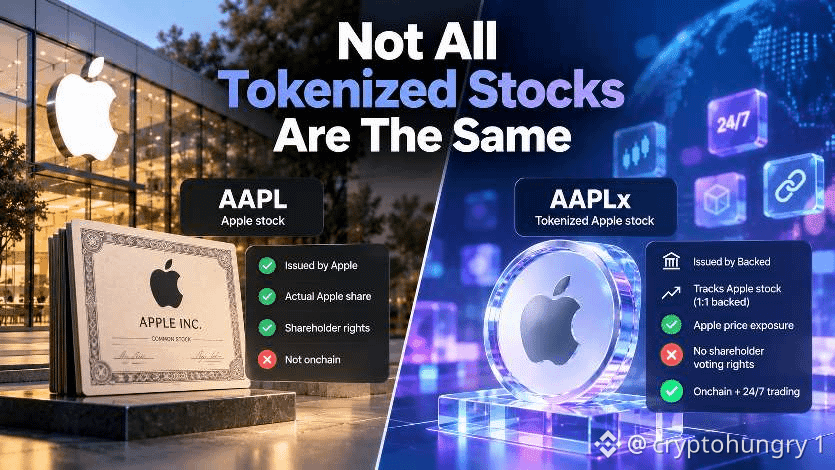
if you buy AAPL, you're buying the actual Apple share.
Apple is the issuer, and you get the rights that come with being a shareholder.
AAPLx is different.
it's a tokenized product issued by @BackedFi, backed 1:1 by AAPL shares.
you get Apple price exposure, but you don't get the same shareholder rights, such as voting rights.
so when you hear "Apple is tokenized", it doesn't necessarily mean Apple itself put its shares onchain.
it could simply be an onchain product tracking the stock.
why tokenize it this way?
you get things like 24/7 trading, onchain settlement, self-custody and the ability to plug the asset into crypto platforms.
but there's another model.
the SEC has also described issuer-sponsored tokenization, where the issuer or an authorized agent connects the token to the official ownership record.
in that case, the token could represent the actual security and its ownership rights, rather than simply tracking its price.
that's a pretty important distinction as more RWAs move onchain.
and this is where standards like ERC-7943 come in.
ERC-7943 gives compliant RWA tokens a common way to handle rules around who can hold and transfer them.
it was developed with contributions from several RWA builders, including @Brickken, DigiShares, CMTA and @Bit2Me, with @Chainlink also working on compatibility through its Asset Compliance Engine.
the bigger question isn't just whether an asset is tokenized.
it's what exactly does the token represent?
ownership, a claim, or simply exposure?
tokenized doesn't always mean the same thing.
$AAPL $AAPLX $BKN
tokenized stocks are getting more attention, but not every tokenized stock gives you the same thing.
take Apple.
if you buy AAPL, you're buying the actual Apple share.
Apple is the issuer, and you get the rights that come with being a shareholder.
AAPLx is different.
it's a tokenized product issued by @BackedFi, backed 1:1 by AAPL shares.
you get Apple price exposure, but you don't get the same shareholder rights, such as voting rights.
so when you hear "Apple is tokenized", it doesn't necessarily mean Apple itself put its shares onchain.
it could simply be an onchain product tracking the stock.
why tokenize it this way?
you get things like 24/7 trading, onchain settlement, self-custody and the ability to plug the asset into crypto platforms.
but there's another model.
the SEC has also described issuer-sponsored tokenization, where the issuer or an authorized agent connects the token to the official ownership record.
in that case, the token could represent the actual security and its ownership rights, rather than simply tracking its price.
that's a pretty important distinction as more RWAs move onchain.
and this is where standards like ERC-7943 come in.
ERC-7943 gives compliant RWA tokens a common way to handle rules around who can hold and transfer them.
it was developed with contributions from several RWA builders, including @Brickken, DigiShares, CMTA and @Bit2Me, with @Chainlink also working on compatibility through its Asset Compliance Engine.
the bigger question isn't just whether an asset is tokenized.
it's what exactly does the token represent?
ownership, a claim, or simply exposure?
tokenized doesn't always mean the same thing.
$AAPL $AAPLX $BKN