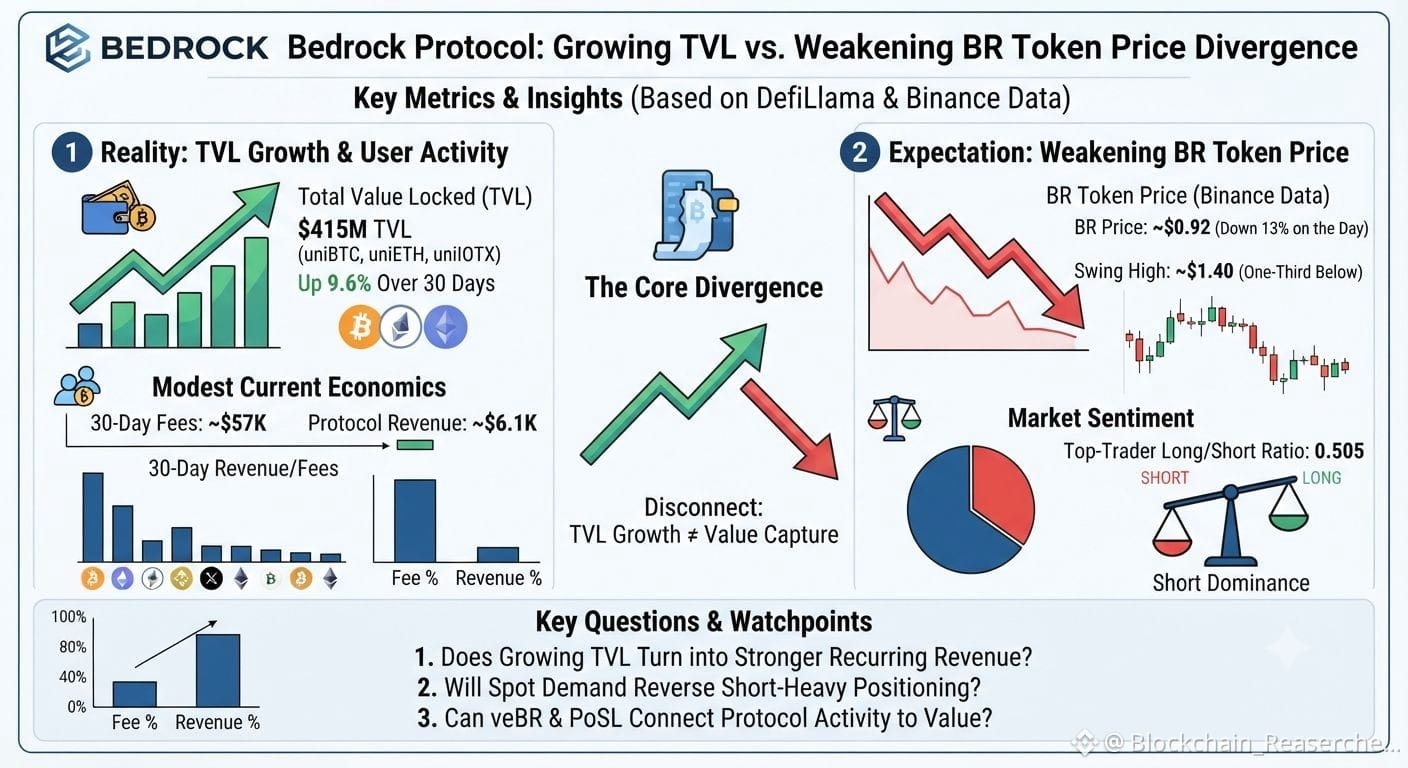

Bedrock’s interesting setup right now is the gap between growing protocol capital and weakening BR price.
DefiLlama currently tracks about $415M TVL across Bedrock’s uniBTC, uniETH and uniIOTX products, up 9.6% over 30 days. Bitcoin and Ethereum account for most of that capital, so this is not just a tiny isolated pool.
But the token is telling a different story. In the Binance data I checked, BR was around $0.92, down 13% on the day, while the 4H chart showed a visible swing high near $1.40, leaving price roughly one-third below that level. The derivatives screen also showed the top-trader long/short account ratio near 0.505, suggesting short-side accounts had become more dominant.
That divergence is what matters. Bedrock’s own design gives BR governance and incentive roles through veBR, while PoSL is supposed to connect protocol activity, liquidity, BR emissions and governance. Yet the current economics are still modest: DefiLlama reports about $57K in 30-day fees but only ~$6.1K of protocol revenue.
So the key question is not whether Bedrock has users or capital—it clearly does. It is whether growing TVL turns into stronger recurring revenue and eventually meaningful BR value capture.
That is the real expectation-versus-reality test for $BR from here.
I’d watch TVL, protocol revenue/fees, and whether short-heavy positioning reverses with spot demand. If TVL keeps rising while revenue stays flat, the market may continue separating Bedrock’s product growth from BR’s valuation.
#Bedrock
DefiLlama currently tracks about $415M TVL across Bedrock’s uniBTC, uniETH and uniIOTX products, up 9.6% over 30 days. Bitcoin and Ethereum account for most of that capital, so this is not just a tiny isolated pool.
But the token is telling a different story. In the Binance data I checked, BR was around $0.92, down 13% on the day, while the 4H chart showed a visible swing high near $1.40, leaving price roughly one-third below that level. The derivatives screen also showed the top-trader long/short account ratio near 0.505, suggesting short-side accounts had become more dominant.
That divergence is what matters. Bedrock’s own design gives BR governance and incentive roles through veBR, while PoSL is supposed to connect protocol activity, liquidity, BR emissions and governance. Yet the current economics are still modest: DefiLlama reports about $57K in 30-day fees but only ~$6.1K of protocol revenue.
So the key question is not whether Bedrock has users or capital—it clearly does. It is whether growing TVL turns into stronger recurring revenue and eventually meaningful BR value capture.
That is the real expectation-versus-reality test for $BR from here.
I’d watch TVL, protocol revenue/fees, and whether short-heavy positioning reverses with spot demand. If TVL keeps rising while revenue stays flat, the market may continue separating Bedrock’s product growth from BR’s valuation.
#Bedrock