
A major security breach at Bitget on September 24, 2026, has created a new risk factor for the crypto market.
Around $387.5 million in crypto assets were reportedly stolen, with $XRP representing one of the largest portions of the compromised funds.
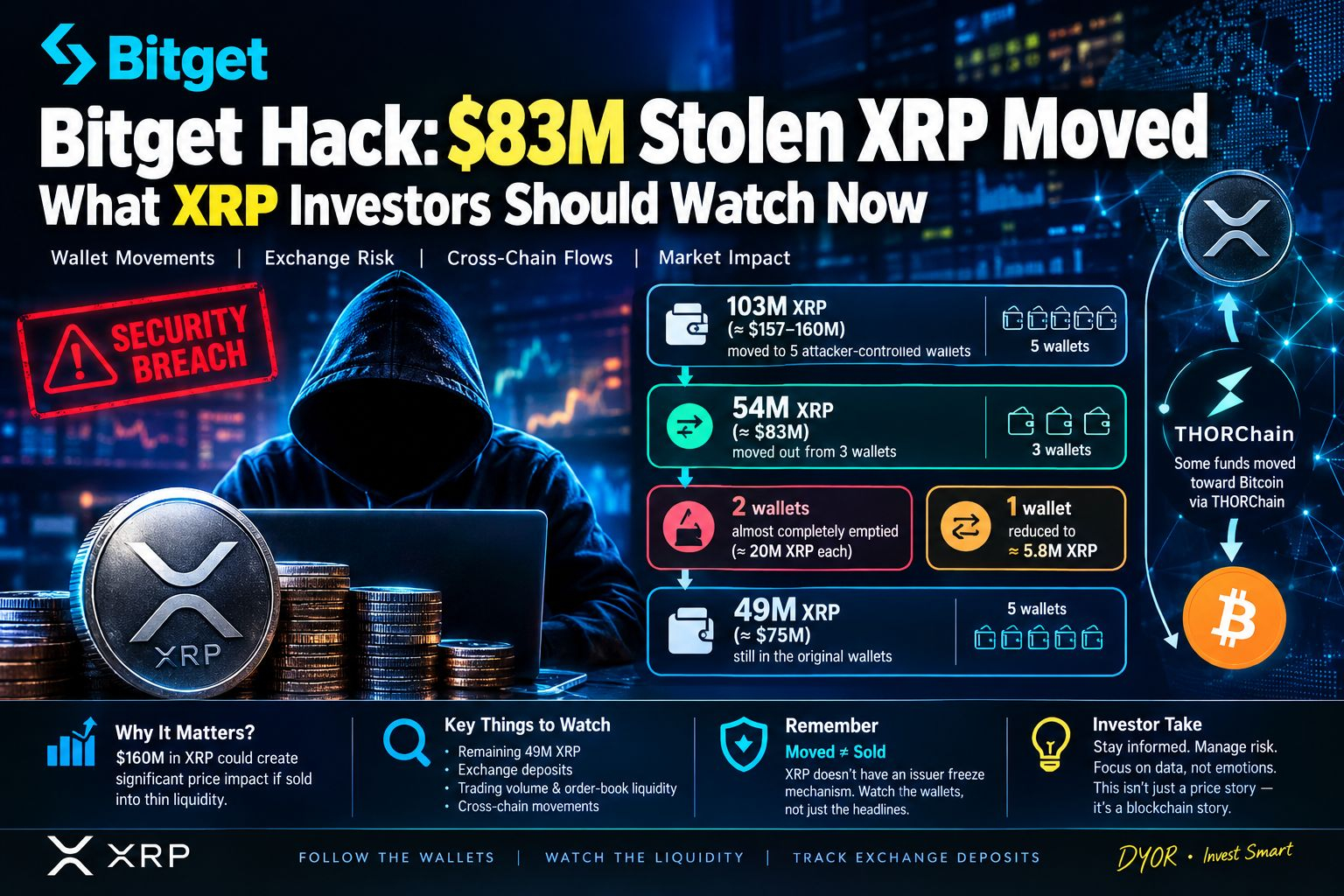
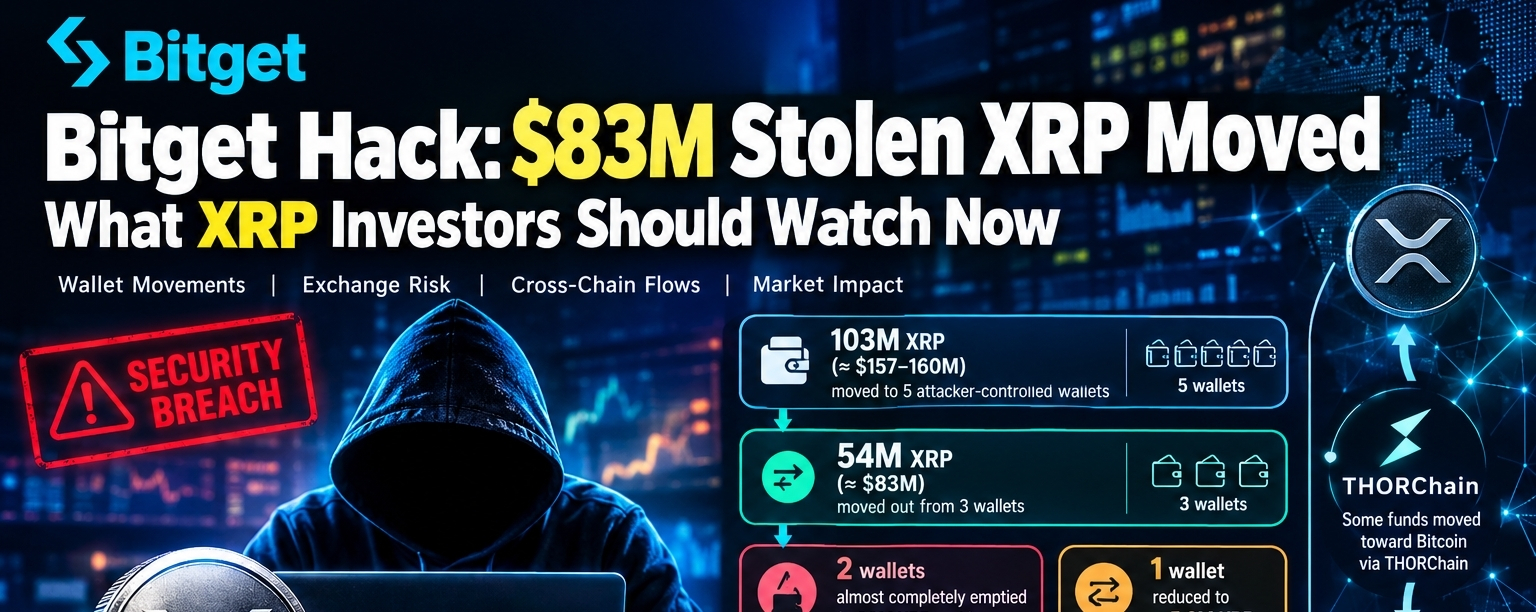
Approximately 103 million XRP, worth roughly $157–160 million at the time, was moved into five wallets controlled by the attacker.
But the more important story is what happened afterward.
By September 26, around 54 million XRP, worth approximately $83 million, had already moved out of those original wallets.
Around 49 million XRP, valued at roughly $75 million at the time, remained in the original wallets.
So the story is far from over.
In fact, the most important part for XRP investors may be just beginning.
🔥 From 103M XRP to Around 49M XRP — Where Is the Remaining Money Going?
According to on-chain tracking, the stolen XRP was initially divided across five attacker-controlled wallets.
Two wallets that originally held around 20 million XRP each were almost completely emptied.
Another wallet was reduced to approximately 5.8 million XRP.
As a result, the combined XRP balance across the original five wallets fell significantly, leaving roughly 49 million XRP.
But there is one critical point investors need to understand:
An XRP transfer does not automatically mean XRP has been sold.
The funds could have been:
Moved to newly created attacker-controlled wallets
Split into smaller amounts
Converted through cross-chain infrastructure
Deposited to an exchange
Settled through OTC channels
Or moved as part of a broader laundering strategy
Therefore, it would be incorrect to assume that all 54 million $XRP has already been sold into the market.
That distinction matters.
📊 Why Is 103M XRP Important for the XRP Market?
At around $1.54 per XRP, 103 million XRP represented roughly $160 million in value.
According to CoinDesk's analysis, that amount represented roughly 4% of XRP's reported daily trading volume at the time.
That may not sound enormous relative to the entire XRP market.
But market liquidity matters.
If $160 million worth of XRP were suddenly market-sold into relatively thin liquidity, the price impact could be much larger than the headline percentage suggests.
On the other hand, if the funds are gradually moved between wallets or converted through OTC and cross-chain routes, the direct impact on the open market could be significantly smaller.
So the key question is not simply:
How much XRP was stolen?
The more important question is:
How is that XRP being moved?
⚠️ The Biggest Risk: “Stolen XRP = Immediate Sell Pressure” Is Not Necessarily True
Some investors may immediately think:
103M XRP was stolen, so XRP is about to dump.
The reality is more complicated.
If the attacker simply moves XRP from one wallet to another, there is no new XRP supply entering circulation and no direct market sell order is created.
But if stolen XRP reaches a centralized exchange, OTC desk, or liquid swap infrastructure and is converted into another asset, the situation changes.
That is when potential selling pressure can emerge.
This is why XRP investors should focus not only on how much XRP is moving, but also on:
Where is the XRP going?
🧩 An Important Point About the XRP Ledger
There is another important aspect of this incident for XRP investors.
Native XRP does not have an issuer-level freeze mechanism comparable to certain centralized stablecoins.
That means there is no central issuer that can simply freeze native XRP sitting in a specific wallet.
CoinDesk reported that Circle and Tether froze roughly $320,000 worth of related stablecoins, while native XRP does not have the same issuer-based freezing mechanism.
This highlights two characteristics of blockchain infrastructure at the same time:
Transparency and decentralization.
Transactions on the XRP Ledger can be publicly tracked.
But being publicly visible is not the same as having the ability to freeze funds.
As a result, centralized exchanges and custodial gateways can become important checkpoints in attempts to identify and restrict the movement of stolen assets.
🌐 Why Cross-Chain Movement Through THORChain Matters
Another development that deserves attention is the reported movement of some stolen assets through cross-chain infrastructure.
Some reports have indicated that portions of the funds may have been moved through THORChain toward Bitcoin.
Bitget's CEO has also called on relevant service providers not to facilitate transactions involving the attacker-linked funds.
But there is another important distinction:
Cross-chain movement does not automatically mean confirmed cash-out.
However, it can make fund tracing more complicated.
When an asset remains on the same blockchain, tracking its movement is relatively straightforward.
But if the path becomes something like:
XRP → another asset → BTC
the fund flow becomes increasingly fragmented.
For that reason, XRP investors should watch not only the XRP Ledger but also cross-chain activity.
💰 The Real Investor Question: Can XRP Absorb This Pressure?
There is one point I would keep in mind.
The stolen XRP does not represent newly created supply.
Those XRP were already part of the circulating supply.
Therefore, this incident does not fundamentally increase XRP's total supply.
The real issue is liquidity and selling pressure.
The key question is:
How quickly—and through which channels—will the stolen XRP be liquidated, if at all?
If the funds remain distributed across wallets for an extended period, direct selling pressure could remain limited.
But if large amounts reach exchanges or liquid markets and are aggressively sold, short-term volatility could increase significantly.
That is why XRP investors should watch wallet activity alongside price action.
📈 One Important Market Signal
Despite the security incident, XRP did not completely collapse.
According to market data cited by CoinDesk, XRP was trading around $1.54 on September 26, while still maintaining roughly a 9% seven-day gain, although it was down around 4% over the previous 24 hours.
This highlights an important characteristic of markets:
A major security event does not automatically change an asset's broader trend.
If broader demand, liquidity and buyer participation remain strong, the impact of an isolated wallet event may be limited.
On the other hand, if stolen funds begin entering liquid markets and aggressive selling follows, the short-term trend could come under pressure.
So for XRP, the most important thing to watch now is:
Not just the news—but the market's reaction to it.
🐋 What Data Points Should XRP Investors Watch?
Over the next several days, I would pay particular attention to several indicators.
1️⃣ The Remaining 49M XRP
How quickly are the remaining approximately 49 million XRP moving?
This is one of the most direct indicators.
2️⃣ Exchange Deposits
Are the stolen XRP entering deposit infrastructure associated with major centralized exchanges?
This is potentially more important than simple wallet-to-wallet transfers because it could indicate possible liquidation.
3️⃣ XRP Trading Volume
Is volume increasing alongside a decline in price?
A sharp decline accompanied by unusually high volume could indicate stronger market pressure.
4️⃣ Order-Book Liquidity
Trading volume alone does not tell the whole story.
Investors should also consider how much bid liquidity exists below the current market price.
5️⃣ Cross-Chain Movement
Are the XRP being converted into other assets?
And if so, where are those assets going?
That could become an important part of the investigation.
🔎 The Biggest Mistake Would Be Panic Selling or Blind Buying
Events like this often create two emotional reactions.
One group says:
“The hacker will dump XRP, so sell immediately.”
Another says:
“XRP survived the hack news, so buy immediately.”
Both reactions can be incomplete.
The market data is still evolving.
A more disciplined approach is to ask:
What is price doing?
What is volume showing?
What are the large wallets doing?
Are stolen XRP entering exchanges?
Are key support levels holding?
Looking at these factors together provides a much clearer picture.
🚨 Another Important Lesson for XRP Holders
This incident is not only about XRP's price.
It once again highlights that holding assets on an exchange and holding assets in self-custody involve different types of risk.
Bitget stated that the breach affected part of its hot/warm wallet infrastructure while its cold wallets remained secure. The exchange later revised the estimated affected assets to approximately $387.5 million and said its User Protection Fund exceeded $464 million. Bitget also stated that it would cover the relevant losses.
For investors, this creates another important question beyond:
“Which coin should I buy?”
The next questions should be:
Where should I hold it?
How much exchange exposure should I take?
How much should remain in self-custody?
How much dependence should I place on a single platform?
In crypto, custody risk is part of portfolio risk.
🧠 My Market Take
The Bitget incident does not, by itself, establish that XRP's long-term fundamental thesis has changed.
However, it has created a meaningful short-term volatility and sentiment risk.
The initial theft involved approximately 103 million XRP.
Around 54 million XRP had already moved out of the original holding wallets.
And roughly 49 million XRP remained in those original wallets according to the latest reports available at the time.
That means on-chain monitoring and liquidity analysis could remain extremely important for XRP over the coming days.
The most important point is:
We still cannot assume that all moved XRP has been sold.
Treating every transfer as a “dump” could therefore lead to incorrect analysis.
🔥 Bottom Line
The Bitget hack's XRP story is not over.
103M XRP stolen
⬇️
~54M XRP moved from the original wallets
⬇️
~49M XRP remaining
⬇️
Cross-chain activity under observation
⬇️
Potential exchange and liquidity pressure
For XRP investors, the most important thing now is not a sensational headline.
It is:
Follow the wallets.
Watch the liquidity.
Track exchange deposits.
Do not confuse movement with selling.
If the remaining XRP gradually moves between wallets without significant exchange deposits, direct market pressure could remain limited.
But if large amounts enter exchanges or liquid swap routes while volume-driven selling begins, short-term volatility could increase substantially.
That is why the most useful approach right now is data-driven monitoring rather than emotional decision-making.
The Bitget hack is a risk event for $XRP —but it is also a real-world example of how blockchain transparency, fund tracing and crypto custody infrastructure work together.
The next major XRP move may not be written only on the price chart.
It could also be visible on the blockchain.
DYOR | Risk Management First | Never Risk More Than You Can Afford to Lose
#BitgetHackerMoves83MStolenXRP #BitgetHackerMoves$83MStolenXRP #xrp #Bitget #crypto