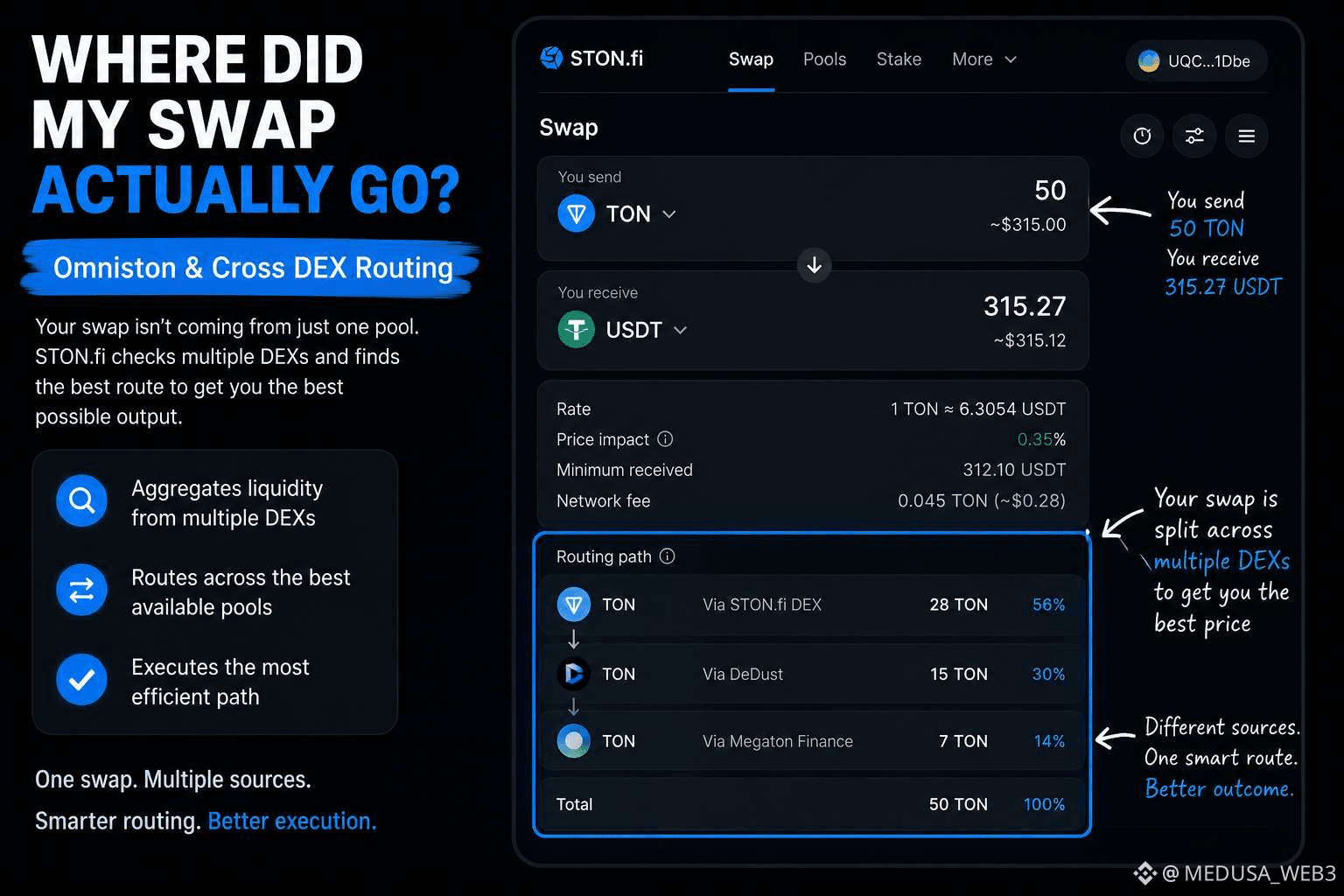
OMNISTON AND CROSS DEX ROUTING, WHY ONE SWAP CAN USE MULTIPLE LIQUIDITY SOURCES
TON has multiple decentralized exchanges, each with its own liquidity. That creates a practical problem for traders: the best available execution may not always be sitting inside one pool.
This is where aggregation becomes useful.
Omniston can source quotes from multiple liquidity sources and route swaps across connected decentralized exchanges. Instead of requiring the user to manually check each venue, the routing layer can compare available execution options.
Consider a simple example.
Exchange A may have the best rate for a small trade, while Exchange B may have deeper liquidity for a larger transaction. Looking at only one exchange could mean accepting an inferior route.
Cross DEX routing changes the process by making multiple liquidity sources available to the execution system.
It can also chain swaps across decentralized exchanges within one transaction when the route requires it.
The important point is that aggregation does not remove market risk. A user still needs to check the quoted output, price impact and other transaction details before confirming.
It simply addresses a structural problem: liquidity is distributed across different venues.
For the user, the practical benefit is less manual comparison.
You choose the tokens and amount. The routing system searches connected liquidity sources and determines an execution path.
That makes liquidity aggregation less about adding another feature to a swap and more about reducing the work required to find an appropriate route.
The next time you swap on TON, pay attention to the route rather than looking only at the token pair.
𝐎𝐟𝐟𝐢𝐜𝐢𝐚𝐥 𝐑𝐞𝐬𝐨𝐮𝐫𝐜𝐞𝐬:
Official Site: app.ston.fi
Technical Documentation: docs.ston.fi
TON has multiple decentralized exchanges, each with its own liquidity. That creates a practical problem for traders: the best available execution may not always be sitting inside one pool.
This is where aggregation becomes useful.
Omniston can source quotes from multiple liquidity sources and route swaps across connected decentralized exchanges. Instead of requiring the user to manually check each venue, the routing layer can compare available execution options.
Consider a simple example.
Exchange A may have the best rate for a small trade, while Exchange B may have deeper liquidity for a larger transaction. Looking at only one exchange could mean accepting an inferior route.
Cross DEX routing changes the process by making multiple liquidity sources available to the execution system.
It can also chain swaps across decentralized exchanges within one transaction when the route requires it.
The important point is that aggregation does not remove market risk. A user still needs to check the quoted output, price impact and other transaction details before confirming.
It simply addresses a structural problem: liquidity is distributed across different venues.
For the user, the practical benefit is less manual comparison.
You choose the tokens and amount. The routing system searches connected liquidity sources and determines an execution path.
That makes liquidity aggregation less about adding another feature to a swap and more about reducing the work required to find an appropriate route.
The next time you swap on TON, pay attention to the route rather than looking only at the token pair.
𝐎𝐟𝐟𝐢𝐜𝐢𝐚𝐥 𝐑𝐞𝐬𝐨𝐮𝐫𝐜𝐞𝐬:
Official Site: app.ston.fi
Technical Documentation: docs.ston.fi