


Start with the problem nobody wants to say out loud.
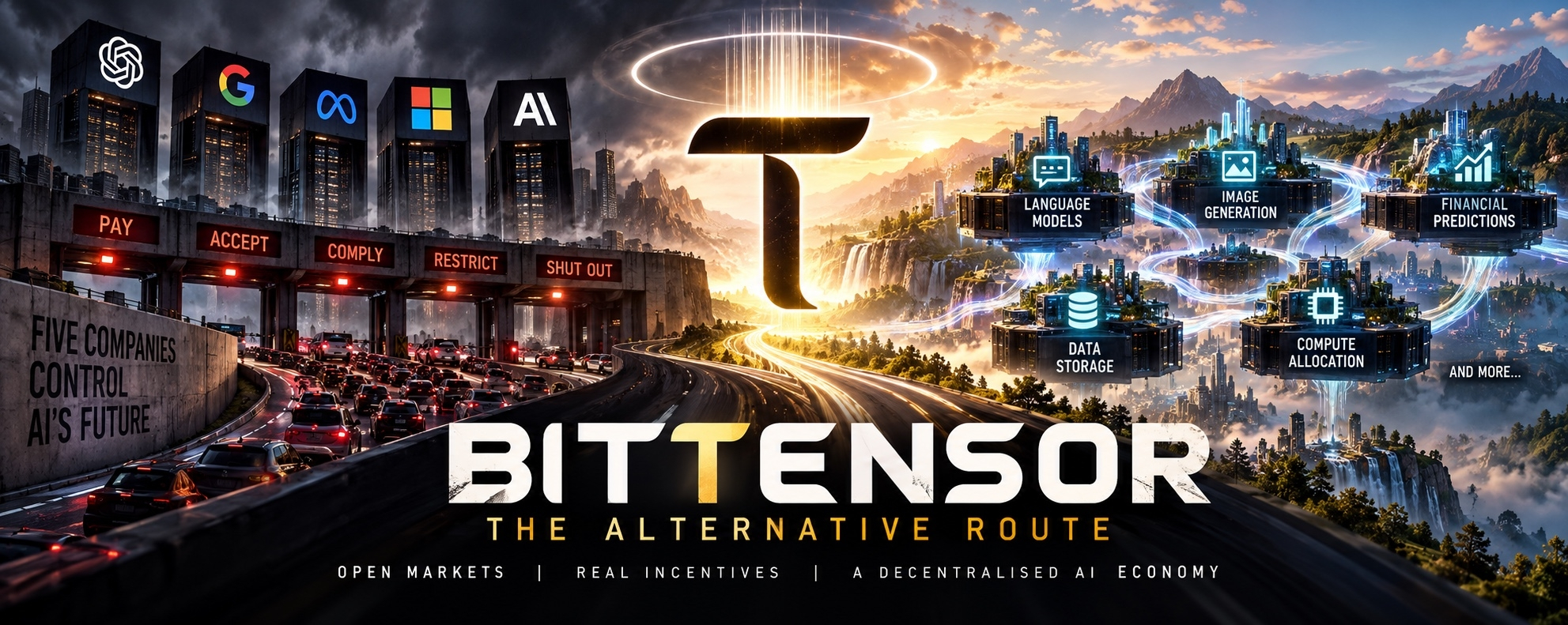
Five companies control the future of human intelligence.
OpenAI. Google. Meta. Microsoft. Anthropic.
They own the models. They own the training data. They own the compute infrastructure. They own the distribution. And they are moving faster than any government, any regulator, or any competitor can keep up with.
If you want access to the most powerful AI being built today, you go through them. You accept their pricing. You accept their terms. You accept that at any moment, they can change the rules, restrict access, or shut you out entirely.
That is not an open future. That is a toll road with five owners and no alternative route.
Bittensor was built to be the alternative route.
To understand Bittensor, you first need to understand what Bitcoin actually did.
Most people think Bitcoin's innovation was digital money. That is true, but it is only half the story.
Bitcoin's deeper innovation was the creation of a perfect market. A decentralised, permissionless, unstoppable market for computing power where anyone in the world could plug in hardware, contribute work, and get rewarded proportionally with no gatekeepers, no contracts, no HR department, and no permission required.
The results of that market were staggering. Bitcoin's network grew to dwarf the computing power of every company on earth combined. Not because one organisation invested in it. Because an open incentive system attracted millions of independent participants, all competing to contribute more, for purely economic reasons.
Bitcoin's market produces one thing: cryptographic hashing power that secures the network. Useful for Bitcoin. Not transferable to anything else.
Bittensor looked at that structure and asked the most important question in crypto since Ethereum.
What if you built that same type of perfect market, but instead of producing useless hashes, it produced intelligence?
This is where Bittensor becomes genuinely different from everything else.
Bittensor is not one network doing one thing. It is a framework, a language for writing decentralised commodity markets called subnets, each one a separate economy with its own rules, its own product, and its own participants, all connected under a single token system.
Think about what Google actually is underneath the product layer.
It is an AI team backed by a storage team backed by a compute team backed by a data acquisition team backed by a network infrastructure team. All of them operating under one roof, sharing resources, compounding advantages that no outside competitor can replicate.
Bittensor gives independent developers the ability to build the equivalent of each one of those teams as its own open market. Then it connects all of those markets together under TAO.
One subnet specialises in language model inference. Another in image generation. Another in financial predictions. Another in data storage. Another in computing power allocation. Each one runs its own incentive mechanism, rewarding participants who produce the best outputs with TAO emissions.
All of them feed into the same ecosystem. All of them are building toward the same outcome: a decentralised AI economy that no single company owns and no government can shut down.
This is not a metaphor. This is the actual architecture.
Now here is the technical piece that separates Bittensor from every other AI token.
Most blockchain networks write their validation rules directly into the chain. That means whatever the network judges on day one is essentially what it judges forever. Updating it requires years of governance battles and protocol upgrades.
Bittensor made a different architectural choice. It separated the blockchain's core functions from the validation systems that run the individual subnet markets. Those validation systems live off-chain. They can be written in any programming language. They can use massive, expensive machine learning models. They can be updated, improved, and replaced without touching the chain itself.
The mechanism holding all of this together is called Yuma Consensus.
Yuma Consensus is what makes Bittensor technically irreplaceable. Most consensus mechanisms can only agree on objective facts. Did this transaction happen? Is this hash valid? Binary questions with binary answers.
Yuma Consensus can reach agreement on probabilistic and qualitative outputs. It can decide whether one AI model gave a better answer than another. It can judge intelligence itself, the most subjective and complex output that any computing system has ever tried to measure.
That capability is not a feature. It is the entire foundation. Without it, decentralised AI markets cannot function. With it, Bittensor becomes the only credible infrastructure layer for a world where AI is produced by open markets instead of closed corporations.
No competitor has replicated the full Yuma plus subnets plus TAO architecture. Most have not even attempted it.
Now the tokenomics. This is where the three threads converge into one thesis.
TAO has a hard supply cap of 21 million tokens. Designed deliberately to mirror Bitcoin. That decision was not cosmetic. It was philosophical. Bittensor's founders understood that the token anchoring a decentralised AI economy needed the same scarcity guarantees as the token anchoring decentralised finance.
The first TAO halving hit in December 2025. Block rewards dropped 50 percent to 0.5 TAO per block permanently. Less TAO entering circulation every single block from that point forward.
But the halving is only one side of the supply equation.
Creating a new subnet on Bittensor carries costs that remove TAO from circulation and affect overall supply dynamics. Every new market added to the ecosystem tightens the economics of the entire network.
Then there is the April 2026 neuron registration update. Every new participant joining any subnet now burns TAO continuously through a dynamic pricing model. More demand for subnet participation means more TAO burned per registration. The network's growth directly accelerates its own deflation.
Subnet owners can also burn alpha emissions directly, reducing outstanding subnet token supply and tightening the economics of their individual markets.
Three separate mechanisms are contracting the supply simultaneously. All of them are accelerating as the network grows rather than slowing down.
Most tokens have one deflationary mechanism and call it a feature. TAO has a system where growth structurally requires scarcity.
Here is the part that took me the longest to fully understand.
TAO is not an AI token in the way that most people use that phrase.
Most AI tokens are one of two things. Infrastructure tokens that provide GPU compute and get paid in a token, essentially Airbnb for hardware. Or application tokens that wrap a specific AI product and sell access to it, entirely dependent on one team continuing to build one thing.
TAO is neither.
TAO is what you hold when you believe that open markets will produce better AI than closed corporations. Not because of ideology but because of incentive design.
Bitcoin proved that an open market with the right incentive structure will outperform any single organisation in producing a specific digital commodity. It did not outperform Google because it was better managed. It outperformed Google because it recruited millions of participants worldwide who had direct economic stakes in its success.
Bittensor applies that same proof of concept to intelligence. The question is not whether decentralised AI markets can theoretically work. Bitcoin has already proved that the mechanism works. The question is whether the specific commodity being produced, intelligence, can be measured and rewarded accurately enough to sustain the market.
Yuma Consensus is the answer to that question.
If it holds, and the evidence so far suggests it does, then Bittensor is not competing with other AI tokens. It is competing with OpenAI. It is competing with Google DeepMind. It is competing with the entire centralised AI industry for the right to be the infrastructure layer that intelligence runs on.
That is a different category of bet entirely.
The honest risks. Because anyone who skips this part is selling you something.
Bittensor is genuinely difficult. The technical barrier to participating as a miner or validator is real. Subnet quality is uneven. Some markets are immature. The governance mechanisms are still developing. And as with any open system, the quality of what gets built depends entirely on the people who choose to build it.
The halving reduces sell pressure from miners, but it also reduces emissions to subnet participants. How that balance plays out across different subnets over the next twelve months is not fully predictable.
And the oldest risk in crypto applies here, too. The best technology does not always win. Distribution, narrative, and timing matter as much as architecture.
The closing thought that I keep coming back to.
Satoshi Nakamoto understood that centralising control over money creates corruption. That is why Bitcoin was built to distribute financial infrastructure across a network that nobody owns.
The same logic applies to intelligence. With consequences that are not comparable. They are exponentially larger.
Money controlled by a central authority creates economic distortion. Intelligence controlled by a central authority creates something closer to civilizational capture. The most powerful cognitive tool in human history, deciding what information people see, what answers they receive, what futures they can imagine, is owned by five companies accountable to no one but their shareholders.
Bittensor is the technical argument that this does not have to be the outcome. TAO is what you hold if you believe that the argument has merit and that the people building the alternative have the architecture to make it real.
I have spent months inside this ecosystem. Reading the whitepapers. Studying the subnet mechanics. Watching the protocol updates ship faster than most blockchains ship anything.
The builders are not waiting. The protocol is not waiting.
The only question is whether you understand this before the market does or after.
That answer is entirely yours.