Why Integrator Economics Can Affect User-Facing Quotes
A wallet quote is not always the raw market quote. With STONfi and Omniston, a business layer can sit between liquidity and the user.
🏗 WHERE THE DIFFERENCE ENTERS
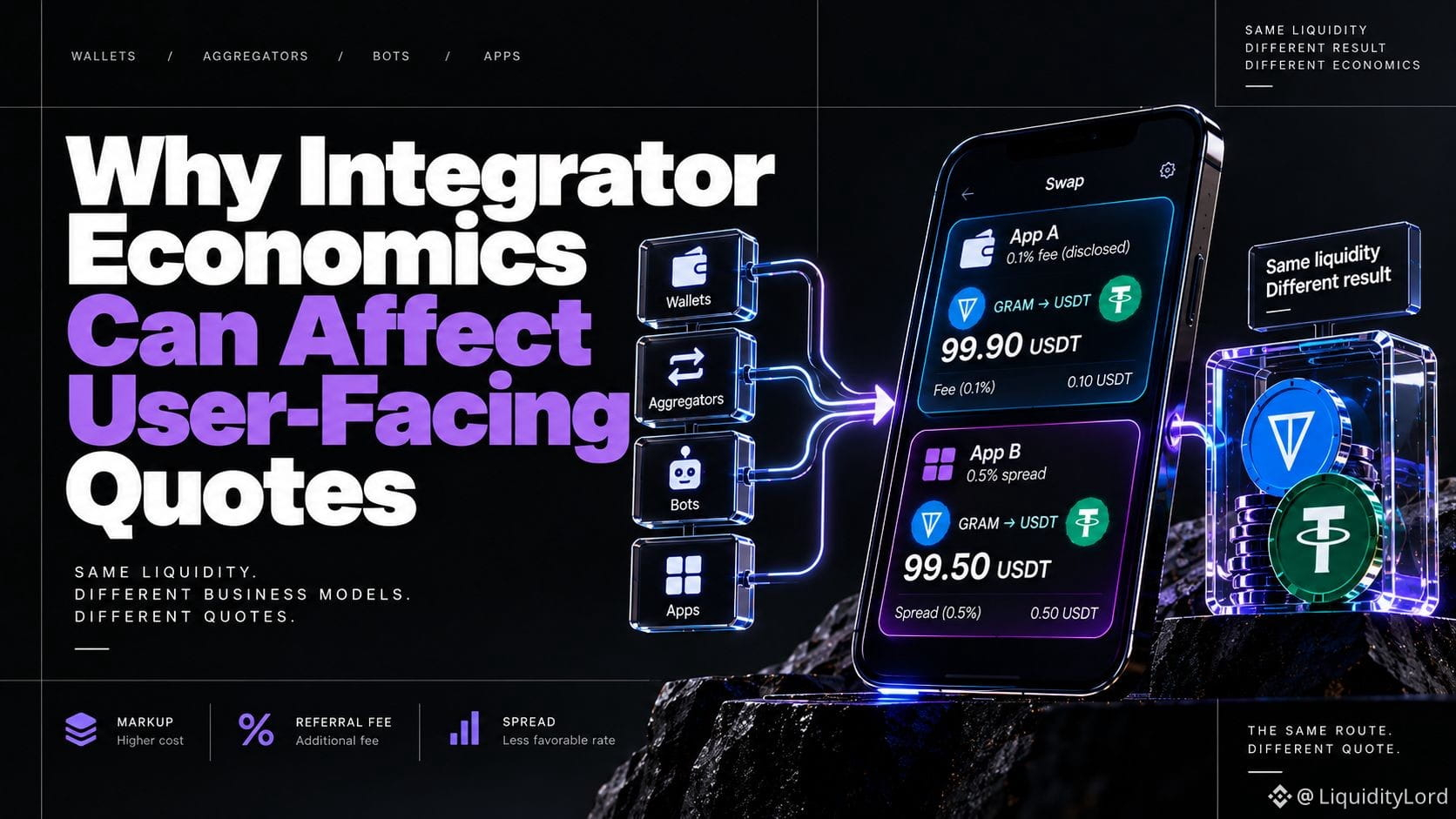
An integrator can be a wallet, aggregator, bot or app using STONfi infrastructure and existing Omniston quotes. The route produces a raw quote. The integrator can adjust it.
Common models include:
- Flat markup — reducing output compared with the raw route.
- Referral or affiliate fee — adding a supported routing fee.
- Spread — presenting a less favorable rate instead of a separate charge.
The liquidity can remain identical; the difference appears at the interface layer.
🔎 SAME LIQUIDITY, DIFFERENT RESULT
Imagine two apps routing the same TON → USDT trade through the same STONfi and Omniston sources. App A applies a disclosed 0.1% fee, while App B applies a 0.5% spread.
Neither necessarily has better pools, and the market has not necessarily moved. Their quotes differ because each business applies its own economics. On a small swap the gap may be minor; on a large trade, it matters.
“Best price” needs context. A displayed quote can represent the market result after the integrator has taken its cut.
🧭 TRANSPARENCY MATTERS
An integrator fee is not automatically a problem. Apps have development and security costs, and a disclosed fee can be legitimate.
The key question is whether users understand the cost before confirming. For larger trades, compare interfaces and fee disclosures.
DeFi composability lets one infrastructure layer serve many apps. The displayed number may pass through another business's incentives.
The raw market quote and the user-facing quote are not always the same number.
Not investment advice - research on your own! 🚀
$BTC
A wallet quote is not always the raw market quote. With STONfi and Omniston, a business layer can sit between liquidity and the user.
🏗 WHERE THE DIFFERENCE ENTERS
An integrator can be a wallet, aggregator, bot or app using STONfi infrastructure and existing Omniston quotes. The route produces a raw quote. The integrator can adjust it.
Common models include:
- Flat markup — reducing output compared with the raw route.
- Referral or affiliate fee — adding a supported routing fee.
- Spread — presenting a less favorable rate instead of a separate charge.
The liquidity can remain identical; the difference appears at the interface layer.
🔎 SAME LIQUIDITY, DIFFERENT RESULT
Imagine two apps routing the same TON → USDT trade through the same STONfi and Omniston sources. App A applies a disclosed 0.1% fee, while App B applies a 0.5% spread.
Neither necessarily has better pools, and the market has not necessarily moved. Their quotes differ because each business applies its own economics. On a small swap the gap may be minor; on a large trade, it matters.
“Best price” needs context. A displayed quote can represent the market result after the integrator has taken its cut.
🧭 TRANSPARENCY MATTERS
An integrator fee is not automatically a problem. Apps have development and security costs, and a disclosed fee can be legitimate.
The key question is whether users understand the cost before confirming. For larger trades, compare interfaces and fee disclosures.
DeFi composability lets one infrastructure layer serve many apps. The displayed number may pass through another business's incentives.
The raw market quote and the user-facing quote are not always the same number.
Not investment advice - research on your own! 🚀
$BTC