
25 U.S. Banks Are Moving Toward On-Chain Deposits — But What Does It Mean for QNT?
A major U.S. banking infrastructure project is moving blockchain-based money closer to the traditional financial system.
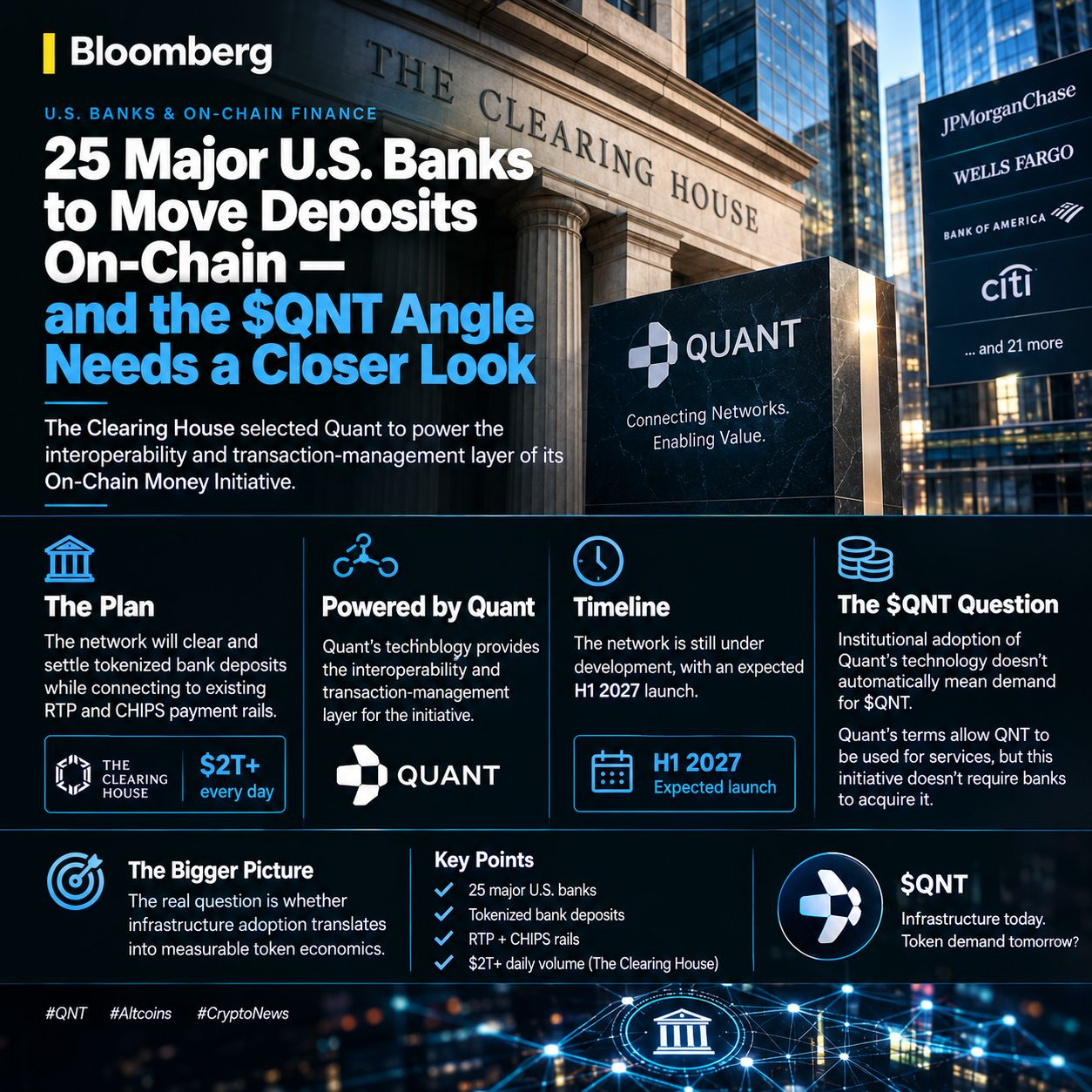
The Clearing House has selected Quant to power the interoperability, orchestration and transaction-management layer of its On-Chain Money Initiative, a network designed to let financial institutions clear and settle tokenized commercial bank deposits.
The initiative was announced with support from major financial institutions, and The Clearing House is owned by 25 of the largest U.S. banks. Its existing payment networks handle more than $2 trillion in transactions each day across wire, ACH, check-image and real-time payments.
The interesting part is how the new system is being designed.
Rather than replacing traditional banking rails, the network is intended to connect on-chain activity with established systems such as RTP and CHIPS. The goal is to allow tokenized deposits to move with greater programmability while remaining connected to existing banking infrastructure.
But where does QNT fit?
This is where the crypto-market narrative needs some caution.
Quant is providing infrastructure for the network, but institutional use of Quant's technology does not automatically mean participating banks must buy QNT tokens.
The Clearing House announcement describes Quant's role in terms of technology and infrastructure. It does not state that banks will need to acquire QNT to participate in the On-Chain Money Initiative.
That distinction matters.
A successful institutional deployment could demonstrate real-world demand for Quant's technology without necessarily translating into equivalent demand for the $QNT token.
The bigger development is tokenized bank money
The initiative itself could be more significant than the token narrative.
The Clearing House says the network is being designed for use cases including corporate treasury, liquidity management, cross-border payments and digital-asset settlement. Participating institutions are expected to gain access to the network in the first half of 2027.
That puts tokenized commercial-bank deposits directly into the conversation around the future of payments.
For banks, the attraction is not simply putting deposits on a blockchain. It's combining programmable, potentially always-on transactions with the existing regulatory and settlement framework of commercial banking.
What QNT traders should watch
The immediate headline is Quant's selection.
The longer-term question is whether the infrastructure eventually creates measurable token economics for QNT.
Until the project moves from development into live institutional use, it's too early to equate the scale of the banking initiative with future QNT token demand.
For now, the story is better understood as:
25-bank infrastructure → tokenized deposits → Quant interoperability layer → H1 2027 target → watch for actual QNT utility.
That's the part traders will need to follow as the project develops.
$QNT
#QNT #Quant #TokenizedDeposits #Crypto #RWA #Banking