

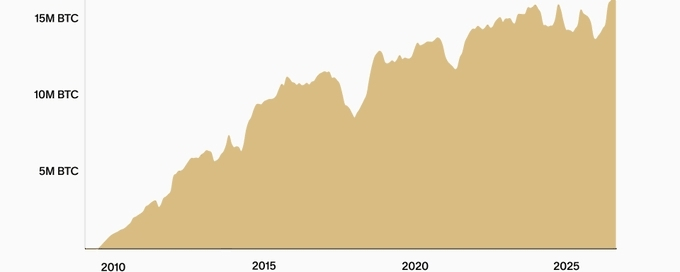

U.S. spot Bitcoin ETFs captured headlines this week by drawing a staggering $2.39 billion in net inflows, marking the largest weekly total of 2026. While a billion-dollar milestone usually points to an explosive retail buying frenzy, a look under the hood reveals that this record week is being driven by a powerful combination of structural supply squeezes and institutional trading strategies rather than fresh retail mania.
The Illiquid Supply Squeeze
The aggressive upward price action accompanying these inflows is primarily a byproduct of a heavily illiquid market. Data shows that roughly 81% of the total circulating Bitcoin supply (approximately 16.3 million BTC) has remained completely stationary for at least six months.
At the same time, overall spot exchange trading volumes are down by roughly 30%. With fewer coins actively changing hands, standard institutional buying forces ETF custodians to absorb a highly limited liquid supply. This causes prices to jump aggressively even without a massive wave of new individual participants entering the crypto space.
The Role of Institutional Arbitrage
A significant portion of the record-breaking capital is tied to sophisticated institutional frameworks rather than long-term directional accumulation. Many hedge funds are actively executing the "basis trade." By purchasing spot Bitcoin ETFs and simultaneously shorting Bitcoin futures contracts on platforms like the CME, these funds lock in risk-free yield from premium differences. This mechanism prints massive inflow data on the ETF side without representing an organic, long-term bullish bet on the asset's appreciation.
However, the fund distribution shows signs of structural maturity. Instead of a single issuer like BlackRock driving the vast majority of the volume, capital was healthily distributed across multiple funds, including Fidelity and Ark Invest. This indicates a broader, more stable institutional baseline.
Momentum Meets Macro Headwinds
The multi-day inflow streak kicked off with momentum, fueled by a massive $998.95 million inflow on Monday that triggered over $262 million in short-position liquidations. This short-squeeze structurally forced bearish traders to buy back Bitcoin, compounding the initial volume.
Despite the strong start, the momentum cooled rapidly as the week progressed. Daily net inflows fell by 87%, dropping to $134.47 million by Friday. This sharp deceleration came on the heels of strong U.S. economic data and surging 10-year Treasury yields, forcing fund managers to practice caution ahead of the upcoming Personal Consumption Expenditures (PCE) inflation report.
Ultimately, the $2.39 billion entering the market is undeniably real, but its behavior reflects strategic institutional accumulation and arbitrage navigating a supply-constrained environment rather than a retail-driven speculative bubble.
#SECCommissionerPeirceToLeaveOct2 #BlackRockBuildsTokenizedPortfoliosForOndo #CircleTetherFreezeBitgetHackerWallet #CoinMarketCapCompletesCoinglassAcquisition
