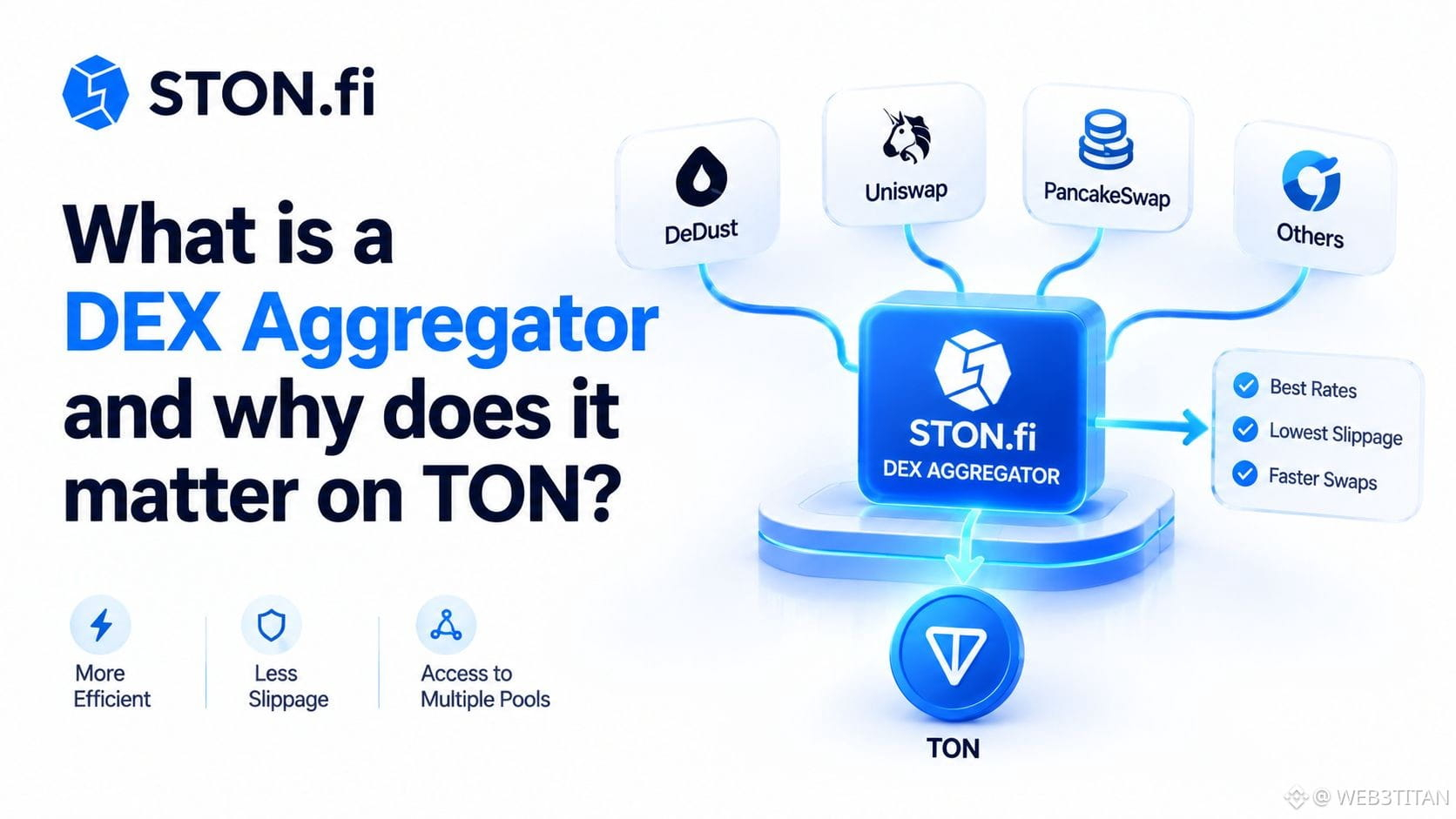
What Is a DEX Aggregator and Why Does It Matter on TON?
Liquidity on TON isn't always in one place. Different DEXs and pools can offer different prices for the same token pair.
That's where a DEX aggregator becomes useful.
WHAT IS A DEX AGGREGATOR?
A DEX aggregator is a routing layer that searches across connected liquidity sources to find efficient ways to execute a swap.
Instead of checking every venue manually, the aggregator compares available routes automatically.
WHY DOES IT MATTER?
Imagine you want to swap TON for another token.
One DEX might have deeper liquidity, while another could offer a better price. A multi-hop route through several pools might also produce better execution than a direct swap.
Liquidity fragmentation means the best available route isn't always in one pool.
It can also affect price impact, especially when a trade uses a shallow pool.
THE MANUAL ALTERNATIVE
Without aggregation, you would need to compare different TON DEXs yourself.
You might check prices, pool depth, and possible routes across several platforms before deciding where to execute.
That becomes difficult when there are many liquidity sources and possible combinations.
WHERE OMNISTON FITS
Omniston is STONfi's liquidity aggregation infrastructure for TON.
It can search connected liquidity sources and coordinate routes for swaps, including documented sources such as STONfi, DeDust, Tonco, and swap.coffee.
This brings route discovery and execution into a unified system rather than requiring users to compare everything manually.
ONE IMPORTANT LIMITATION
An aggregator can only optimize across the liquidity sources it is connected to.
So aggregation doesn't mean every possible market is automatically included.
MY TAKE
The main value of aggregation is simple: more connected liquidity sources create more routes to compare.
On a fragmented network like TON, that can make finding efficient swap execution much easier.
$BANK $XRP
#CircleMints500MUSDCOnSolana
Liquidity on TON isn't always in one place. Different DEXs and pools can offer different prices for the same token pair.
That's where a DEX aggregator becomes useful.
WHAT IS A DEX AGGREGATOR?
A DEX aggregator is a routing layer that searches across connected liquidity sources to find efficient ways to execute a swap.
Instead of checking every venue manually, the aggregator compares available routes automatically.
WHY DOES IT MATTER?
Imagine you want to swap TON for another token.
One DEX might have deeper liquidity, while another could offer a better price. A multi-hop route through several pools might also produce better execution than a direct swap.
Liquidity fragmentation means the best available route isn't always in one pool.
It can also affect price impact, especially when a trade uses a shallow pool.
THE MANUAL ALTERNATIVE
Without aggregation, you would need to compare different TON DEXs yourself.
You might check prices, pool depth, and possible routes across several platforms before deciding where to execute.
That becomes difficult when there are many liquidity sources and possible combinations.
WHERE OMNISTON FITS
Omniston is STONfi's liquidity aggregation infrastructure for TON.
It can search connected liquidity sources and coordinate routes for swaps, including documented sources such as STONfi, DeDust, Tonco, and swap.coffee.
This brings route discovery and execution into a unified system rather than requiring users to compare everything manually.
ONE IMPORTANT LIMITATION
An aggregator can only optimize across the liquidity sources it is connected to.
So aggregation doesn't mean every possible market is automatically included.
MY TAKE
The main value of aggregation is simple: more connected liquidity sources create more routes to compare.
On a fragmented network like TON, that can make finding efficient swap execution much easier.
$BANK $XRP
#CircleMints500MUSDCOnSolana