
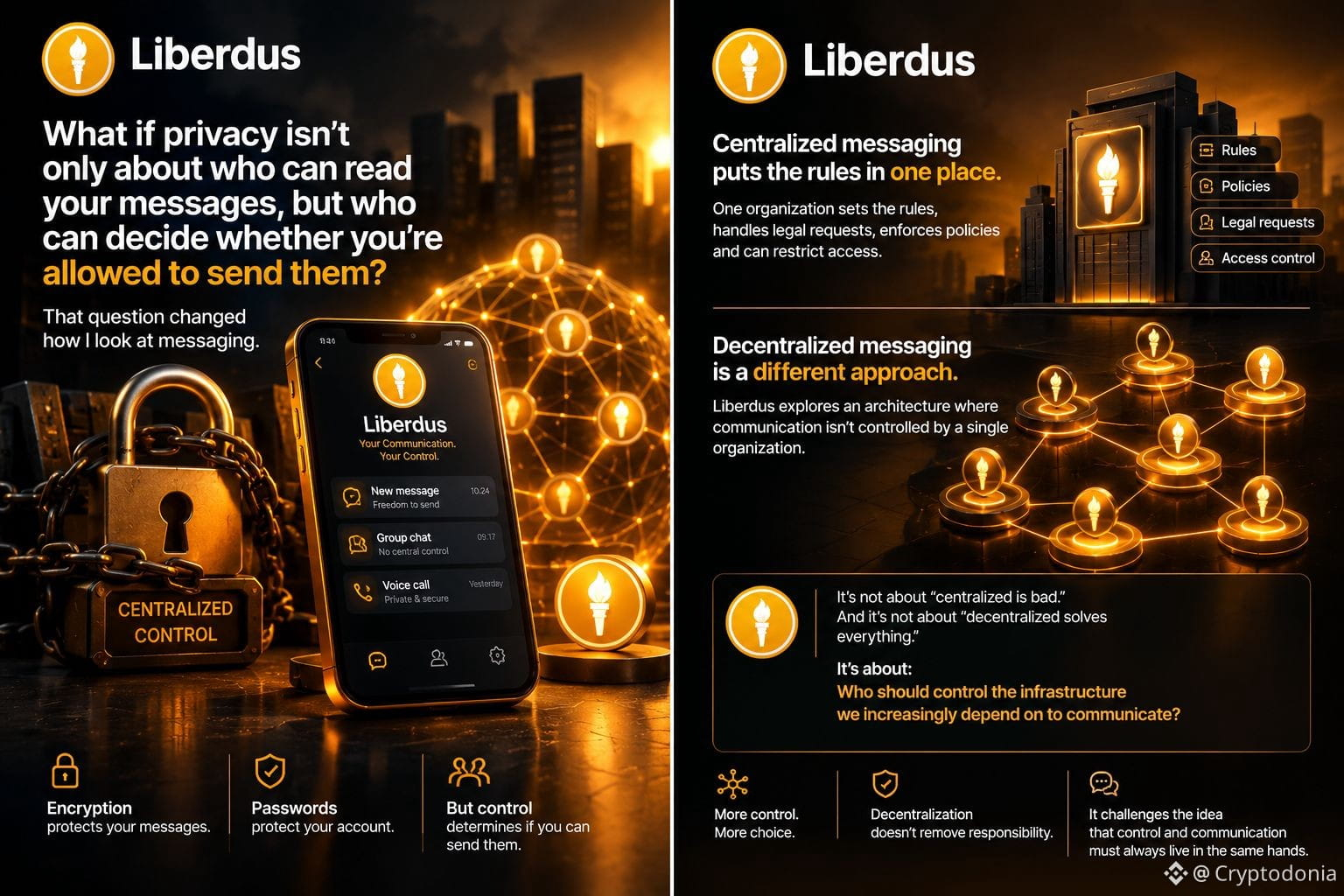
What if privacy isn't only about who can read your messages, but who can decide whether you're allowed to send them? That question changed how I look at messaging. Most of us think about privacy as encryption, passwords and who can access our conversations. But there's another layer we rarely discuss: control. When your communication depends entirely on centralized infrastructure, someone operates that infrastructure. They set the rules, enforce policies, handle legal requests and ultimately have the ability to restrict access. Some of that control is necessary. Scams, abuse and illegal activity need to be addressed. But should meaningful communication always depend on one organization? That's where decentralized messaging becomes interesting. #Liberdus is exploring a different architecture where communication isn't built around a single organization controlling the entire network. And I think that's the bigger conversation. Not “centralized is bad.” Not “decentralized solves everything.” But: Who should control the infrastructure we increasingly depend on to communicate? Decentralization doesn't eliminate responsibility. It challenges the idea that control and communication must always live in the same hands. Maybe the future of private communication isn't just about hiding your messages. Maybe it's also about having more control over the network that carries them. That's the part of #Liberdus I find worth paying attention to. #Security $XRP #Privacy $SOL


Veröffentlichen
Haftungsausschluss: Enthält Meinungen von Drittanbietern. Keine Beratung. Binance AI wird ohne Gewähr bereitgestellt. Siehe AGB.