


#Solana ($SOL SOL): The High-Performance Blockchain Powering the Next Wave of Web3
Solana has evolved from a high-speed blockchain into a broader infrastructure platform for payments, stablecoins, DeFi, tokenized assets, trading and consumer applications.
The important question for fundamental analysis isn't simply whether SOL will rise or fall.
The better question is:
Is Solana generating increasing real-world economic activity while improving its technology and attracting users, developers and institutions?
1. What Is Solana?
Solana is a high-performance blockchain designed to process transactions quickly and at relatively low cost.
Its ecosystem supports:
DeFi
Stablecoins
Payments
Tokenized real-world assets
NFTs
Gaming
Trading
Consumer applications
Institutional financial infrastructure
Solana's official ecosystem data currently highlights 50M monthly active addresses, 3.5B monthly transactions and $3.3T in trading volume across the network's ecosystem metrics.
2. The Biggest Fundamental Advantage: Performance
Solana's central value proposition is performance.
The network has continued reducing its slot times and increasing capacity.
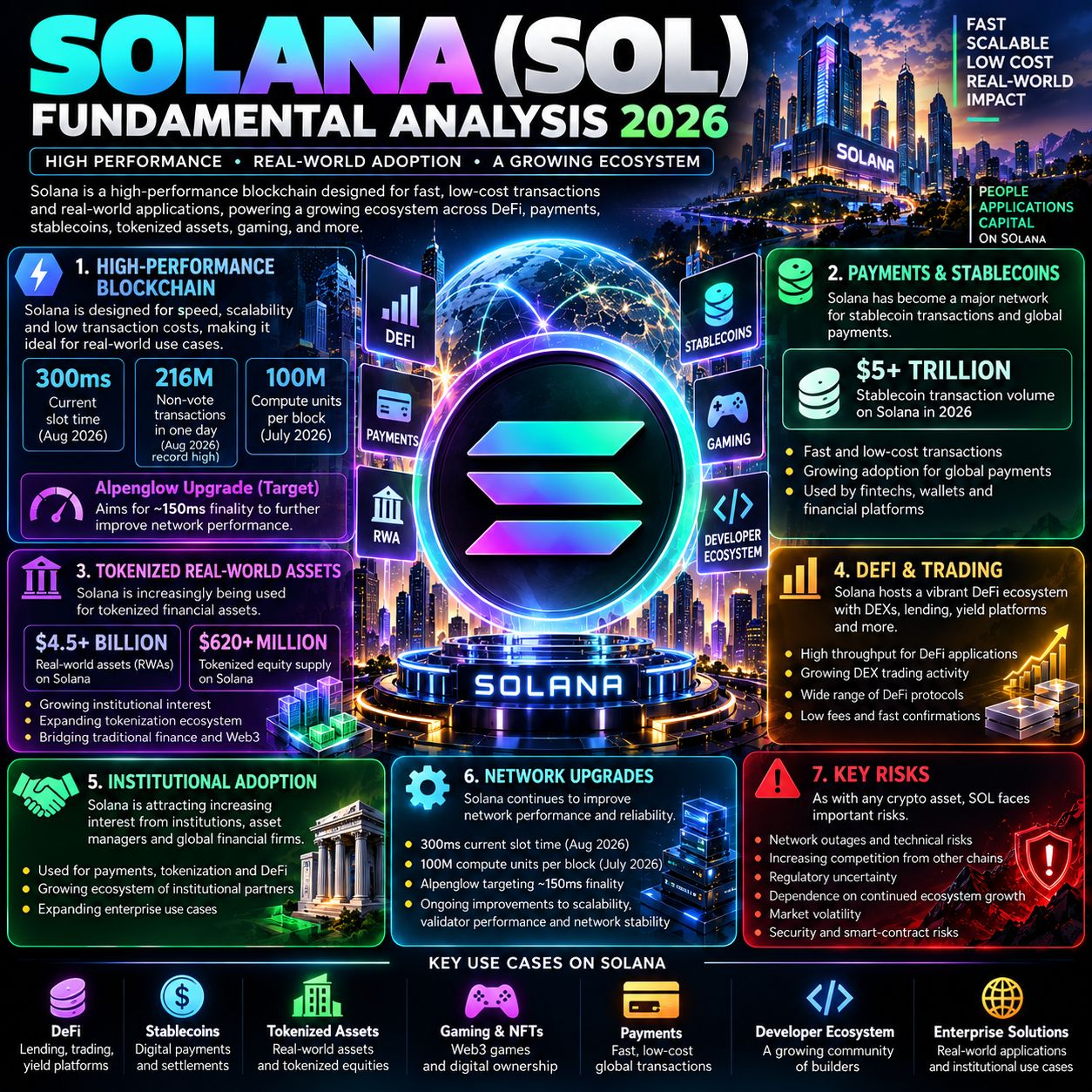
In August 2026, Solana reported reaching approximately 300ms slot times and processing a record 216 million non-vote transactions in a single day.
The network also increased its block capacity to 100 million compute units in July 2026.
For applications involving frequent transactions, speed and transaction costs can be important competitive advantages.
3. Payments and Stablecoins
One of the most interesting developments around Solana is the expansion from crypto trading toward payments.
In 2026, the ecosystem has seen stablecoin activity involving companies such as Western Union, Visa, MoneyGram and other financial infrastructure providers.
Solana reported more than $5 trillion in stablecoin transaction volume during 2026 as of September 24, according to the Solana Foundation.
That matters because stablecoins could become an important bridge between traditional finance and blockchain-based payments.
4. Real-World Asset Tokenization
Tokenization is another major part of the Solana fundamental story.
Real-world assets on Solana now include:
Tokenized equities
Treasuries
Private credit
Commodities
Funds
Reinsurance
Other financial assets
As of September 2026, the Solana Foundation reported more than $4.5 billion of real-world assets on the network and more than $620 million of tokenized equity supply.
This is important because it moves blockchain technology beyond purely crypto-native applications.
5. DeFi and Trading
Solana has developed a significant decentralized-finance ecosystem.
Its infrastructure supports:
Decentralized exchanges
Lending
Perpetual markets
Liquidity protocols
Stablecoin applications
Yield products
High throughput is particularly relevant for trading applications where users require fast execution and relatively low transaction costs.
6. Institutional Adoption
Institutional participation is becoming an increasingly important part of the Solana ecosystem.
The network has attracted financial institutions and infrastructure providers working on:
Tokenized funds
Stablecoins
Payments
Trading
Custody
Real-world assets
For example, Solana's September 2026 updates highlighted institutional tokenized-fund initiatives involving Allfunds and other financial infrastructure.
The key metric to watch is whether institutional experimentation continues developing into real transaction volume and recurring economic activity.
7. Solana's Technology Roadmap
Solana's technology development remains an important fundamental catalyst.
The upcoming Alpenglow consensus upgrade targets approximately 150ms finality, according to Solana's technical documentation.
Solana is also working with multiple validator implementations, including Agave and Firedancer.
These developments aim to improve:
Finality
Performance
Reliability
Validator diversity
Network scalability
8. Network Reliability
High performance is valuable only if the network remains reliable under heavy demand.
Solana has experienced outages and infrastructure challenges in its history.
However, a recent August 2026 infrastructure incident caused nearly 29% of network stake to go offline temporarily, while blocks continued to be produced and transactions continued to land, according to the Solana Foundation.
This illustrates both sides of the fundamental story:
Strength: the network continued operating under a major infrastructure disruption.
Risk: infrastructure concentration and validator/network reliability still deserve monitoring.
9. SOL Token Economics
SOL is the native asset of the Solana network.
It is used for:
Transaction fees
Staking
Network participation
Ecosystem applications
Unlike Bitcoin, SOL does not have a fixed 21-million maximum supply.
Therefore, fundamental analysis of SOL should pay attention to:
issuance + staking + network activity + fee economics + token demand
rather than simply assuming that scarcity alone will drive value.
10. Major Catalysts for SOL
⚡ Network performance
Continued improvements in throughput and finality could make Solana more attractive for high-frequency applications.
💵 Stablecoin adoption
Growing stablecoin settlement could increase network activity.
🏦 Institutional tokenization
More financial assets moving on-chain could increase real economic use.
🌐 Payments
Expansion by payment companies could bring blockchain technology to larger user populations.
📈 DeFi and trading
Continued liquidity and application growth could strengthen the ecosystem.
🛠️ Developer growth
A growing developer ecosystem can create new applications and use cases.
11. Major Risks
Solana also has important risks.
Competition
Ethereum, BNB Chain, Avalanche and other networks compete for developers, liquidity and users.
Network reliability
High-performance infrastructure creates demanding technical requirements.
Centralization concerns
Validator economics, infrastructure concentration and hardware requirements remain important considerations.
Regulation
Changes in regulation can affect exchanges, DeFi, tokenized assets and institutional activity.
Smart-contract risk
Applications operating on Solana can contain vulnerabilities.
Market volatility
SOL remains exposed to the broader cryptocurrency cycle.
12. Bullish Fundamental Scenario
A constructive fundamental scenario would involve:
Continued stablecoin growth
Increasing payment adoption
Expansion of tokenized assets
More institutional activity
Strong DeFi and trading volumes
Successful technology upgrades
Increasing developer and user activity
These developments could strengthen Solana's position as blockchain infrastructure.
They do not guarantee a specific SOL price.
13. Bearish Fundamental Scenario
The fundamental environment could weaken if:
Network activity falls substantially
Developers move to competing chains
Institutional adoption slows
Security or reliability problems damage confidence
Regulation restricts important applications
DeFi activity contracts sharply
Broader crypto liquidity deteriorates
14. SOL Fundamental Dashboard
For serious analysis, track these metrics:
MetricWhat it tells youSOL priceMarket valuationSOL/BTCRelative performanceActive addressesUser activityTransactionsNetwork utilizationStablecoin volumePayment/financial activityDeFi TVLDeFi ecosystem healthDEX volumeTrading activityRWA valueInstitutional/tokenization growthSOL stakingNetwork participationDeveloper activityEcosystem developmentNetwork uptimeReliability
15. SOL vs ETH vs BNB
Each network has a different fundamental model.
Bitcoin:
Scarcity + decentralized monetary asset + security
Ethereum:
Smart contracts + settlement + DeFi + Layer-2 ecosystem
BNB:
Exchange ecosystem + BNB Chain + DeFi + low-cost applications
Solana:
High performance + payments + trading + tokenized assets + consumer applications
The useful comparison is therefore not simply which token has the highest price.
Instead compare:
users + economic activity + developer growth + token economics + institutional adoption + network reliability.
Final Thoughts
Solana's fundamental story is increasingly about real-world blockchain usage.
Stablecoins, payments, tokenized assets, DeFi and institutional infrastructure are moving beyond experimentation and into larger-scale production.
The most important question for SOL investors is therefore:
"Can Solana continue converting its technical performance into sustainable economic activity?"
If network usage, payments, tokenization and institutional adoption continue expanding, the ecosystem could become increasingly important within digital financial infrastructure.
At the same time, competition, technical risks, regulation and crypto-market volatility remain significant factors.
Understanding both the opportunities and risks is more useful than relying on a simple bullish or bearish prediction.
Disclaimer
This article is for educational and informational purposes only. It is not financial advice or a recommendation to buy or sell SOL. Cryptocurrency markets are highly volatile, and investors should conduct their own research and consider their own risk tolerance before making financial decisions.